


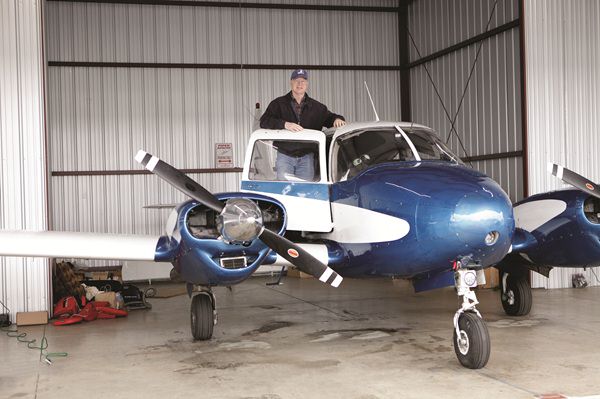
A retired airline pilot gives his Piper PA-23 Apache a panel upgrade with modern round gauges, preserving the airplane’s retro timeless charm (and his budget) while enhancing reliability and functionality.
By Eric Parks
I bought my 1955 Piper PA-23 Apache named Annie (sometimes “Double Trouble Annie!”) in 2019, and so began a yearslong process of fixing and improving the little twin. One of the things I loved about Annie from the start was that she combined an excellent mix of both new and old. She still had the original short nose and round tail with an original Apache paint scheme, but also had modern paint colors and a few Geronimo upgrades including the dorsal fin, wing tips, and flap gap seals.
I knew Annie was never going to be kept in her original “as delivered from the factory” condition, as she already had received quite a few updates along the way.
Why upgrade the engine instruments now?
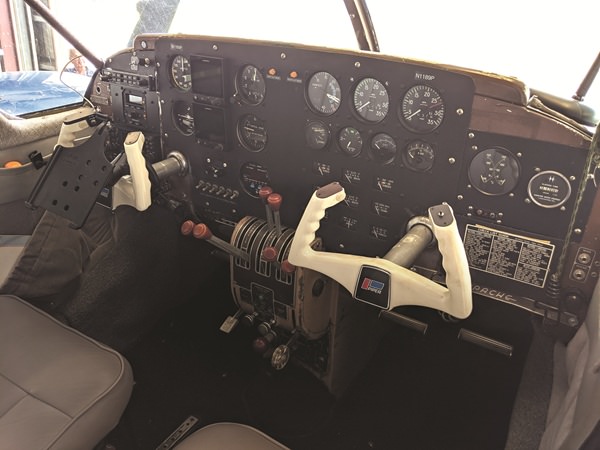
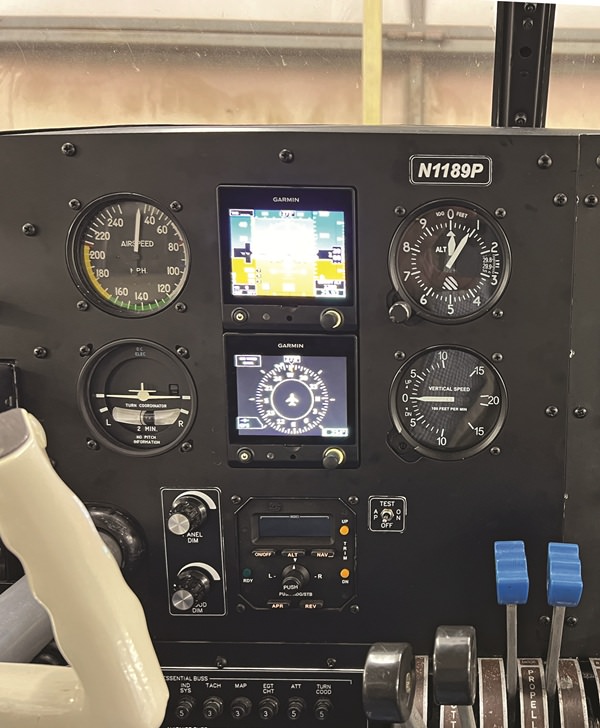
As Annie was being upgraded, I realized that I needed to do a major update on the engine instruments. When I bought her, Annie had already been given very nice panel upgrades, including a dual Garmin G5 installation that gave me “glass” for my PFD and HSI. Also, she had an S-TEC autopilot with altitude hold and a Garmin GNS 430 with a backup Trig TY91 com radio.
The basic instruments for IFR were there, but the engine instruments were lacking (though legally sufficient). She still had the original style tachometer and manifold pressure gauges as well as CHT, but there was no EGT at all, and a digital fuel flow gauge was installed but never seemed to work properly.
Further, only one CHT was giving good readings, so I was only reading the CHT on one cylinder (on one engine!) and had no EGT readings at all. It was clear that I needed to see more information from my engines!
While I like the idea of keeping the plane “retro” where it makes sense, in this case, that ship had already sailed. With the fancy G5 installation, Annie’s panel was already much more modern than original. I resigned myself to the fact that Annie was going to be a mix of the newer upgraded modern features combined with whichever retro styles we could retain.
As I considered the possible updates or upgrades, I checked to see what it would cost to just overhaul the mechanical tachometer and manifold pressure gauges. Wow! The price was so high that an overhaul was more than just buying newer electronic gauges! So, although I like the retro look of the old mechanical gauges, I quickly decided to go with newer electronic ones. The additional benefit of going that route was the new gauges are simply way more accurate—a big advantage.
Choices, choices…
Once I knew I was going “more modern,” the question became “How modern?!” I started flying back in 1978, so there has been quite a bit of change since my earliest experiences. I was willing to consider anything that was newer and better than what she originally came with. For me, cost is always a consideration, and, of course, with a twin you get to double the cost when it come to the engines!
The first gauges I considered were old-style mechanical gauges such as the Alcor, which give both EGT and CHT in the same gauge. I could install two of those (one for each engine) and be done with it. However, that was only going to give me one reading from one cylinder per side, and there was no type of “warning message” available, such as a flashing light or a color change to indicate problems.
I wanted more ability to monitor the entire engine, so I looked at gauges like those from Electronics International that are digital and have the ability to provide data from all four cylinders. The issue with that was they still only showed one cylinder at a time, and it was a very simple LCD readout with no color or scale, just digits. That seemed to be too little advancement.
I wanted to see all cylinders at once and really wanted color to help in spotting problems as soon as possible. It quickly became apparent that I wanted “glass” for my engine monitor. That meant a more modern look, but it would also be a little more efficient at utilizing the real estate in my panel.
Now that I knew I was going for the more modern glass setups, I looked at the big screen options that Garmin, Electronics International, and JP Instruments (JPI) offer. Ouch! The price went way up, but now I was seeing the kind of features I really wanted. I began to think I would install one of the big-screen graphic engine monitors such as the Garmin 275 or JPI EDM 790. I just wasn’t liking what I envisioned as the final product, though. I knew a unit from either manufacturer would work just fine, but the overall look didn’t work for me.
Insight Instruments
I began to look more at the series of engine instruments available from Piper Flyer Association supporter Insight Instrument Corp. (see Resources). They have a product lineup that goes from very simple (for basic trainers) up to fancy units (for turbocharged and, yes, even radial engines). After looking at the lineup, I knew Insight would advise me to get the Insight G4, designed for twin-engine aircraft.
Looking at the price had me thinking twice, so I started looking at the feature sets of the entire Insight lineup. Although the G4 included primary gauge info such as tach and manifold pressure, I wasn’t sure I liked the idea of cramming so much on one display. As a retired airline pilot, I like the idea of redundancy and backup. Putting so much into one gauge or display concerned me, plus I like making some of the information more obvious and readable. Also, it comes down to aesthetics, and I still like the round dial look. In fact, I wanted to stack my gauges similar to what I’ve seen in the Beechcraft King Air, with all the needles and readouts they had to stuff in the panel.
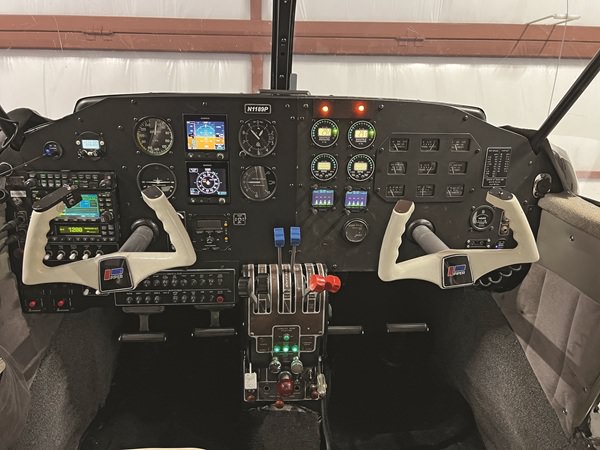
By going with the Insight G2, I got a smaller round form factor (2.25 inches for the G2, versus 3.125 inches for the G4). I selected the Electronics International M-1 and R-1 for displaying manifold pressure and the tachometer (RPM). This allowed me to stack the instruments and spread out the readouts efficiently, while keeping a bit of the old-school round dial look. I felt that Insight provided a lot of standard features, too.
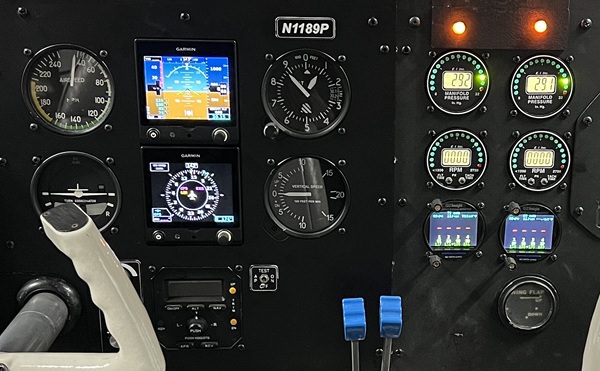
Final results
As I compared what I would get for the basic price on each option, it became obvious that you must be very aware of what the total cost will be for all the features you want. I am very happy with the final result, as it gave me the upgraded information I needed and a look to the panel that I enjoy.
The G2 gives me the ability to see the CHT and EGT for all cylinders on each engine at the same time. I did have to buy two gauges, one for each engine, but that was still cheaper than the G4 or other options. I now get fuel flow, bus voltage, outside air temp, and carburetor temp—all included. The displays are in color, which makes reading and interpreting the data much easier. By selecting a separate page, you can also get to the total fuel used by each engine. Although the G2s do not display manifold pressure and tachometer, the cost was still less when including the extra gauges than if I had gotten the fancier versions that included them.
As my installation was done by myself and a friend who is an A&P/IA, we were concerned about getting support from Insight, as we had quite a bit of complex new wiring and sensors to install. I’m happy to say Insight supported us the entire time and I can heartily recommend them. We have had no issues with the Electronics International gauges, either, so that has been excellent as well.
I feel very confident that I could have chosen several other options that would have worked, but for me, the Insight G2 was the right mix of color graphics and information without making things too complex. I find the Electronics International gauges, with both the digital and LED readouts, very accurate but also easy to glance at while flying. Some people would have chosen to go all in on full big screen displays, but I’m happy with the combination of “round dial” and “digital” we got for Annie.
Editor’s note: Follow along with Eric’s Apache journey on Piper Flyer’s forum at www.piperflyer.com/forum/pa-23/832-flying-an-apache.html
Eric Parks is a retired airline pilot. After flying jets for his career, he and his wife Barbara enjoy flying their Piper PA-23 Apache to find new places to see and to visit friends and family. He is building an experimental Bearhawk with a friend and hopes to have it flying soon. Send questions or comments to editor@piperflyer.org.

