Close Menu
Piper Flyer AssociationPiper Flyer Association
  • Home
  • Members
    • Member Dashboard
    • Parts Locating
    • Edit Profile
    • Member Benefits
    • Renew
  • Forums
  • Piper Models
    • Piper Singles
      • Piper Cubs
      • Piper PA-11, PA-12, PA-14
      • Piper Short Wing
      • Piper PA-18 Super Cub
      • Piper PA-24 Comanche
      • Piper Pawnees
      • Piper PA-28 Cherokee
      • PA-32 Series
      • Piper PA-38 Tomahawk
      • Piper M Series
    • Twin Engine
      • Piper PA-23 Apache/Aztec
      • Piper PA-30 Twin Comanche
      • Piper PA-31 Series
      • Piper PA-34 Seneca
      • Piper PA-42 Cheyenne
      • Piper PA-44 Seminole
  • Magazine
    • ONLINE MAGAZINES
      • 2026 ONLINE MAGAZINES
      • 2025 ONLINE MAGAZINES
      • 2024 ONLINE MAGAZINES
      • 2023 ONLINE MAGAZINES
      • 2022 ONLINE MAGAZINES
      • 2021 ONLINE MAGAZINES
      • 2020 ONLINE MAGAZINES
      • Prior Years
    • Article Archive
      • Maintenance & Technical
      • Other Popular Articles
    • Featured Articles
  • Knowledge Base
    • Aviation News
    • Aviation Alerts
    • Videos
    • Annual Checklist
    • Piper Flyer Sponsors
    • Keep Your Piper Ownership Affordable
  • Login
  • Join
Free Newsletter
What's Hot

Garmin Pilot expands weather tools and brings SmartCharts Airport Diagrams to the web

Garmin adds more than a dozen more Guided Visual Approaches to aviation database lineup

More than 2,500 aircraft are now equipped with Garmin’s revolutionary Autoland system

Facebook X (Twitter) Instagram
Join PFA Renew
Piper Flyer Association
Free Newsletter Login
  • Home
  • Members
    • Member Dashboard
    • Parts Locating
    • Edit Profile
    • Member Benefits
    • Renew
  • Forums
  • Piper Models
    • Piper Singles
      • Piper Cubs
      • Piper PA-11, PA-12, PA-14
      • Piper Short Wing
      • Piper PA-18 Super Cub
      • Piper PA-24 Comanche
      • Piper Pawnees
      • Piper PA-28 Cherokee
      • PA-32 Series
      • Piper PA-38 Tomahawk
      • Piper M Series
    • Twin Engine
      • Piper PA-23 Apache/Aztec
      • Piper PA-30 Twin Comanche
      • Piper PA-31 Series
      • Piper PA-34 Seneca
      • Piper PA-42 Cheyenne
      • Piper PA-44 Seminole
  • Magazine
    • ONLINE MAGAZINES
      • 2026 ONLINE MAGAZINES
      • 2025 ONLINE MAGAZINES
      • 2024 ONLINE MAGAZINES
      • 2023 ONLINE MAGAZINES
      • 2022 ONLINE MAGAZINES
      • 2021 ONLINE MAGAZINES
      • 2020 ONLINE MAGAZINES
      • Prior Years
    • Article Archive
      • Maintenance & Technical
      • Other Popular Articles
    • Featured Articles
  • Knowledge Base
    • Aviation News
    • Aviation Alerts
    • Videos
    • Annual Checklist
    • Piper Flyer Sponsors
    • Keep Your Piper Ownership Affordable
  • Login
  • Join
Piper Flyer AssociationPiper Flyer Association
Renew
Home » Power for the Cub
Piper Cub: J-3/J-4/J-5

Power for the Cub

Jen DBy Jen DJanuary 21, 2015Updated:April 12, 20265 Mins Read
Facebook Twitter Pinterest LinkedIn Tumblr WhatsApp Email

February 2005-

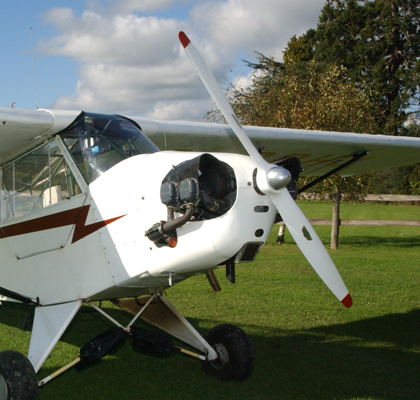
Piper’s ubiquitous Cub—from the humble J-2 through the PA-18 and all the variants in between—has always been known as a design that could be successful when equipped with virtually any powerplant that happened to be available.
Unfortunately, in its early days there were not that many reliable engines from which to choose. The Cub had that problem when C. Gilbert Taylor developed the prototype in 1930. He had chosen the Brownback Tiger Kitten (hence the name Cub), an inverted two-stroke twin of 20-25 horsepower that would just barely get the airplane off the ground with a single pilot aboard, so a 9-cylinder Salmson AD-9 radial of 40 hp was substituted for its first successful flight during the winter of 1930 at Bradford, Pa.

By the time the E-2 got its Type Certificate in November 1931, it was powered by Continental’s new 37 hp A-40, the first practical, successful flat four, and as such the direct ancestor of every modern piston aircraft engine built today. The importance of the Continental A-40 cannot be overstated; it virtually made the Cub possible.
An L-head design with cast iron cylinders, it had one-piece heads for each pair of cylinders, single ignition and only two main bearings. Its 3.1″ x 3.8″ bore and stroke gave a 115-cu.-in. displacement and a low fuel consumption rate of 2.8 gph.
Although the A-40 only had a 200-hour TBO, it was easy to start, smooth, reliable, and most importantly, cheap. Nothing did as much to keep private flying alive during the Depression as the Cub and the A-40.

The next significant Cub engine was introduced in 1935 by Franklin. The first aircraft product from the company which had built air-cooled automobiles until being bought out of bankruptcy by its employees (who changed its name changed to Air Cooled Motors). The engine was the 4AC150—four cylinders, 150 cu. in.—and was a considerably more sophisticated design than the A-40.
Although rated at 50 hp at 2,150 rpm, it did little to improve the Cub’s performance, but worked well in other applications. The White Truck Co. found the 4AC150 perfect to power the first of their now well-known stand-up delivery trucks.
Taylor Aircraft had been on the brink of bankruptcy when William T. Piper bought it in 1932. Then in 1937 a fire destroyed the factory and about 75 unfinished airplanes. Piper negotiated for the vacant Susquehanna Silk Mill in nearby Lock Haven and moved production there. He also changed the name of the company to Piper Aircraft, and the first model to emerge was a redesign of the E-2/J-2 called the J-3.

It was about the same time that the Lycoming Corp., located less than 40 miles from Lock Haven in North Central Pennsylvania, introduced its flat four. Called the O-145 for its displacement, it gave 50 hp at 2,300 rpm. All four cylinders were cast in one piece with the iron crankcase and employed one of the first examples of wedge-shaped combustion chambers in its aluminum heads.

The engine proved to be so trouble-free that Lycoming quickly developed it into 65 and 75 hp versions. Continental also introduced a new flat four the same year, the 171-cu.-in. A-50, which delivered its power at a low 1,900 rpm. Its cylinders were steel forgings that screwed into aluminum heads and the crankcase was a split aluminum casting.
The A-50 provided a real gain in performance for the Cub and became the preferred powerplant. Within a year, they followed with the A-65, which emerged as the definitive Cub powerplant. Manufacture of the engine would continue until 1960.
In June 1941, Army Air Force trials were staged to choose a design for observation aircraft among Piper, Aeronca and Taylorcraft. Piper furnished a standard J-3C-65, and an order of 40 was issued under the designation O-59, which was later changed to L-4.

When its wartime production was added to its civil sales when the last J-3 rolled out the doors at Lock Haven March 7, 1947, a total of more than 20,000 had been built.
The Cub name continued on the J-4 Coupe, J-5 Cruiser and PA-11 Special, but the original design lived on with the November 1947 introduction of the PA-18 Super Cub. It had a 95 hp C-90 engine and refined features.
The 105 hp PA-18-105 appeared in 1950 and was replaced later in the year by a 125 hp Lycoming O-290 powered variation that also had flaps and balanced ailerons. Later that year, the 135 hp Lycoming was made available along with a special 105 hp retro-version for the Civil Air Patrol.

By 1954, the PA-18’s horsepower had grown to 150 with the new O-320 Lycoming engine. Before Piper sold PA-18 manufacturing rights to a Texas company in 1981, it had built 10,222 Super Cubs. The Cub chapter of aviation history ended after a half-century.
During that time, its power had grown by a factor of four and gross weight and speed by 50 percent, and its popularity was legendary. Starting out with no reputation at all, the Cub’s unhurried nature soon won friends the world over. Pilots always smile gently when they speak of the Cub; they learned to forgive its shortcomings—just as it forgave theirs.

As a Piper Flyer contributing editor, Daryl Murphy specializes in historic articles, since he was there when it happened. Murphy began flying and writing about flying during the LBJ Administration, and in addition to duties at Piper Flyer, he is a correspondent for Aviation International News and General Aviation News.

Previous ArticleEAA AirVenture 2015 Selects Clarity Care of Oshkosh to Benefit From Annual Runway 5k Run/Walk
Next Article Comanche History
Jen D

Related Posts

A Piper Flitfire Flies Again

June 5, 2024

Keep Those Old Cubs Rolling & Stopping

November 16, 2018

Date with an Old Flame

August 30, 2018

Piper Cub & the Reed Clipped Wing Conversion

July 13, 2016
Don't Miss
Aviation News

Garmin Pilot expands weather tools and brings SmartCharts Airport Diagrams to the web

By Kent DellenbuschOctober 22, 2026

Garmin today is announcing new Garmin Pilot features designed to give pilots greater weather awareness…

Free Newsletter

Piper Flyer Association is the trusted resource for Piper aircraft owners and pilots, providing expert maintenance guidance, ownership support, and safety information for Piper airplanes.

About Us

  • Mission Statement
  • Our Values
  • Who We Are
  • Contact Us
  • Mission Statement
  • Our Values
  • Who We Are
  • Contact Us

Site Info

  • Advertise
  • Privacy Policy
  • Terms of Service
  • Cancel/Refund
  • Advertise
  • Privacy Policy
  • Terms of Service
  • Cancel/Refund

Membership

  • Join
  • Events
  • Benefits
  • Join
  • Events
  • Benefits

Get In Touch

1042 N Mountain Ave Ste B #337 Upland, CA 91786
Email:
 kent@aviationgroupltd.com
Contact: 626-844-0125

Free Newsletter
Facebook X (Twitter) Instagram

All rights reserved. PIPER FLYER ASSOCIATION. © 2004-2026 All Rights Reserved

Type above and press Enter to search. Press Esc to cancel.

In order to provide you with the best online experience this website uses cookies.

By using our website, you agree to our use of cookies. Learn more

Functional Always active
The technical storage or access is strictly necessary for the legitimate purpose of enabling the use of a specific service explicitly requested by the subscriber or user, or for the sole purpose of carrying out the transmission of a communication over an electronic communications network.
Preferences
The technical storage or access is necessary for the legitimate purpose of storing preferences that are not requested by the subscriber or user.
Statistics
The technical storage or access that is used exclusively for statistical purposes. The technical storage or access that is used exclusively for anonymous statistical purposes. Without a subpoena, voluntary compliance on the part of your Internet Service Provider, or additional records from a third party, information stored or retrieved for this purpose alone cannot usually be used to identify you.
Marketing
The technical storage or access is required to create user profiles to send advertising, or to track the user on a website or across several websites for similar marketing purposes.
  • Manage options
  • Manage services
  • Manage {vendor_count} vendors
  • Read more about these purposes
View preferences
  • {title}
  • {title}
  • {title}

Sign In or Register

Welcome Back!

Login below or Register Now.

Lost password?

Register Now!

Already registered? Login.

A password will be e-mailed to you.