


11 tips to help you make a smart buying decision.
By Dennis Wolter
The most important rule in the sales game is “you make your money when you buy something, not when you sell it.” When it comes to buying an airplane, it’s about saving money in the long run. Saving money happens to be a big factor in the airplane-happiness formula.
As outlined in my previous article “Start with the Right Airplane,” in August 2018’s Piper Flyer, once a thorough search has identified a strong candidate airplane, it’s time to commit to a thorough inspection. What follows is a list of observations and guidelines to use before and during a pre-purchase inspection.
Tips for Pre-Purchase Aircraft Inspection
1. Have the inspection performed at a neutral facility by a trusted inspector who is interested in protecting you.
2. The first thing I would verify during a pre-purchase inspection is that the data plate and logbooks actually belong to the airplane. That may sound crazy, but considering the age of the fleet and the many reasons a less-than-honest person can benefit from changing the identity of a damaged or stolen airplane, these things happen. At Air Mod, we have seen this issue rear its ugly head three times in the past 15 years.
3. Have copies of the logbooks sent to the inspecting agency in advance. Be suspicious of missing logbooks, sketchy entries, or unusual periods of idle time when the aircraft was not flown. Missing items or gaps in the documentation could be an attempt to cover up damage history.
4. Establish a clear understanding with the seller regarding your expectations, and let them know what item(s) constitutes a dealbreaker. Be realistic; you are not buying a new airplane. If a non-dealbreaking item is found, be fair and objective when negotiating the cost of fixing it. Don’t be a nitpicker. Choose your battles as to what issues you may want to negotiate.
5. Confirm that the equipment list conforms to what is actually installed in the airplane. Most importantly, affirm that the installed equipment is approved for the candidate airplane and that the proper paperwork verifying approval for installation in that exact make and model of aircraft is contained in the aircraft’s records. It’s also very important to inspect the quality of the workmanship and the components used in the installation.
The process of acquiring paperwork after the fact for previously-installed-but-undocumented equipment can be expensive, and perhaps, impossible. I like to get the original equipment list from the manufacturer and compare it to what is currently installed in the airplane. Deviations can then be checked out to ensure the required documentation is in the aircraft or engine logbooks.
6. Don’t buy a corrosion bucket. Your money is in the airframe. Almost all 30-plus-year-old airframes, most of which were not primed with zinc chromate during manufacture, will have some corrosion. But corrosion can be remediated and controlled with modern technology and proper intervention techniques. (Wolter will cover corrosion issues in more detail in future articles. —Ed.)
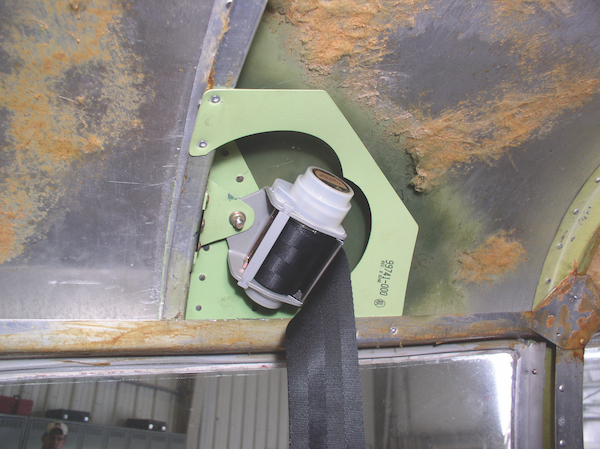
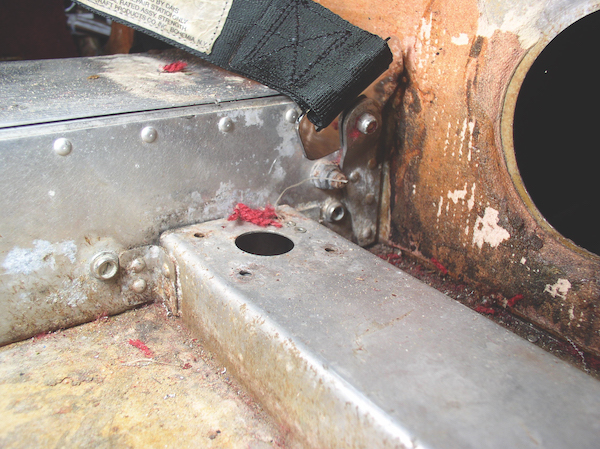
In Piper airframes, we tend to find the most cabin corrosion hidden behind and below the floor carpets. Unfortunately, one must remove the often glued-in-place floor carpet as well as any foam or heavy cardboard substrate material in order to inspect the belly skins and structure for corrosion. Additionally, the lower glued-in-place side wall carpet must be peeled back in the corners to inspect the steel riveted-in-place reinforcement corner brackets and seat belt attachment fittings.
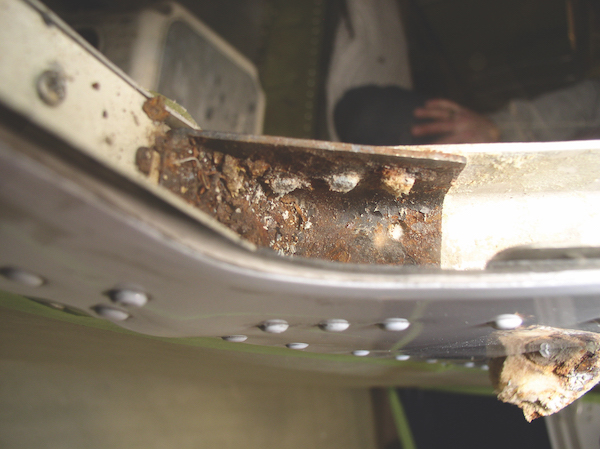
One final cabin item to inspect requires removing the windshield post plastic trim and inspecting the lower steel attachment brackets. We often find these critical steel reinforcement components to be rusting with their aluminum attachment rivets corroding.
The rest of the airframe (wings, aft fuselage, tail assembly, etc.) is easily inspected by removing inspection panels and fairings.
7. Identifying undocumented damage requires a careful and experienced eye. A savvy technician will know where and how to spot repaired damage. Overset rivets or driven rivets replaced with blind rivets are cause for some investigation.
Shiny or zinc chromated new components in older airframes are just some of the clues that can reveal a secret. Be curious about a 40-year-old retractable-gear airplane; many have had gear-up incidents somewhere in the past.
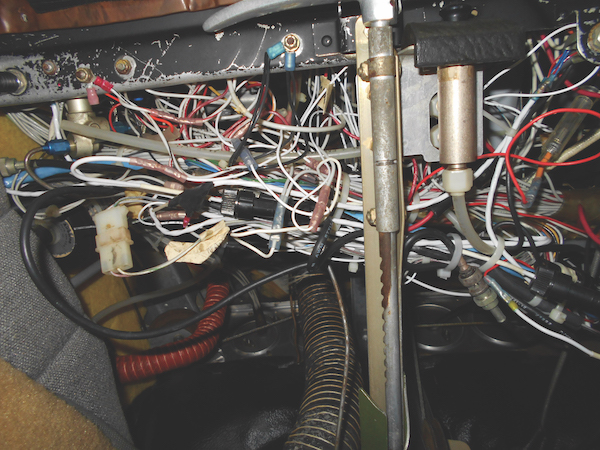
8. Don’t overlook an evaluation of the avionics equipment in the candidate airplane. Having a knowledgeable technician ground-check the radios and autopilot is a very good investment. The technician can confirm that all equipment is approved for installation in the specific make and model of aircraft and that all components are approved to work together. They can also verify that the installation was done well. Not all work is good work, as shown in the accompanying picture below.
9. Carefully inspect any modifications that were installed after the aircraft was built. Look closely to assess the quality of workmanship and verify that approvals and appropriate paperwork are included in the logbooks.
10. Ruling out the presence of hail damage is one inspection that’s sometimes overlooked. The best way to check for hail damage is to turn off the lights in a closed hangar and put a bright single light source as close to the aircraft skin as possible; look for any waviness in the skin surface that will be visible in the very low angle of the light. It is surprisingly difficult to see slight unevenness in a metal surface in bright overhead light. Skilled use of body fillers can hide almost any dent.
11. Not all engines are created equal. Low-horsepower four-cylinder Lycoming engines of 180 hp or less are about as bulletproof as they come. These engines can be evaluated with the usual maintenance record check, compression test, borescope cylinder inspection and an oil filter inspection.
High horsepower equals high heat, and high heat equals more stress on cylinders, rings and valves. Add turbocharging to the system and there are more items to check out. Complex engines require careful and knowledgeable management and inspection. I personally believe the most predictable and cost-effective plan is to buy a high-horsepower airplane with a run-out engine and start your relationship with your airplane with a fresh quality overhaul.
It’s important to point out that not all overhauls are alike. By FAA definition, an engine can be considered overhauled if it has been disassembled, cleaned, inspected and all the critical components are precision measured to ensure that they meet minimum tolerance.
This means that worn, but still serviceable, parts can be put back in an engine that can then be logged as overhauled and legally signed off for return to airworthy service.
If one critical component experiences as little as one-thousandth of an inch of additional wear, the engine is no longer airworthy. So, hours since overhaul can have a significant—and precarious—meaning. (For more on this subject, see “My Engine is 50 Hours from TBO” by Bill Ross. You can find the article in the September 2018 issue. —Ed.)
The most predictable way to make sure an overhauled engine makes it to TBO is to require that it be overhauled using new limits. That means that all the parts begin their new life fitting exactly to new engine specifications and have a margin for wear that will help to ensure performance longevity, and, most importantly, safety—all the way to TBO.
Two more engine issues that are important to consider are how active the engine has been and how many years it’s been since it was last overhauled.
Be concerned about an engine that was overhauled 20 years ago or has been inactive for an extended period of time. An inactive engine tends to develop corrosion and arthritic components, decreasing the likelihood that the engine and supporting components will make it to TBO. These conditions will often lead to increased maintenance issues along the way.
Writing this article reminded me of a wise older gentleman (fortunately, it seems like every airport has one) who said something years ago that I think was probably true, but at the time seemed a little harsh. He told me, “The three biggest lies in aircraft shopping are: one, no damage history; two, no corrosion; and three, the engine temperature and manifold pressures have never gone above redline.”
Considering the age of the fleet today, these three comments are likely true and worthy of your attention. Be a smart buyer.
Until next time, fly safe!
Industrial designer and aviation enthusiast Dennis Wolter is well known for giving countless seminars and contributing his expertise about all phases of aircraft renovation in various publications. Wolter founded Air Mod in 1973 in order to offer private aircraft owners the same professional, high-quality work then only offered to corporate jet operators. Send questions or comments to editor@www.piperflyer.com.
Further Reading
“My Engine is 50 Hours from TBO” by Bill Ross, Piper Flyer, September 2018

