


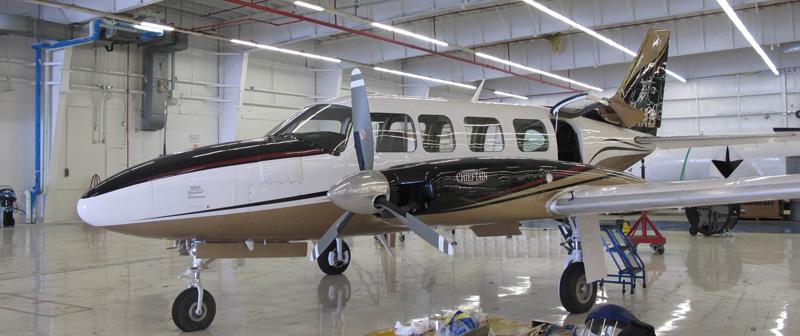
Whether it’s a sports car or an electronic device, a from-the-factory restoration can be a major selling point. It was no different for Ariel Quintela, a Florida-based pilot who was looking to move up to a twin.
From their home in Odessa, Fla., the Quintelas—Ariel, his wife Vilma and their daughter Camila—have flown with family and friends all over the United States, and often travel to their second home in North Carolina. Quintela has also been a volunteer pilot with Angel Flight since 2006.
After eight years of flying a Cessna 206, Quintela was ready to enjoy the added safety of a second engine. “Plus, we like to travel with bikes,” Quintela added. “The 206 was just too small.”
Quintela started researching and decided a Piper Chieftain would best suit the family’s needs.
The easy-flying Chieftain
The PA-31-350 Chieftain is a stretched version of the Piper Navajo with a fuselage that is two feet longer than the Navajo. Piper factories in Lock Haven, Penn. and Lakeland, Fla., produced 1,825 of these aircraft.
The plane has more power than a Navajo—350 hp—and eliminated critical engine issues through the installation of Lycoming TIO-540 and a LTIO-540 engines.
Chieftans rolled off the line from the mid-1970s through 1984. (Initial deliveries were delayed due to the flood at the Lock Haven plant.) The airplane was developed to compete with the Cessna 402 and was equipped for operation in all weather.
With an attractive operating cost, nice size and speed as well great storage capacity, Chieftains have been utilized by cargo, charter and feeder airline operators in addition to private individuals and companies for 40 years. With so many produced, it’s still a viable aircraft as far as parts availability.
The airplane has many fans—not just of its excellent takeoff and landing performance—but of its good flying manners. Many consider it one of the easiest-to-fly twins.
Often, Chieftains are equipped with the Colemill Panther conversion so popular with Navajos. This conversion uses the airplane’s 350 hp engines but mounts four-blade “Q-tip” propellers to aid the Chieftain’s built-in vibration dampers. With more efficient props and winglets, pilots report a marked increase in climb performance, even with the “old” engines. And with vortex generators installed, the aircraft’s MTOW can be close to 7,400 pounds.
Finding the right one
Quintela had been looking at aircraft for three years when he came across a mention of factory-restored Chieftains. “I didn’t realize they did that,” he said. (Apparently, not very many others did, either—in 10 years as the Piper Flyer Association, we’d never heard of this program until Quintela called us!)
After holding on to the information for a few months—and after quickly passing on more than one well-worn PA-31-350—Quintela reached out to Piper.
When Quintela first spoke to fleet salesperson Hans Stancil in January 2011, he got some bad news. Piper had nixed the program due to the soft economy and slow aircraft sales. But at the same time, he’d found a clean Chieftain, S/N 31-8052122…
“The people at Piper are extremely professional and caring,” he said. “One of my first questions was, ‘If I buy it, will you maintain it?’” The answer was yes.
“It was an easy decision once I met with them,” he continued. “I signed the contract , and they did everything they said they would—and more.”
He flew down to Vero Beach to see his 1980 Chieftain, N21AB, still in its original colors… and all apart. “I was able to be involved in the whole process,” he said. Of Stancil, Quintela said, “He helped me from Day One.”
Quintela’s aircraft was stripped—“I mean, completely,” Quintela emphasized—and then fully restored by head mechanics Vincent Zarrella and Frank Haas and their team. With an older twin like Quintela’s, this peace of mind meant everything.
Piper Aircraft has been manufacturing aircraft at the Vero Beach facility since 1962. With this kind of history—along with a reassuring level of transparency, including meeting with the lead mechanics—Quintela said, “I knew exactly what I was buying.”
Factory technicians worked on the airplane when time allowed, so it may not have been the speediest restoration on record—but it’s said that good things come to those who wait. Quintela’s 34-year-old aircraft has a Piper warranty, and he loyally takes N21AB to Vero Beach for servicing and annuals.
On the day Quintela took delivery, Piper arranged a presentation and had the gleaming Chieftain under a tent. Quintela received a beautiful yearbook-style document of the entire process as a gift from Piper.
Piper Aircraft continued to impress Quintela. “They were concerned about my experience with a twin, so Bart Jones flew with me to my home base, and he also spent a few hours with me the day before.”
“I sent them all thank-you letters,” he told me.
More room for family, more room for fun
“Now with the Chieftain,” he said, “we have room.” Bikes, luggage, and precious cargo all fit easily into the family airplane.
“Aviation is a passion,” said Ariel Quintela. “It’s something I’d always wanted to do.” (Sound familiar?) “When I decided to go to flight training my father and mother both got on the phone to talk me out of it,” he revealed. “But they came around.” So much so, that his mom was his first passenger.
Quintela’s philosophy about life and flying is based from a quote by prominent Tampa, Fla. historian and businessman Tony Pizzo. “There are 24 hours in a day,” Quintela told me. “Eight hours a day to work, eight hours a day to sleep, and what you do with the remaining eight hours is where you end up in life. For me, that’s enjoying family and flying.”
Quintela can now fly his parents, his wife and his other family members and friends comfortably in the Chieftain, and says they all are definitely enjoying the airplane. The family still travels regularly to North Carolina and is looking at making a few trips out west. “There are so many beautiful places in the U.S. we have yet to conquer,” he said.
Quintela also uses his Chieftain occasionally for business, mostly to look at properties from the air. Quintela is president of Ariel Homes and A-Investments Development Corp., and his company provides general contractor services with completions of 20 to 30 residential home sites a year, as well as commercial projects. Ariel Homes recently expanded into the full development of subdivision sites in Odessa, Lutz, Land O’ Lakes and Oldsmar, and other Florida locations.
Sources: AOPA.com, Wikipedia.com
Heather Skumatz is the associate editor at Piper Flyer magazine. Send questions or comments to editor@www.piperflyer.com.

