


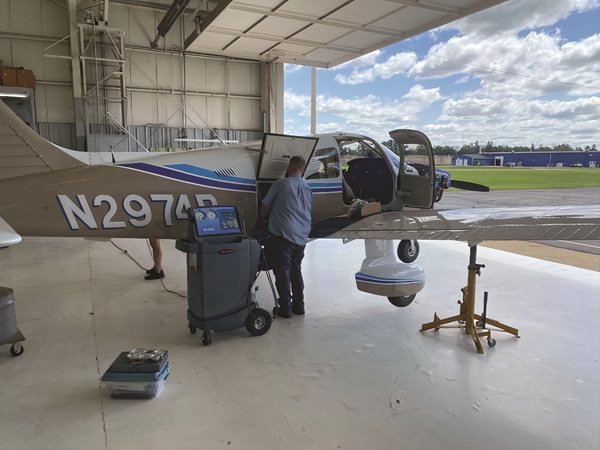
Explore the cool comfort, hidden complexities, performance trade-offs, and costs associated with factory air conditioning systems in Piper PA-28 and PA-32 aircraft.
By JP DesCamp
I hope you’ve had a chance to read my previous articles about the complete restoration of my 1980 Piper PA-28-181 Archer II aircraft. In this article, I will focus on the optional factory-installed air conditioning system, which tends to generate a lot of discussion among the small cadre of owners who either love or feel indifferent to these systems.
History of PiperAire
First, a bit of history is in order. Piper began developing a simple and effective air conditioning system for the Cherokee family of aircraft in August 1969. Four Cherokees were used for testing, including a Cherokee 140 and a Cherokee 180 (appropriately registered as N140AC and N180AC). Piper formally introduced “PiperAire” in 1972 across the Cherokee model range, including PA-28 and PA-32 aircraft.
Benefits and downsides
This option was a hit with southern-based flight schools and operators who toiled in sunny, hot climes… but it was very expensive, and it robbed 68 pounds of useful load. That gave pause to buyers when selecting options. PiperAire is not like the air conditioner in your car that can blow you away with “brain freeze” cold air. Rather, the PiperAire system provides cool air during taxi and after takeoff, given the limitations provided by a 14-volt blower fan.
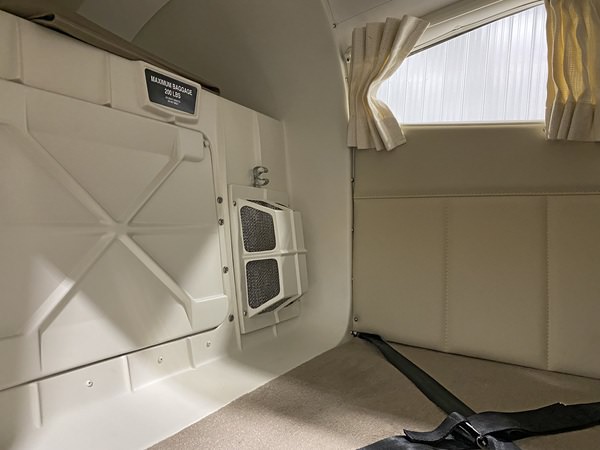
On the positive side, the system does an admirable job of dehumidifying air, which is half the battle. A small discharge port on the left side of the fuselage behind the aft bulkhead provides an exit point for the water which is extracted through the evaporation cycle. On newer Archer III aircraft, the 28-volt system provides more “oomph” due to the heavier-duty blower fan, but the cooling factor is much the same.
My experience with PiperAire
I like the system. During my last annual, it was time to clean, vacuum test, and recharge the system with the environmentally friendly R-134a refrigerant. We also lowered the condenser door to clean out 43 years of accumulated oil, bugs, and debris from the condenser fins by using a solution of Simple Green and warm water.
No leaks were found after pulling a 24-hour vacuum overnight. For safety reasons, my mechanic underfilled the system, with the proviso that I return for a top-off of R-134a at a later date. The results were encouraging. We were experiencing record high temps (along with high humidity levels) in West Michigan when we ran the system for the first time in many years.
While taxiing, it’s common practice to crack the cabin door open to try and stay somewhat cool. I can honestly say that despite these high temps, I chose to close and lock the door with the air conditioning on full blast prior to takeoff. There was no brain freeze from the overhead vents, but instead, a cool airflow that was dry enough to appreciate the effort and expense of resurrecting this system. A sizable puddle of water from the discharge port accumulated on the hangar floor after my flight. It works!
After the aircraft was painted by Sturgis Aviation, I paid a visit to my friends at Bartelt Aviation, which is also located at the Kirsch Airport (KIRS) in Sturgis, Michigan. Upon inquiring about getting an air conditioning charge (basically a top-off), the first question asked was, “Is your system R-12 or R-134a?” I explained that a conversion from R-12 to R-134a had recently been completed. As expected, their reply was positive. In fact, Bartelt explained to me that R-12 refills (“charges”) are no longer performed at their facility.
A Robinair recovery, recycle, and recharge unit was hooked up to the recently converted high- and low-pressure ports. The first cycle was to recover and evacuate the system. The amount of refrigerant removed was 0.3 pounds. The next cycle charged the system with 1.9 pounds of refrigerant per Conversion Air specifications.
It’s worth noting that even with just 0.3 pounds of refrigerant, the system did an admirable job of cooling. But with a charge of 1.9 pounds…wow! The system was now blowing cold air at a decent rate, even with the smaller 14-volt blower fan.
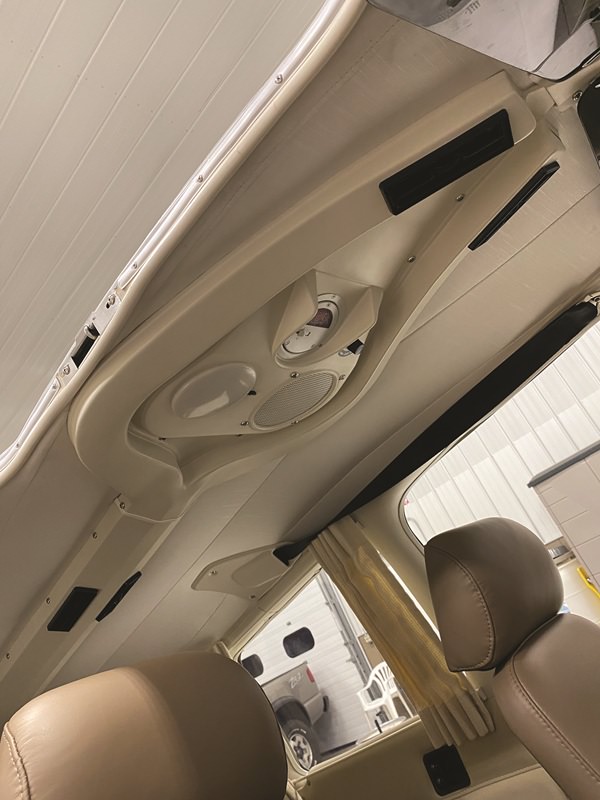
I want to add one important detail: Be sure the air conditioning scat tube ducting located behind the bulkhead is in good shape, with the proper stainless-steel clamps in place. Inside the cabin, check to ensure the overhead duct is clean and devoid of any air leaks that may weaken the airflow going forward to the rear and front seat passenger vents. This will ensure adequate airflow, even on the hottest of days, just as Piper designed it.
System components
Let’s review the major components of the system for a better understanding of how this contraption actually works. The vapor cycle system consists of five major components; the evaporator (located and attached to the rear bulkhead), condenser (the motorized unit that drops the condenser coils down into the airstream), expansion valve (located adjacent to the evaporator), compressor (located in the engine compartment, opposite the alternator), and the receiver/dryer (located next to the expansion valve).
During operation, the compressor’s belt-driven pulley compresses the refrigerant to a superheated gas. This gas then goes to the condenser, where cooling air from the slipstream removes heat from the gas, thereby condensing it to a liquid. The liquid is then stored in the receiver dryer until it is needed. The refrigerant flows past the expansion valve as a liquid.
Here, it is metered to the evaporator at a rate that will allow all of the liquid to evaporate and return to the compressor at a reduced pressure. The heat required for this evaporation is absorbed from the warm cabin air passing over the evaporator cooling fins. This air is moved by the cabin air fan when the air conditioning switch is activated, and the fan switch is set to HI or LOW. Older PA-28s have a MEDIUM setting as well.
Performance considerations
Be aware that when the PiperAire system is being used, there will be an approximate 2- to 3-knot reduction in indicated airspeed. This is due to the condenser door being lowered into the slipstream.
Also note that when the air conditioner is turned ON, and the throttle is advanced to full power, the condenser door will retract automatically (or at least it should, provided the limit switch on the power console is correctly positioned to actuate the closed-door circuit). This is to ensure takeoff performance is as indicated in the POH.
This limit switch function can (and should) be checked during annual or 100-hour inspections by simply turning the master switch on, along with setting the blower fan and air conditioning switch to ON. The condenser door should lower itself. Push the throttle all the way to the stop—the door should retract. If not, adjust the limit switch for proper activation. Pull the power level back a half inch or so; the condenser door should lower once again.
Performance at altitude
We pilots recall from our training that temperature decreases approximately 2 to 3 degrees C per thousand feet. When reaching cruising altitude in that nice cooler and drier air, normally the air conditioning is turned off, so speed reduction is no longer a factor. But while on the ground, during climbing or descending, it’s worth its weight in gold (or, at least, in sweat)!
Some aircraft owners whose planes are equipped with PiperAire have elected not to maintain (or have removed) the air conditioning components from their aircraft. The logical reasoning is to increase the useful load by 68 pounds. Another reason is these older systems relied on R-12 refrigerant. The production of R-12 was banned in 1996.
On May 12, 1993, in the Federal Register (58 FR 28094, “Protection of Stratospheric Ozone”), the Environmental Protection Agency (EPA) proposed HFC-134a for retrofitting existing CFC-12 vapor cycle systems. Please note the Archer III models are exempt because they already use EPA-approved R-134a refrigerant. This put owners of Archer II (and previous similar models) in a conundrum of what to do. Some owners continued to use R-12, provided you could find it on the open market.
R-12 can still be found, but it remains increasingly expensive. In addition, you’d need to find a backyard mechanic to charge the system…never mind making a logbook entry! Professional maintenance providers are no longer allowed to charge an aircraft with R-12.
Others choose to remove the system altogether and gain extra useful load. Then, there’s a small group of people (like me) who refuse to let a good air conditioning system go to waste.
R-12 to R-134a conversion
A small company by the name of Conversion Air of Waco, Texas, stepped up to the challenge by providing conversion kits for many Piper aircraft and other manufacturers as well. It’s not cheap. The conversion kit (R-12 to R-134a) is listed for roughly $6,500 in the spring of 2025, and it includes a new compressor, flexible hoses, valves, caps, and other related components. When you open the box and remove all the stuff, you may ponder: “Is that all I get for $6,500 bucks?” Well, yes, that’s all. But, you do get something perhaps worthy of great expense: paperwork (and lots of it) in the form of an STC.
I chatted with a very personable company representative named Rhonda Finch. She agreed with my observation regarding the cost but went on to explain that the process of obtaining an STC for the PA-28-181 aircraft was an expensive, time-consuming effort when working with the FAA. It took me a while to understand her point of view, but then it dawned on me that every task that’s outlined in their 31-page installation manual is blessed by the FAA (Federal Airconditioning Association?), then permanently entered into your airframe logbook. OK, I get it.
The installation manual for the conversion kit is very detailed, and it will take a person who is a certified air conditioning guru to figure it out. I consider myself “certifiable” (but not in a technical sense) to handle this.
In my airplane’s case, I caught a little break by having my existing York compressor overhauled by Skyline Accessories of Sand Springs, Oklahoma. The cost for that was $1,395. So yes, I did save a little, versus the Conversion Air compressor at $2,000. Before Skyline received my compressor, I was warned that a new clutch might be needed, thus increasing the price to nearly $2,000. Fortunately, the existing clutch was in good shape, so another near miss.
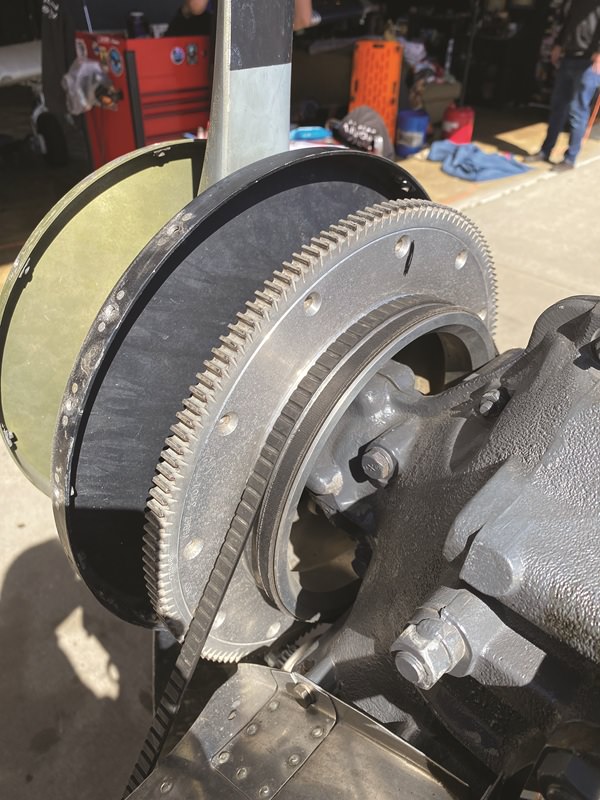
Another financial near miss was avoided when I discovered my aircraft already had the Piper V-belt Conversion Kit, Part No. 767-310, installed. (This kit retails for around $5,000 at Muncie Aviation. SkyGeeks had one listed for an astonishing $7,777). This upgraded flywheel incorporated two re-engineered pulley belt flanges to accommodate the hefty compressor V-belt, Part No. 73965-010, along with an improved and much heftier alternator V-belt, Part No. 73965-020.
Before this conversion kit came to market, affected aircraft used a really skinny, frail-looking alternator belt that would not handle the rigors of continued regular operation without breaking—sometimes while flying in IMC. A slight misalignment of the pulleys made things even worse. Myriad service difficulty reports, combined with customer demand, brought about this design change.
It’s important to note that only certain serial numbers of Archers are eligible for conversion. They are Serial Nos. 28-7690001 through 28-8690056 and 28-90001 through 28-90205. If your aircraft was not equipped with factory air conditioning, there is no provision to add it unless you can find parts from a scrapped Archer and build the system yourself. I do not recommend this. There are a number of structural airframe modifications needed that would require field approval and the services of a DER to make this a legal installation.
In other words, you’ve got to have air conditioning already installed to utilize the conversion option. The conversion kit is only applicable to aircraft with OEM air conditioning. If you’re sweating over the fact that air conditioning for your aircraft is elusive, another option exists with Arctic Air, a company that makes portable air conditioners.
In the meantime, stay cool!
JP DesCamp is a recovering 37-year retired airline addict who now enjoys single-engine bug smashers at or below 5,000 feet. He lives with his partner in Kalamazoo, Michigan. Send questions or comments to editor@www.piperflyer.com.
Resources

