


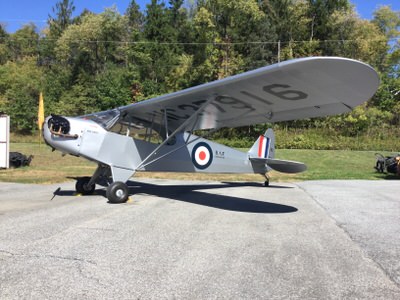
A 1941 Piper J-3 Cub Special, owned by Connecticut pilot Rod McKenzie, has been restored to honor heroic British aviators of World War II.
By Dennis K. Johnson
Rod McKenzie, a corporate pilot living in Danbury, Connecticut, was minding his own business one night when the telephone rang. On the line was “some British guy,” according to McKenzie, “asking me about my Flitfire.”
“Huh? What’s a Flitfire?”
That’s when McKenzie learned that he didn’t own just any one of the nearly 20,000 Piper Cubs built between 1938 and 1947, but a small piece of aviation history and a symbol of friendship between America and Great Britain during World War II.
McKenzie had found the then-51-year-old J-3 C-65 Cub Special, NC37916, on a ranch in Montana in 1992. He flew it home to Connecticut, and after providing years of fun low-and-slow flying while enduring the harsh Northeast weather on the airport field, McKenzie’s trusty Cub finally encountered a hailstorm in 2002 that caused the insurance company to write it off.
“The Cub had been painted with enamel, which is very strong, but not so flexible,” McKenzie explained. “When the hail struck, it caused circular cracks in the paint, often called ‘ringworm,’ which would then allow light to get at the fabric below and degrade it.”
“So, my mechanic wouldn’t sign it off as airworthy.” The little yellow plane was grounded.
McKenzie stripped off the beaten fabric, removed the wings and piled the parts into his garage. It was time to bring the historic plane back to life with a full and accurate restoration.
A short history lesson
The summer and autumn of 1940 was a dark time for the people of Great Britain. Hitler’s Luftwaffe mounted a massive air campaign designed to destroy the Royal Air Force (RAF) in advance of an invasion.
First, the Luftwaffe targeted major shipping cities, such as Portsmouth, followed by RAF airfields, aircraft and munitions factories and finally, London. The Germans called it the “Luftschlacht um England,” while the British called it The Battle of Britain.
The Royal Air Force was the only defense for the beleaguered British. They sent up their limited fighters against overwhelming German fighter and bomber aircraft. RAF pilots flew numerous missions each day from July to October and suffered almost disastrous casualties.
But after months of steadfast resistance, Hitler finally relented and a wary peace returned to the skies above England, although bombing raids continued at night.
It was of these fighter pilots that Churchill would say, “Never in the field of human conflict was so much owed by so many to so few.” The victory came with a high toll for the RAF, with almost 1,500 pilots and aircrew killed.
The families of these brave airmen were aided by the RAF Benevolent Fund (RAFBF), a charitable organization established after World War I.
In 1941, support for the Benevolent Fund’s efforts came from across the Atlantic in the person of William T. Piper, president of the Piper Aircraft Corp., based in Lock Haven, Pennsylvania. Mr. Piper wanted to aid the RAFBF’s charitable work by donating a Piper J-3 Cub as a prize in a fundraising effort.
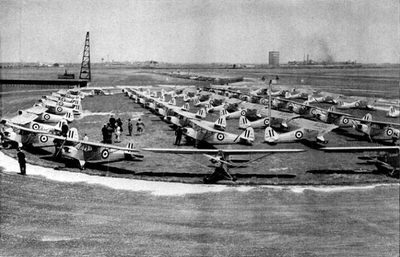
Mr. Piper asked each dealership across the United States to make a matching donation of one Cub, which would represent their state. A total of 49 Cubs were donated, one for each of the 48 states, plus Piper’s original airplane. These were given the name Flitfire, an allusion to the famous British fighter plane, the Spitfire.
The aircraft were manufactured at Piper’s Lock Haven factory between April 10 and April 22, 1941. The first Flitfire, Mr. Piper’s, was powered by a 65 hp Franklin engine and registered NC1776. The remaining Cubs were powered by Continental, Lycoming or Franklin engines. All were painted in a silver, military-style scheme with RAF insignias and the words “Royal Air Force Benevolent Fund” on the side.
The airplanes soon became known as the Flitfire Brigade. Some factory data indicates that a total of 51 Cubs were built and painted silver. It seems likely that Mr. Piper had a couple backups ready to go if any of the 49 developed problems or were otherwise rendered unairworthy.
Coming back to life
In 2009, the restoration of McKenzie’s Flitfire began by sending the fuselage to Clyde Smith, an acknowledged expert on Piper Cubs, who restores the vintage aircraft in his shop at the William T. Piper Memorial Airport (KLHV) in Lock Haven, Pennsylvania.
That’s the same airfield where Cubs were originally built, and NC37916 hadn’t returned there since it flew away in 1941.
Inspection of the metal tube fuselage revealed a lot of hard knocks in this Cub’s life. “Although many of the repairs were crude, obviously not done by a careful mechanic, I’m sure it was safe because some of those welds were so heavy. It may have actually been parts of two different airplanes,” said McKenzie.
“Also, Clyde discovered that the fuselage was bent from at least one accident,” he added.
“It could have been repaired, but it was more economical to just buy a new fuselage from Univair , so I had one shipped to Clyde.”
McKenzie explained, “I could pay to have Clyde fix the old fuselage or pay for a new one; it would have cost about the same. Time was the deciding factor. With a new fuselage, it was all done and ready for the job to progress.”
The Univair fuselage was new and straight, but it wasn’t completely accurate for a Flitfire. The Univair product is based on the 1946 Cub, which has a different cockpit overhead and skylight than a 1941 Cub. Smith cut and welded new tubing above the cockpit to replicate the Flitfire’s shape.
A new gas tank was fitted in place and a new stainless steel firewall was installed. “It looked like a homemade gas tank had been installed at some point,” said McKenzie.
Instead of the original cotton fabric, Smith covered the fuselage with a synthetic fabric envelope, Poly-Fiber, made by Consolidated Aircraft Coatings.
“Back in the 1940s these types of planes would be recovered with cotton or linen every three years or so,” said McKenzie. “I sure didn’t want to do that.”
At this time, the metal parts of the cockpit that would be exposed when the airplane was finished were painted using Randolph Ranthane aircraft coating.
Bringing it home
During the winter of 2014–2015, the fabric-covered fuselage and control surfaces were shipped from Smith’s Lock Haven shop to Bob Hunt, a fabric airplane specialist in Hackettstown, New Jersey, for completion and assembly.
Hunt, who has restored about 24 fabric planes, said, “This was one of most interesting, historically, that I’ve ever worked on. Replicating the original paint scheme was especially challenging.”
Hunt got the Flitfire back on its landing gear, with new tires and modern disc brakes made by Grove. He cleaned, inspected, repaired and installed hundreds of parts for the controls, instruments, seating and engine mounting.
“The wooden wing spars were inspected for signs of rot or fatigue and found to be in good shape—except that they’d been chopped,” said McKenzie. Sometime in the past, fiberglass booster wingtips had been installed. The original curved wingtip was removed, and the spar cut about 6 inches to install these aftermarket wingtips, which are meant to improve the slow flying characteristics.
The original spars could have been extended with splices, but once again, ordering new ones was an economical and expedient way to go. Bob Hunt buys the spar blanks from Aircraft Spruce and finishes them himself.
Some of the original wing ribs were good and some bad, so new one-piece Dakota metal ribs were used and new wooden wingtip bows were fabricated.
After installing fresh leading-edge metal, new cables and pulleys, the wings were also enclosed in synthetic fabric. To improve the plane’s range, an 8-gallon wing fuel tank was also installed.
With so many new parts, it’s a metaphysical question if the airplane is still a vintage model or a new replica. “If you have the data plate, you can have an entire plane built around it and call it a vintage aircraft,” said McKenzie, “but I hope this airplane has enough of the original parts to be considered historical.”
Although McKenzie strived to return the aircraft to its original appearance, he “didn’t want a museum piece, but a safe and flyable airplane,” so a few modifications for performance and safety were allowed to the original equipment.
“Sometime in the past, huge aftermarket brakes, plus different wheels and tires had been installed. They worked great, but they weren’t correct,” said McKenzie. The new disc brakes from Grove are not exact replacements for the original drum brakes, but they accept the same wheels and tires as the original, 8.00-4 wheels and 8.00-4 tires. The new brakes are inconspicuous enough to not detract from the historic aircraft’s appearance.
Along with new brakes, McKenzie selected a 90 hp Continental engine over the original 65 hp Lycoming, which provides additional power while making it easier to service.
“On the Lycoming, the cylinders are part of the engine block, so there’s no such thing as ‘pulling a jug’ if you have a cylinder problem. You need to pull the entire engine. The Continental has removable cylinders and is easier to source parts,” McKenzie explained.
Cockpit
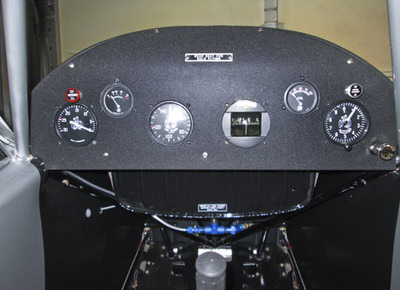
The instrument panel was restored with a vintage crinkle black paint and the black-face style instruments overhauled by Keystone Instruments, also located at Lock Haven airport.
If simple is your type of flying, then this is your plane. The Flitfire features only six instruments—tachometer, oil temperature gauge, oil pressure gauge, compass, airspeed indicator and altimeter.
“Most of the Cubs had a combined oil pressure and temperature gauge, where this one has two separate ones. I don’t know why, but it’s far rarer,” McKenzie explained.
“It was a shame to paint black the beautiful birch floorboards, but that’s the way it was when it came from the factory,” said McKenzie. “I had custom carpet mats made to protect them from dirt and rain.”
The area beneath the instrument panel down by the pedals was painted black, and the remainder of the cockpit, silver. Black leather tufted seats were custom stitched and installed, plus new four-point seatbelts from Aircraft Belts.
“It was a real challenge to replicate the three-piece windshield of the time. We installed all new windows and a one-piece windshield from LP Aero Plastics. So, we had to fabricate and install fake mullions in the fragile plastic windshield. Drilling holes in the Plexiglas, which can crack so easily, was nerve-wracking,” said McKenzie.
Like many airplanes of that era, the Flitfires had no electrical system, so hand-propping was a skill McKenzie had to master when he first acquired the aircraft. “It’s safe to hand-prop if you know what you’re doing and don’t ever get complacent,” said McKenzie.
Without an electrical system or battery, McKenzie uses an Icom A-24 handheld navcom connected to a hidden strap antenna inside the tail to communicate. Currently, he flies without a transponder and uses an Apple iPad to navigate. A battery-powered Artex ELT 1000 406 MHz ELT was installed in the event of an in-flight problem becoming an on-the-ground problem.
The airplane, like most Cubs, sports a beautiful varnished wooden propeller with no spinner. Four glossy black engine cylinders poke through the cowling into the airstream for efficient cooling.
Paint scheme
As noted above, the airplanes of the Flitfire Brigade were painted not in the customary Cub yellow but in a silver scheme with British RAF roundels on the wings and fuselage, and a red, white and blue flash on the vertical stabilizer.
“RAF Benevolent Fund” was painted on the fuselage; “Flitfire” plus the state name for each plane was painted on the engine cowling. It is interesting to note that nowhere on the exterior is any Piper logo or name. Mr. Piper could have used this as an opportunity to send 49 flying billboards around the country, but he didn’t.
Since the Flitfires made national news for a few days in 1941, there were many professional photographs to guide NC37916’s painting, including images from Life Magazine.
“The graphics on flat surfaces were painted and the curved ones got decals,” said McKenzie. “It’s not as simple as you would think to paint a perfect circle on the top of a wavy wing surface, so we used decals made by AeroGraphics of Loveland, Colorado.”
While Hunt completed his part of the project, the engine was being rebuilt by Dan Fogle in North Salem, New York. Hunt delivered the fuselage to Fogle’s shop for the engine installation and then they trailered all the finished parts to a hangar at Danbury Municipal Airport (KDXR) at Danbury, Connecticut.
The two craftsmen and McKenzie assembled the plane, rigged it and weighed it just in time for 2015’s Sentimental Journey Fly-in, the annual gathering of Piper aircraft at Lock Haven. There, the meticulously restored “Flitfire New Jersey” won the award for “Best J-3 Cub.”
In 2017, McKenzie made a 24-hour round-trip flight to EAA AirVenture at Oshkosh and was rewarded with a Silver Lindy, the award for Antique Reserve Grand Champion in the Bronze Age category (planes built from 1937 to 1941).
The Brigade in the Big Apple
This little airplane that flew halfway across the country in 2017 as a 76-year-old, began its life making another famous cross-country flight, landing among fashion models, national news coverage and a swank gala.
Five days after the last Flitfire rolled out the factory door, April 27, 1941, the 49 Cubs of the Flitfire Brigade flew from Lock Haven to New York City.
Seven flights of seven airplanes flew in formation, first to Allentown-Bethlehem Airport (now Lehigh Valley International, KABE —Ed.) and then over New York City, approaching from Staten Island, past the Statue of Liberty, then northward over Manhattan and Central Park up to the George Washington Bridge.
The group then turned south again to midtown Manhattan, flying by the Empire State Building, then east to Flushing Airport, an airport on Long Island that no longer exists.
Gala at LaGuardia
Two days later, on April 29, the Flitfires flew to New York Municipal Airport, now known as LaGuardia (KLGA), in close formation. It’s claimed that the Flitfire Brigade was the largest mass landing to that date.
The airplanes were christened by fashion models who popped red, white and blue balloons fastened to the propellers and Piper officially presented the airplanes to Thomas Beck, president of the RAFBF.
That evening, a black-tie fundraiser was held at the airport. Celebrities, business and civic leaders enjoyed cocktails, dinner and a show, followed by games and the raffle of NC1776.
In total, the gala raised $12,000 for the RAFBF. (Approximately $200,000 in today’s dollars, corrected for inflation. —Ed.)
Fundraising tour
The next day, the 48 remaining Flitfires flew off on fundraising tours, each flying to its namesake state. Some Piper dealers used the Flitfires to raise money for the RAFBF by selling rides; others were raffled off; and some were just sold.
The first Flitfire, NC1776, was flown across the United States on a war bond tour by several famous pilots, including Orville Wright, and then was sold.
A long and winding road
Between the day it departed Lock Haven in 1941 until it returned in 2015, 74 years had intervened, and the little Cub had a history as varied as America itself.
After the fundraiser, the airplane was flown to the New Jersey Piper dealer, Cahill Flying Service in Bridgeport, New Jersey.
In August, it was won by a high school student in the Basking Ridge Fire Co. carnival raffle. He immediately sold it for $1,200 to the Army Air Corps flight training facility at Somerset Hills Airport. (The Somerset Hills Airport in Basking Ridge, New Jersey, closed in 1983. —Ed.)
McKenzie says that FAA records reveal 23 different owners of this Cub. Through the years the Cub moved slowly westward, residing in New Jersey, Pennsylvania, Indiana, Illinois, North Dakota, South Dakota and eventually ending up on the ranch in Montana.
It had been a crop duster and it had been wrecked. It went through numerous engine changes, receiving Franklin, Continental and Lycoming powerplants at one time or the other. McKenzie helped bring it back from Montana to the east, where it began its life. McKenzie continues to fly the historic 77-year-old Flitfire every week.
Where are the Flitfires now?
After the war, many Flitfires made their way to private owners and were usually repainted in the traditional Cub yellow paint scheme and their wartime history forgotten.
It’s not certain, but it seems that there are only four Flitfires still painted in the original RAF silver. Along with the New Jersey Flitfire, the Indiana and Wisconsin Flitfires have been seen flying recently. Piper’s original Flitfire, NC1776, is on display at the North Carolina Aviation Museum in Asheboro, North Carolina. Others are flying under yellow paint jobs, likely with many owners unaware they own a piece of American history.
Dennis K. Johnson is a writer and a New York City-based travel photographer, shooting primarily for Getty Images and select clients. He spends months each year traveling, flies sailplanes whenever possible and is the owner of N105T, a newly-restored Piper Super Cub Special. Send questions or comments to editor@piperflyer.org.
Resources
Piper Flyer Supporters
Other Parts, Accessories and Services
Consolidated Aircraft Coatings (Poly-Fiber, Randolph)

