


August 2012
Considering that Piper produced this quick-and-cheap two-seater after going bankrupt, it is surprisingly good.
When the American economy went into reverse in 1947, Piper could not have been more wrong-footed. It had a huge inventory, a massive factory with too many workers and went bankrupt.
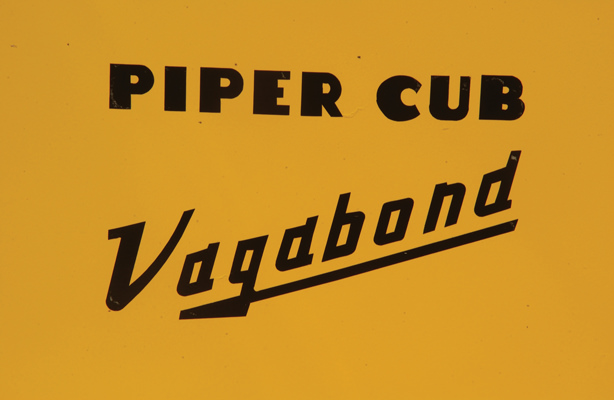
Out of necessity came a little wonder, though—the Piper Vagabond (PA-15). It was designed to be inexpensive and quick to build, to use up the stock of part-built Cubs and Super Cubs, and to be an airplane that would sell in a recession…
so it had to be cheap. No frills.
No one really thought it would fly well, but to the amazement of all involved, it did. Some say it flew better than the Cub it was modified from.
Ed Terris owns a rare example of the Piper Vagabond—rare because it’s remained virtually unmodified since it left the factory, aside from a few changes to the instrument panel.
When it comes to airplane design, less is often more. Good airplanes can be ruined by additional seats and a more powerful engine, because everything has to be strengthened and you have to carry more fuel. A good part of the power is expended on the extra weight; a light, agile airframe becomes clumsy.
I had already flown one of the later variations on the airframe, a 115 hp Piper Clipper (PA-16) with four seats. I found the Clipper functional, but a poor load carrier (the owner had removed the rear pair of seats as useless) and not particularly pleasant to fly. The Clipper was also a pain to land. So I jumped at Ed’s invitation to try the first of the breed, the Vagabond, which he claimed was much better.
LOADED AND CLIPPED
Let’s compare the two. To make a Vagabond, the Cub’s fuselage had 3 feet, 7 inches lopped off its length. The wings were clipped by 5 feet, 8 inches. Apparently, this was done to save material, including fabric and paint. Where the Cub looks cute but graceful, the Vagabond just looks chunky. Yet it also looks more modern.
The shorter fuselage may have been one reason for the Vagabond’s side-by-side seating. The Cub’s fore-and-aft seating had been better suited to military training. For one thing, sitting centrally makes life a little easier for the student; for another, who wants to sit right next to one sweaty young man after another?
The Vagabond’s side-by-side seating may also have been adopted because it was known to have customer appeal. The accepted theory is that in peacetime, men wanted to fly with their wives and sit next to them. Anyway, it proved popular.
One radical piece of cost-cutting was to do away with the bungee suspension that takes the landing shocks in the Cub. The only shock absorption in the Vagabond is in the tires—but in such a lightweight flying machine, 11 psi tires can take the strain just fine.
For some reason, an entirely superfluous elevator trim is fitted, but it doesn’t add much weight or complexity, because it’s the spring bias kind. This is easier to manufacture than the screw-jack that raises and lowers the elevator’s leading edge in the Cub. (When I owned a Cub, that screw-jack was inclined to develop play and seemed to need work most years.) The screw-jack is more aerodynamically efficient than trim tabs or bias systems, but the saving in cruise speed can’t be more than a knot or two.
The Super Cub I owned later had tanks in the wings, and when I worked as an aviation engineer, I came to hate wing tanks. Yards of plumbing means lots of trouble; the tanks lead a hard life in the wings and can leak. Inspecting them annually is a pain in the neck. The Vagabond has a tank behind the instrument panel, like the Cub. Much better.
In one aspect the Vagabond is more sophisticated than the Cub—instead of a float and wire fuel gauge, it has one taken from a Ford Model A, worked by a cork float. But Ed Terris says it’s difficult to read in flight, so he relies on a dipstick before taking off; he also relies on his knowledge of the engine’s fuel consumption.
At least the Vagabond is fitted with toe brakes, but one economy is a little surprising—no dual controls. (A later variant, the PA-17 Vagabond Trainer, does have dual controls.) In the PA-15, there’s just one control stick and one set of rudder pedals on the left side of the cockpit. But if the target market in 1947 was the pilot and his wife, in those days the assumption may have been that she wouldn’t want any controls. And the target market had already learned to fly with the military and wasn’t looking for a trainer. The throttle control on the far left of the panel is a large plunger. The mixture is pre-set, so there’s no control in the cabin.
The instrument panel in Terris’ Vagabond is a combination of authentic-looking dials with cream-painted faces, and concessions to modernity: a GPS mount, ELT, artificial horizon, vertical compass, radio and even a transponder.
TAILWHEEL PECULIARITIES
One economy too far with the Vagabond is the Scott 3000 tailwheel. Presumably because it was cheaper, Piper seems to have fitted one that can’t swivel independently. It goes where the rudder goes, limiting it to the maximum deflection of the rudder—about 35 degrees each way. To turn beyond that you can either drag the tailwheel sideways by using the brakes on the main wheels, or lift the tailwheel by giving a blast of power and forward stick, using rudder to yaw the airplane.
Furthermore, to get any kind of steering from the tailwheel, it has to be linked tightly to the rudder, which is fine at taxiing speed, but not when you’ve just landed. At higher speeds, the tailwheel is much too highly geared. And Ed says, “If you don’t have the tailwheel springs good and tight, she’ll ground loop on you once the tail is down, the rudder loses power, and you’re dependent on the tailwheel to run straight.”
The inability to swivel is also a pain when it comes to maneuvering the Vagabond into and out of its hangar. Terris made a neat little wheeled dolly onto which he drops the Vagabond’s tailwheel. It looks slightly absurd with such a small aircraft; I mean, okay, a Stearman is big and heavy and needs a tailwheel dolly… but a Vagabond?
FLYING A TRUE VINTAGE
Since you can’t fit a starter and alternator to the O-145-B2 engine, it has to be started by swinging the propeller. Ed Terris has an external fan generator, but it’s only enough to run the radio and transponder. Ed is staying on the ground for my flight, so he’ll swing the prop for me. I climb aboard via the single door on the right, which has a catch to hold it open.
Since it’s a warm day, Terris suggests pre-setting the clamshell air intakes for cabin air (you can’t reach them in flight). There’s also a sliding window on the left. The original aircraft had a single lap strap that went around both occupants, but Ed’s has two three-way straps.
I check the fuel tap is set to on, and work the Lunkenheimer primer through a couple of cycles, set the left mag to on, call out, “Contact,” and the tiny 65 hp Lycoming bursts into life at Ed’s first swing. It gurgles happily, quietly muttering to itself at low revs, producing very little vibration. I set both mags to on, push on the toe brakes, release the brake plunger on the instrument panel, and set off.
One drawback while moving off is that the wings are in my sight line, so I can’t see the tips easily to make sure I have clearance as I pass obstructions. Also, once I move from tarmac onto grass, the lack of suspension and short fuselage make themselves felt in a rather bumpy ride. Slowing down helps a lot, though. On the plus side, I can see over the nose and don’t have to weave from side to side to look at where I’m going.
The preflight checks are: slow running, carb heat and a mag check. I don’t set flaps, because there aren’t any. I line up on the concrete runway and open the throttle, producing a more familiar noise level. The spiral airflow needs a dab of rudder to keep me running straight and a bigger jab of rudder when I ease the stick forward to raise the tail. Acceleration in the Vagabond is considerably better than in a 65 hp Cub, and after a short run I can lift off and climb away at 65 mph. The initial climb rate is 600 fpm and the nose is noticeably higher in climb than a Cub’s.
CRUISING; AIR-TO-AIR
At cruise height I lower the nose and set the throttle just below the red line, which is at 2,550 rpm. This produces an impressive 100 mph maximum level speed. Then I throttle down to 2,300 rpm and let the speed settle at 85 mph, which Ed told me is his usual cruise speed. At this setting the little 65 hp Lycoming is quite economical, using four gallons (US) an hour.
We—the cameraship’s pilot and I—are heading for another airfield which has a grass runway. The idea is to see how the Vagabond compares with the Cub on grass runways that aren’t particularly generous for length. Cubs do remarkably well in this situation; how will the Vagabond manage?
On our way to the grass airfield, I hug in close to the cameraship and we make some left and right orbits so that the cameraman can take his photographs. We also shoot a breakaway and some head-on pictures. At between 85 and 90 mph, our formation speed, the Vagabond’s controls are light and powerful, especially the rudder. I can react quickly to the photographer’s instructions to move in or out, up or down, and my only criticism is that the view out is rather limited. It isn’t nearly as easy to fly close formation as it would be in a Cub. The side windows are shallow and the roof gets in the way. In fact, I have to undo my seatbelt so that I can crane forward to see past the roof.
Once we reach the grass airfield, the cameraship drops down to land and I see how the Vagabond behaves in loitering flight—circling at low level and at low speed over one spot. The Cub did a lot of this in its wartime career. The Vagabond is pleasant to fly in this mode, but falls well short of the Cub, which has a superb view downward. You do need to use quite a lot of rudder in turns at loitering speed, but rudder use doesn’t seem to be quite as critical as in the Cub. The ailerons are powerful and produce a brisker roll rate than the Cub’s.
A CAREFUL LANDING
I am nervous about the landing I am about to make on grass. The Clipper I flew was prone to groundlooping and you had to be quick on the brakes once it began to let go. Plus, there was that bucketing when I taxied the Vagabond across the grass at the last airfield. I am determined to stay alert.
As recommended by Terris, I set an approach speed of 70 mph. The aeroplane flies steadily and seems quite stable. A touch high, I sideslip to get back on the glideslope. The runway is only 600 yards long and I don’t want to land hot. I cross the threshold at 65 mph having straightened out of the sideslip and I can still see the runway over the nose.
With the speed still coming back, I close the throttle and level off. The float continues for a good five seconds while I keep the nose coming up and the stick coming back. The stick reaches the halfway-back point when I feel the wheels touch—all three together—and we roll smoothly down the grass. There’s no bucketing or roughness, and we didn’t bounce. (The Clipper was horribly bounce-prone; neither I nor its owner could get it to touch down without bouncing. But then the Clipper had bungee suspension and that is notoriously badly damped. Maybe a rigid undercarriage is better. Or maybe I just did everything right this time?)
I make gentle use of the toe brakes and we come to a halt halfway down the runway, after a landing run over a 50-foot hedge of just 300 yards.
There was no temptation to ground loop that I could see. Usually you can feel if there’s a tendency to ground loop in an unfamiliar taildragger, but the Vagabond seems well-tamed in this respect, too. I was working my feet, but that was only to be expected on a fairly rough grass runway.
One difference with the Cub is that the touchdown speed is definitely higher, at least 10 mph, maybe 15 mph. However, the Vagabond has a lighter airframe with less momentum.
Ed Terris, who trained on a Cub, didn’t find the Vagabond tame. He told me that he had suffered two groundloops in the airplane before he got the hang of it. (So maybe I was just lucky.) Ed recommends that any newcomer to tailwheel aircraft fly a few circuits in a Pitts Special or some other, twitchier airplane than a Cub before tackling a Vagabond.
Turning to backtrack is bound to be a challenge with the Vagabond tailwheel fixed to the rudder. This is rather a narrow runway with high grass on either side, but I do just manage to get the airplane turned without having to leave the cockpit and push sideways on the tailplane. The brakes are effective but not as effective as disk brakes; the Vagabond shares with the Cub drum brakes with an inflating bladder pushing against brake pads.
Having turned the airplane again at the upwind end of the runway with forward stick and a burst of throttle, I line up to take off. We clear the ground within one-third of the 600-yard runway, so the takeoff run is just 200 yards. The Vagabond has now become tamed as far as I’m concerned (and it wasn’t very wild to begin with!), so I make two more circuits just for the joy of it.
WELL BEHAVED
On the flight back to the Vagabond’s base, I climb into the upper air to sample its stall behaviour. Setting the speed to 60 mph and with half throttle I bank the wings 60 degrees and pull back on the stick to make a turn, which I progressively tighten.
Soon we are whizzing around like a dog chasing its tail and I’m heaving back on the stick, trying to make the aircraft stall. Instead of stalling, it eventually begins to lose height no matter how I position the nose above the horizon, so I try to force a stall by raising the nose and pulling the stick to its back stop. The Vagabond gently levels its wings. It’s like an old dog sitting down rather than play fetch it considers undignified.
Next I try the wings-level stall. With throttle closed and carb heat pulled, I maintain altitude and watch the airspeed indicator slowly unwind. It eventually passes through 40 mph, the lowest number on the dial, and then the needles comes to a halt just short of the stop. The stick is not quite fully back, the nose is up 30 degrees and the airplane is flying, responding to aileron, but going down. However, the descent is a gentle 500 fpm. Holding everything eventually increases this to 700 fpm, but I feel as though I’m in a glider, because the Vagabond is quite stable and still definitely flying. Even full rudder (I try it both ways) only lazily drops a wing, and the nose drops a bit, but stays well above the horizon.
My conclusion from all this is that despite its clipped wings, the Vagabond still has plenty of wing area, enough to make it docile near the stall. The only gotcha I can see is that the airplane is so well behaved, you might be tempted to get too slow on final approach and drop it on. It does mush downward more readily than a Cub.
I relax and enjoy the rest of the flight, appreciating just how comfortable a Vagabond can be on a sunny day. The roof, which was a nuisance during the formation work, is now a boon, since it keeps the sun off. The view ahead and down through the left window is fine for navigation. Stability isn’t all that great and you can’t keep the wings level for long on rudder alone, so you do need to keep one hand on the stick except for short intervals.
The poor visibility makes itself felt again when I rejoin the pattern, and I feel particularly vulnerable when turning. I bank both ways, reasoning that the sun flashing off the aircraft’s paint will alert anyone I don’t see.
My final landing is on a hard runway and while I touch down smoothly and don’t bounce, the rollout keeps me on my guard. On a hard surface (as opposed to grass) the over-sensitive tailwheel steering makes the Vagabond quite squirrely… not in the Pitts Special-category, but heading that way. For this reason, I didn’t touch the brakes, but even so the Vagabond slows to walking speed without using more than a fraction of the runway.
I taxi my way slowly back to the airplane’s hangar, bucketing gently across the grass, with an appreciation of why Piper had such a success with the Vagabond. It was very affordable—perhaps as little as $30,000 in today’s money—yet it was safe, comfortable and easy to fly, had nice handling and produced a respectable cruise speed from a small motor.
I run the engine at low revs for 90 seconds to allow it to cool evenly, then shut down and climb out. I shake Ed warmly by the hand; he has been waiting patiently for our return. It must have been tempting to fit a Continental engine or change that tailwheel, I tell him, but I’m glad he kept things just as they were. This is a fine aircraft and I’m grateful for the privilege of him letting me fly it.
Nick Bloom, a prolific writer and accomplished competition aerobatic pilot, has flown and written about some 100 different aircraft. For six years Bloom was editor of the UK’s best-selling General Aviation magazine, Pilot. His aviation novels include “Ace” and “The Flight Instructor.” In the workshop next to his private airstrip near London, he has rebuilt a Stampe and a Tipsy Nipper and is currently constructing a Currie Wot. Send questions or comments to editor@www.piperflyer.com.
BIRTH OF THE VAGABOND
When Piper went bankrupt in 1947, it had 2,500 employees. All the same, why not just refinance the company and just go back to making Cubs and Super Cubs? The company also had a promising four-seater at that time, the 115 hp Family Cruiser.
Ed Terris asked that question of Bill Piper, Jr., who explained that ex-G.I. pilots looked on the Cub as military and utilitarian. Besides, so many were out there that as a product they were approaching market saturation. The owners in New York definitely felt that the new slimmed-down Piper with 200 employees ought to be making a fresh start with a new product.
Astonishingly by today’s standards, the Vagabond was designed in just 80 days. Bill Piper, Jr. told Terris that it was a shortage of wing ribs that determined the shorter wing span. And the Lycoming was adopted because its factory was closer, and neither Lycoming nor Continental would part with their engines on credit. It was easier for Piper employees to drive a truck to Lycoming, hand over a stack of greenbacks and drive away with a couple of engines in the back than it would have been to go the greater distance to Continental.
The PA-15 Vagabond was a success: 387 were built.
1948 Piper PA-15 Vagabond
Specifications
DIMENSIONS
Wingspan: 29 feet, 3 inches
Length: 18 feet, 8 inches
Height: 6 feet
WEIGHTS AND LOADINGS
MTOW: 1,100 pounds
Empty weight: 620 pounds
Load: 480 pounds
Fuel: 12 gallons (US)
PERFORMANCE
Max level speed: 100 mph
Cruise: 90 mph
Initial climb: 510 fpm
Range: 250 miles

