


When an IFR Clearance and Command Judgment Diverge.
By Brett Henley
Flying a PA-34 Piper Seneca II from Daytona Beach International Airport (KDAB) in Daytona Beach, Florida, to Warren County Memorial al Airport (KRNC) in McMinnville, Tennessee, under IFR
is normally uneventful. The Seneca is a stable IFR platform—predictable, capable, and comfortable in cruise. With both engines operating normally and weather within limits, this flight began as a routine cross-country.
But a wildfire Temporary Flight Restriction (TFR) in southeastern Georgia would turn it into something else entirely.
A Routine Vector
During preflight planning, I noted the TFR associated with active forest fires. The TFR extended roughly 40 nautical miles laterally and from the surface to 5,000 feet msl. My original GPS direct route would have taken me through it. To avoid the area, I amended the flight plan to track east using the Vienna VOR (VNA). The risk had been identified. The mitigation was deliberate.
Level at 8,000 feet under IFR with Jacksonville Center, I was tracking approximately 350 degrees toward VNA when the controller instructed: “Fly heading 320.”
I complied, assuming it was a short vector for traffic or sequencing. The Seneca settled into the new heading without protest. Everything felt normal.
As the miles passed, it became clear the assigned course would take me directly through the TFR I had intentionally planned to avoid. I keyed the mic.
“Center, just confirming—there’s an active TFR in that area. I had planned to route east of it.”
The response was calm and technically correct. The TFR extended only to 5,000 feet msl. I was at 8,000 feet. I was cleared through. Maintain 8,000.
From a regulatory standpoint, nothing was wrong. From a command standpoint, this was the moment that mattered. This is where I should have said, “Unable.”
An Eye-Opening Experience
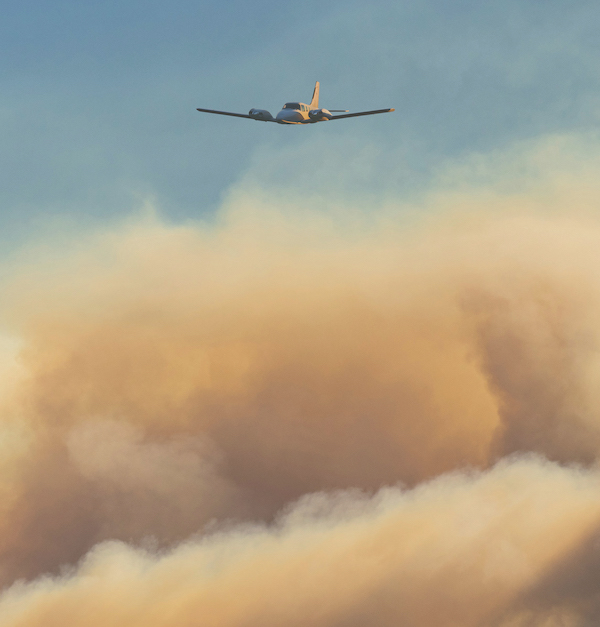
As we approached the fire zone, the sky took on a different character. The horizon shifted to a dense yellow hue— thick smoke and suspended particulate muting the light and flattening the landscape below. It didn’t resemble ordinary haze; it felt heavy.
In the back seat, my daughter asked quietly, “Is that normal?”
I answered yes. But if I’m honest, the reassurance came from clearance— not conviction.
Wildfires create powerful convective columns. Heated air rises aggressively, and those columns do not stop neatly at the altitude printed in a NOTAM. The TFR defines airspace boundaries. It does not define the limits of vertical energy.
Moments later, the airplane reminded me of that.

The vertical speed indicator began to rise—500 feet per minute, then 1,000. I brought both engines to idle immediately and pushed the nose forward. The pitch angle steepened— nearly 20 degrees down.
The airplane kept climbing. Passing through 10,000 feet, I transmitted: “Unable to maintain assigned altitude.”
The climb continued—11,000, then 12,000 feet. ATC issued an unrestricted altitude block, removing the assigned altitude constraint so I could focus solely on aircraft control.
Then, just as abruptly, the vertical vector reversed. The VSI swung downward. The Seneca entered a rapid descent—3,000 to 4,000 feet per minute. I eased the yoke back gradually, managing energy and load factor until the descent stabilized around 6,000 feet MSL.
The engines sounded normal. The controls felt intact. We were intact. But the margin had narrowed more than I care to admit.
A Delta Airlines aircraft had been monitoring the frequency and heard the entire exchange. After I regained control, ATC asked whether there were injuries onboard or suspected aircraft damage—clear evidence they understood the seriousness of what had just occurred.
Shortly afterward, that Delta flight was cleared through the same general area at a higher altitude. The crew responded immediately: “Unable.” There was no hesitation. Clearance does not equal obligation.
Lessons Learned
The Seneca II is a capable IFR platform. But no piston twin can overpower a wildfire-induced convective column.
Under 14 CFR 91.3, the pilot in command is the final authority as to the operation of the aircraft. I had seen the TFR. I had built in an avoidance route. I had questioned the vector. But I did not draw the final line.
What stays with me is not the altitude excursion. It is my daughter’s question—and how quickly I answered.
I have logged more than 3,500 hours in various aircraft. Experience is not measured in time; it is measured in the decisions that reshape the next one. This flight reshaped mine.
If conditions exceed your comfort or performance margin, say “unable.” The most important authority in the cockpit is not the clearance you receive. It is the decision you make to accept it.
Brett Henley is a Tennessee-based aviator, flight instructor, and member of the Warren County Airport Board. With more than 3,500 hours of flight time and certifications as an Airline Transport Pilot (ATP), Multi-Engine Instructor (MEI), Certified Flight Instructor– Instrument (CFII), and Certified Flight Instructor (CFI), Brett has dedicated his aviation career to flying, teaching, and mentoring the next generation of pilots. Send questions and comments to editor@piperflyer.com.

