Close Menu
Piper Flyer AssociationPiper Flyer Association
  • Home
  • Members
    • Member Dashboard
    • Parts Locating
    • Edit Profile
    • Member Benefits
    • Renew
  • Forums
  • Piper Models
    • Piper Singles
      • Piper Cubs
      • Piper PA-11, PA-12, PA-14
      • Piper Short Wing
      • Piper PA-18 Super Cub
      • Piper PA-24 Comanche
      • Piper Pawnees
      • Piper PA-28 Cherokee
      • PA-32 Series
      • Piper PA-38 Tomahawk
      • Piper M Series
    • Twin Engine
      • Piper PA-23 Apache/Aztec
      • Piper PA-30 Twin Comanche
      • Piper PA-31 Series
      • Piper PA-34 Seneca
      • Piper PA-42 Cheyenne
      • Piper PA-44 Seminole
  • Magazine
    • ONLINE MAGAZINES
      • 2026 ONLINE MAGAZINES
      • 2025 ONLINE MAGAZINES
      • 2024 ONLINE MAGAZINES
      • 2023 ONLINE MAGAZINES
      • 2022 ONLINE MAGAZINES
      • 2021 ONLINE MAGAZINES
      • 2020 ONLINE MAGAZINES
      • Prior Years
    • Article Archive
      • Maintenance & Technical
      • Other Popular Articles
    • Featured Articles
  • Knowledge Base
    • Aviation News
    • Aviation Alerts
    • Videos
    • Annual Checklist
    • Piper Flyer Sponsors
    • Keep Your Piper Ownership Affordable
  • Login
  • Join
Free Newsletter
What's Hot

Missions of Honor’s Yellow Ribbon Honor Flight honors veterans as part of EAA AirVenture Oshkosh 2026 activities

Garmin brings revolutionary SmartCharts to Garmin Pilot Web

Southwest Airlines bringing ‘Independence One’ to EAA AirVenture Oshkosh 2026

Facebook X (Twitter) Instagram
Join PFA Renew
Piper Flyer Association
Free Newsletter Login
  • Home
  • Members
    • Member Dashboard
    • Parts Locating
    • Edit Profile
    • Member Benefits
    • Renew
  • Forums
  • Piper Models
    • Piper Singles
      • Piper Cubs
      • Piper PA-11, PA-12, PA-14
      • Piper Short Wing
      • Piper PA-18 Super Cub
      • Piper PA-24 Comanche
      • Piper Pawnees
      • Piper PA-28 Cherokee
      • PA-32 Series
      • Piper PA-38 Tomahawk
      • Piper M Series
    • Twin Engine
      • Piper PA-23 Apache/Aztec
      • Piper PA-30 Twin Comanche
      • Piper PA-31 Series
      • Piper PA-34 Seneca
      • Piper PA-42 Cheyenne
      • Piper PA-44 Seminole
  • Magazine
    • ONLINE MAGAZINES
      • 2026 ONLINE MAGAZINES
      • 2025 ONLINE MAGAZINES
      • 2024 ONLINE MAGAZINES
      • 2023 ONLINE MAGAZINES
      • 2022 ONLINE MAGAZINES
      • 2021 ONLINE MAGAZINES
      • 2020 ONLINE MAGAZINES
      • Prior Years
    • Article Archive
      • Maintenance & Technical
      • Other Popular Articles
    • Featured Articles
  • Knowledge Base
    • Aviation News
    • Aviation Alerts
    • Videos
    • Annual Checklist
    • Piper Flyer Sponsors
    • Keep Your Piper Ownership Affordable
  • Login
  • Join
Piper Flyer AssociationPiper Flyer Association
Renew
Home » Topics » Main Forum » MAINTENANCE » Red Fin

Red Fin

  • Index
  • Recent Topics
  • Search
  • Index
  • Recent Topics
  • Search
Login

Posted In: MAINTENANCE

  • Participant
    STEVE on June 9, 2022 at 2:41 pm #21431

    Hi David,
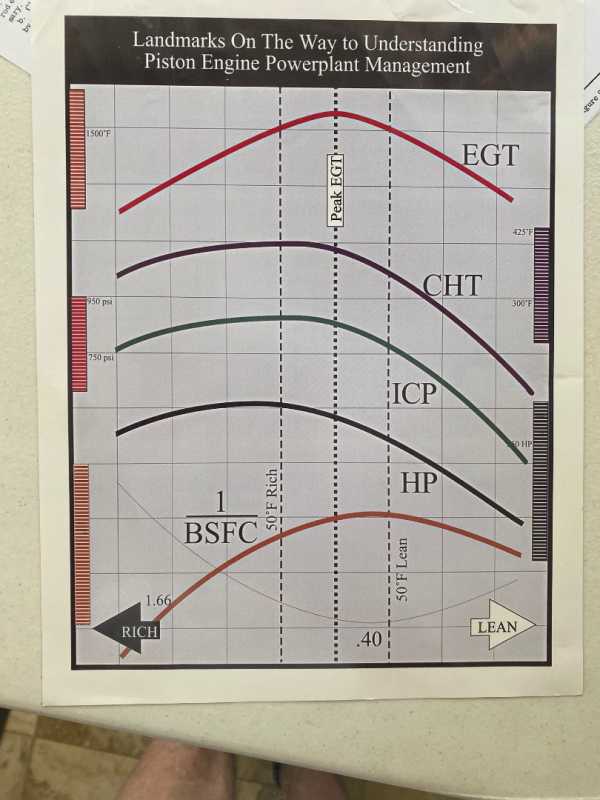
    I’ve gone back and studied my Advanced Pilot Seminar notes and remembered that the red box/red fin is where the mixture produces the highest internal combustion pressures, CHTs and EGTs are at peak or near peak.
    One of the instructors, John Deakin (who wrote a very interesting series titled “Pelican’s Perch” on Avweb) told me this, “If you’re at 65% power of so, 50 deg F ROP (rich of peak) probably won’t get you in trouble and will give you close to maximum power for that manifold pressure and RPM. But the fact is that 50 deg F ROP will produce the absolute hottest possible temperatures for all parts of the engine.”
    I have attached a chart that shows the relationship between EGT, CHT, Internal Combustion Pressures (ICP), HP and Brake Specific Fuel Consumption to better illustrate this.
    Best,
    Steve GAMILandmarksChart.jpg
    Participant
    David on May 18, 2022 at 1:46 pm #21409

    I received a response from GAMI so was very thankful for that.
    Although there was no specific failure mode associated with the “Red Box”, it is associated with reduced engine life and as such there are no catastrophic failures associated with it. This probably explains some of the controversy.

    I appreciate the lead.

    Participant
    David on May 11, 2022 at 6:41 am #21391

    Thanks Steve, looks like a good place to start.
    Dave

    Participant
    STEVE on May 10, 2022 at 8:21 am #21386

    Hi Dave,
    The red fin or red box came out of a class developed by General Aviation Modifications, Inc, also known in the industry as GAMI.
    GAMI is based in Ada, OK and is headed by George Braly. Everything Savvy Aviation passes on came from GAMI.
    GAMI hosts what it calls the Advanced Pilot seminars. Years ago I sat in class for 2 days when the class was presented in Ada. Two of the presenters are no longer able to work so the Advanced Pilot seminar is now an online course. You can access is at http://www.advancedpilot.com.
    I would start your search there.
    Best,
    Steve

    Participant
    David on May 5, 2022 at 6:12 pm #21377

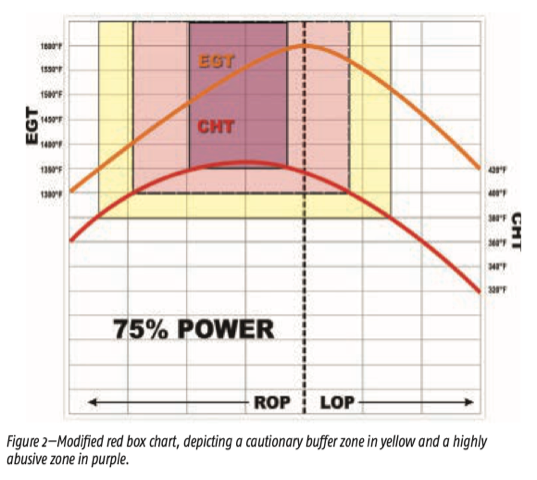
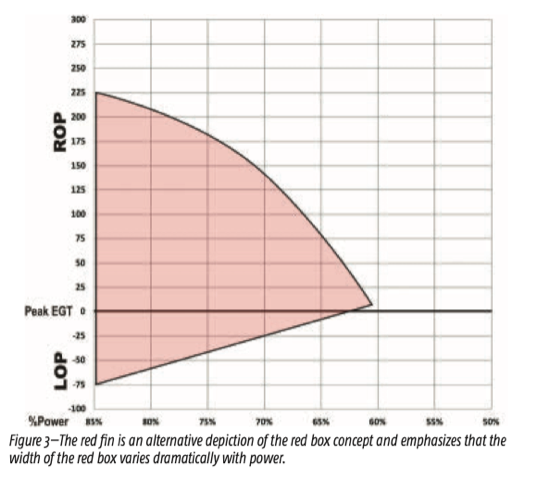
    Having taken some college courses in internal combustion engines (I’m an engineer), going through my textbooks (2 volume set of “The Internal Combustion Engine in Theory and Practice), and using some of my career in ignitions, I think I have some familiarity with engines. When operating a typical small airplane piston engine, the EGT and CHT as a function of load and mixture looks like this below. These are taken from https://resources.savvyaviation.com//wp-content/uploads/articles_eaa/EAA_2012-12_red-box-red-fin.pdf but are typical of what a lot of resources present. Seems like everyone references these diagrams. My basic question is what is the stressor or failure mode that is driving the “red box” or “red fin”? Some articles indicate high cylinder pressures, but the would create more torque and doesn’t coincide with the peak power mixture (providing the pressure/angle curve doesn’t get altered somehow). Detonation might be a possibility but increasing the octane rating doesn’t seem to alleviate this problem. My best guess is strictly thermal, especially since the CHT peaks right at the center of the Red Box. I’ve toyed with created a lumped parameter model of the piston and cylinder but haven’t gotten around to it yet. The articles that I’ve researched don’t seem to be specific with respect to this failure or stressor, so I’m hoping someone could shed some light on this. (or at least get me a contact at Lycoming I can have a conversation with)

    Thanks for the help!
    Dave P

    Attachments:
    • PastedGraphic-1.png
    • PastedGraphic-2.png
Viewing 5 posts - 1 through 5 (of 5 total)
  • You must be logged in to reply to this topic.
Log In

Piper Flyer Association is the trusted resource for Piper aircraft owners and pilots, providing expert maintenance guidance, ownership support, and safety information for Piper airplanes.

About Us

  • Mission Statement
  • Our Values
  • Who We Are
  • Contact Us
  • Mission Statement
  • Our Values
  • Who We Are
  • Contact Us

Site Info

  • Advertise
  • Privacy Policy
  • Terms of Service
  • Cancel/Refund
  • Advertise
  • Privacy Policy
  • Terms of Service
  • Cancel/Refund

Membership

  • Join
  • Events
  • Benefits
  • Join
  • Events
  • Benefits

Get In Touch

1042 N Mountain Ave Ste B #337 Upland, CA 91786
Email:
 kent@aviationgroupltd.com
Contact: 626-844-0125

Free Newsletter
Facebook X (Twitter) Instagram

All rights reserved. PIPER FLYER ASSOCIATION. © 2004-2026 All Rights Reserved

Type above and press Enter to search. Press Esc to cancel.

In order to provide you with the best online experience this website uses cookies.

By using our website, you agree to our use of cookies. Learn more

Functional Always active
The technical storage or access is strictly necessary for the legitimate purpose of enabling the use of a specific service explicitly requested by the subscriber or user, or for the sole purpose of carrying out the transmission of a communication over an electronic communications network.
Preferences
The technical storage or access is necessary for the legitimate purpose of storing preferences that are not requested by the subscriber or user.
Statistics
The technical storage or access that is used exclusively for statistical purposes. The technical storage or access that is used exclusively for anonymous statistical purposes. Without a subpoena, voluntary compliance on the part of your Internet Service Provider, or additional records from a third party, information stored or retrieved for this purpose alone cannot usually be used to identify you.
Marketing
The technical storage or access is required to create user profiles to send advertising, or to track the user on a website or across several websites for similar marketing purposes.
  • Manage options
  • Manage services
  • Manage {vendor_count} vendors
  • Read more about these purposes
View preferences
  • {title}
  • {title}
  • {title}

Sign In or Register

Welcome Back!

Login below or Register Now.

Lost password?

Register Now!

Already registered? Login.

A password will be e-mailed to you.