


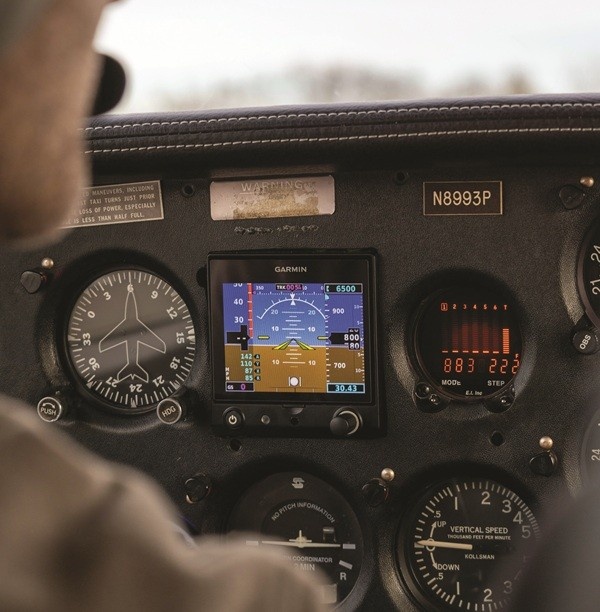
Electronic attitude indicators offer improved reliability, safety, and functionality—often without the cost or complexity of a full glass-panel overhaul. Here’s what to consider before making the swap in upgrading your Piper attitude indicator.
By Troy Whistman
Walking up to a typical legacy General Aviation (GA) single-engine aircraft, pilots may be greeted by the familiar “six-pack” of round analog instruments—altimeter, airspeed, attitude, heading, turn coordinator, and vertical speed. These “steam gauges” have defined the flying experience and the look of aircraft panels for decades. But in recent years, a new wave of electronic “glass” instrumentation has offered compelling alternatives that promise enhanced safety, reliability, and situational awareness.
For aircraft owners, the decision to replace steam gauges with glass instruments is a significant one. It involves not just personal preference, but also regulatory considerations, installation logistics, cost, and, above all, a careful analysis of what best fits the mission and budget. Some choose to do a complete panel overhaul, cutting a new panel that houses flat-screen PFDs and MFDs, new radios, and more—at great expense. But there are other options for those whose wallets and ambitions are more restrained.
In this article, we’ll examine the reasons pilots may choose to replace their analog attitude indicator (AI) with an electronic unit, what options exist for the certified General Aviation market, the realities of installation, and what you can expect during—and after—the transformation.
Why upgrade?
Many GA aircraft still retain their original panels, which, for anything built before the early 2000s, almost always means mechanical-gyroscopic flight instruments. While safe and serviceable, several situations might encourage an owner to consider an upgrade to newer electronic instrumentation.
The first reason to consider an upgrade is reliability issues. For those with pneumatic-driven AIs, the vacuum (or pressure) pump system and its associated hardware are known failure points. While wet pumps tend to be less failure-prone than dry pumps, they’re not invincible either. Filters and tubing must be kept maintained to ensure reliable service. Any instrument-rated pilot who trained on round gauges knows how critical it was to develop and maintain “partial-panel” skills; attitude indicator failures in IMC have claimed the lives of many a pilot (and their passengers).
The internal spinning gyros themselves—whether pneumatically or electrically driven—are also known failure points. The typical gyros in an aircraft’s attitude indicator spin at approximately 15,000 rpm—this high rotational speed is needed to provide enough gyroscopic rigidity to resist changes to its plane (no pun intended) of rotation, allowing for accurate indications of aircraft attitude throughout maneuvers.
To achieve such high rotational speeds, gyros spin on very precise bearings. Over the years, these can wear down, leading to more friction, creating drag that slows the gyro. Perhaps you’ve heard this wear and drag after shutting down, as a noisy attitude indicator’s gyro spins down.
Contamination and loss of lubrication can also create problems. Filters are placed in the supply lines for pneumatically driven AIs to help prevent this issue, but dust, oil, or moisture can get inside the unit and impede the gyro’s ability to achieve rated RPM. As lubricants break down, the gyro may not spin as freely, further increasing wear and causing the AI to become sluggish—or worse, present incorrect or laggy information.

Reliability can also be affected by internal parts that can wear, get slightly out of balance, or even bend over time due to vibrations, bumps, or just old age. In electrically powered gyros, old wiring can offer increased resistance, and old motors can produce less “oomph,” causing the gyro to spin more slowly than it used to.
When any of these happen, the attitude indicator might show the wrong pitch or roll, lag behind actual aircraft movement, or even tumble completely.
The traditional way to address these issues was to send your AI out for an overhaul or order a new mechanical AI. That’s still an option, but many pilots are choosing to take a step into the future and increase reliability by simply replacing their mechanical AI with an electronic one with no moving parts, without doing a fullbore glass panel upgrade.
A second reason to consider upgrading is improved safety and situational awareness. Not only are electronic AIs more reliable than mechanical ones, making flight in IMC less worrisome, but many of them also do much more than display the attitude of the aircraft. Some units can integrate with your GPS navigator and integrate data from multiple sources. These external inputs, combined with sensors internal to the electronic AI, give you the ability to see attitude, heading, airspeed, altitude, and nav data on a single display, simplifying your instrument scan and reducing head movement.
Third, an upgrade can remove significant weight from the aircraft, especially for pneumatically driven AIs. If you don’t need that vacuum pump to operate boots, door seals, or another instrument in the panel, your mechanic may be able to remove the entire vacuum system from the aircraft when an electronic AI is installed.
Have you been thinking about swapping out your mechanical AI for a modern electronic version in your Piper? Let’s look at some of the options available to you if you’re considering this approach.
Today’s certified electronic AI retrofit options
The market for certified standalone electronic attitude indicators has grown rapidly and matured significantly. Garmin, uAvionix, Mid- Continent, RC Allen, Bendix King, and L3 all offer FAA STC’d options for you to choose from. In this story, we focused on single-instrument replacement units. If you’re willing to replace more than one instrument (i.e., attitude and heading indicators) at the same time, additional options we didn’t cover, like the Aspen Evolution series, become available.
We’ve compiled a list of commonly available options (as of late 2025) in the table below, highlighting specific models, their approximate price in USD (before installation and options such as battery backup), key features, and the form factor of each unit.
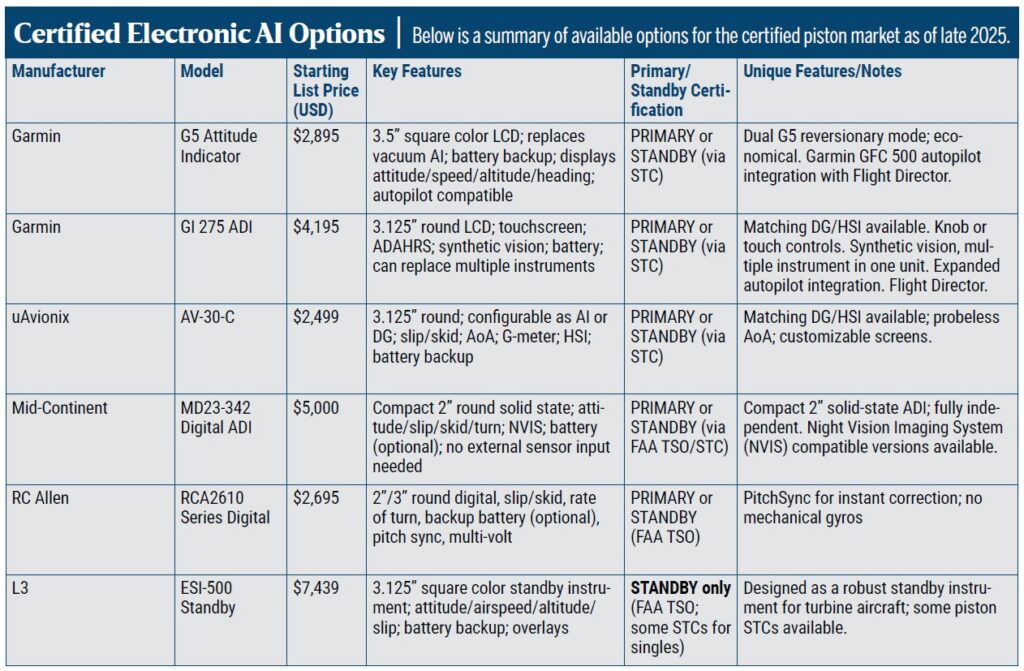
Some units have been recently discontinued and thus may suffer from availability issues, and some are certified as standby (backup) options only; we’ve included notations where that is applicable to help guide your decision.
This list is not exhaustive. If you’ve selected another certified option for your Piper, we’d love to hear which unit you chose to install and your experience with it. Write to us at editor@piperflyer.com.
Installation considerations
While your typical A&P can swap out your mechanical AI with a replacement unit, you’ll probably find that most of them will encourage you to use an experienced avionics shop to replace it with an electronic unit. There’s typically more work involved—and that might include integration with your radios, autopilot adapters, rewiring, routing/tapping into pitot-static plumbing, removal of a vacuum system and its components, and panel modifications if needed. You may even need to have a fresh pitot-static check done after the work is complete, which is something an avionics shop can get done for you.
Labor for single-instrument electronic replacements (such as the Garmin G5 or GI 275, uAvionix AV-30, RC Allen RCA 2610, or Mid-Continent MD23-342) typically ranges from 16-24 hours per instrument. Still, it can run longer when time for any supporting work is added. Total installed cost (hardware plus labor for one instrument) is typically $5,000-$7,000, depending on local shop rates and any optional features you might add. This may sound like a lot, but it’s a drop in the bucket compared to the $70,000+ figures we’ve seen folks spend for full glass panel replacements (such as Dynon SkyView and Garmin G3X Touch).
With the current demand for avionics upgrades, shops often quote lead times of several months, and delays are common, especially if parts are backordered or schedules are full. It’s advisable to check both the availability of hardware and shop scheduling before committing to an upgrade.
Also discuss the shop’s policies on hardware acquisition, deposits, and their warranty coverage on labor and parts. Some shops require you to pay up front (or make a deposit) to secure a slot, and they order your parts in advance so they’re ready and on-site when you show up. Others don’t require any deposit yet still order your parts in advance (on their dime), as was my experience with Sarasota Avionics in Florida. My point is, shop around and ask questions to avoid surprises.
Some pilots may choose to do a “piecemeal” approach, swapping out a single vacuum AI with its modern electronic equivalent, simply because the gyro or vacuum pump died, and that’s the end of it. Others may embrace a rolling modernization effort: integrating new digital attitude indicators, radios, GPS navigators, engine monitors, and maybe even an autopilot over time, as budget allows, and as equipment fails or ages out. You’ll choose what’s best for you and your airplane, your flying style and budget, and your tolerance for downtime.
Final thoughts: Is it worth it?
With prices for standalone electronic flight instruments declining, options increasing, and the used market increasingly favoring glassequipped aircraft, the case for at least partial modernization grows stronger each year. Enhanced reliability, improved safety, increased aircraft value, and lower long-term maintenance costs are all strong motivators.
For most owners, the best approach is that of informed decision-making. Study your options. Check your aircraft’s eligibility (STC coverage). Plan for shop lead times. Ensure regulatory compliance. And, perhaps most importantly, consider how any changes impact your flying and training.
Transitioning from steam to glass does require some adaptation, particularly for instrument-rated pilots. Glass instruments often present more information, sometimes in non-traditional layouts (tape gauges, synthetic vision, color codes, numeric values versus trend needles, and where-oh-where is that slip-skid indicator now?!). Many organizations and CFIs recommend several hours of transition instruction and simulated IMC before flying IFR after a panel upgrade. It’s not just learning to interpret the new instrument; pilots must also master the menu logic and failure modes of modern systems.
In closing, the modernization of GA instrument panels is extremely well supported by avionics manufacturers— just don’t expect that the journey from pneumatics to pixels is as simple as swapping out a few instrument panel screws.
Associate Editor Troy Whistman and his wife Teresa fly out of the North Central Texas area. He particularly enjoys using aviation as a tool to help others; thus, he flies for and is on the board of Angel Flight South Central and believes that flying kids for Challenge Air is some of the most rewarding flying he has done. Send questions or comments to editor@piperflyer.com.
Resources
PFA SUPPORTERS
OTHER
KELLY MANUFACTURING CO. (RC Allen Instruments)

