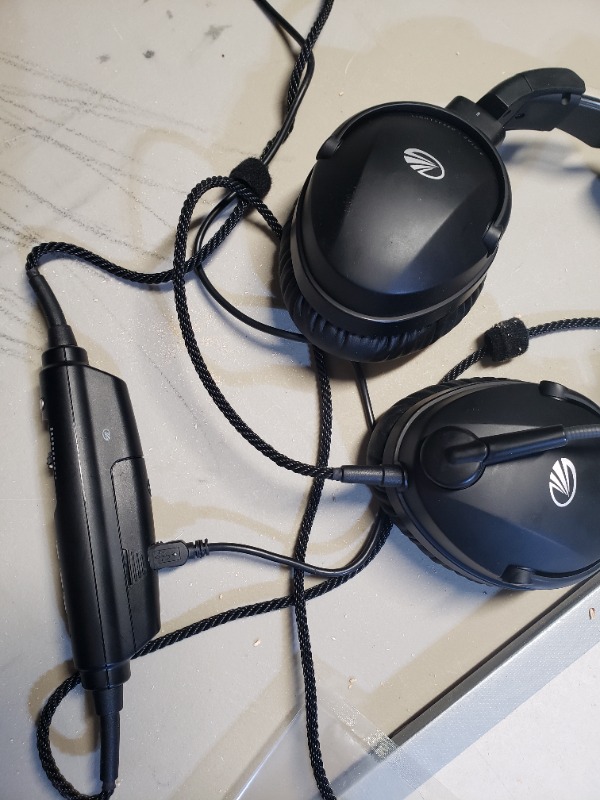
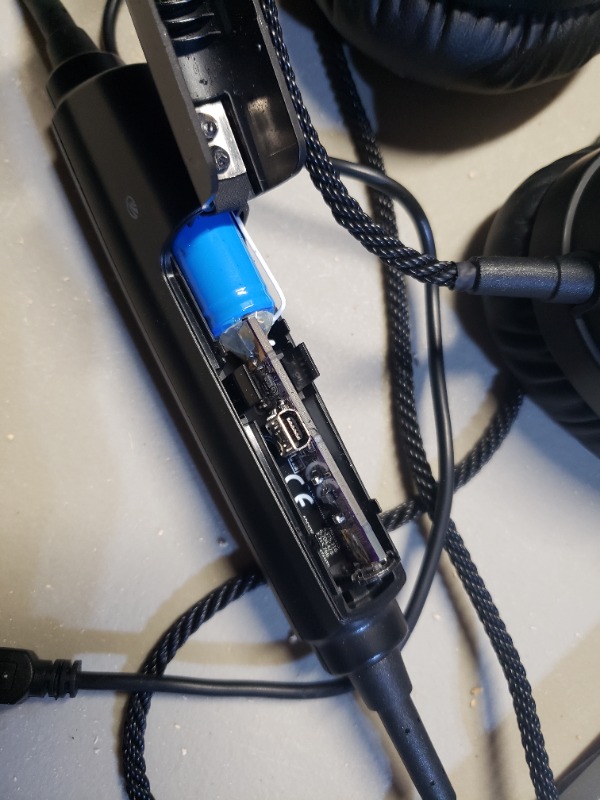
Here are the updated files for the board with the ferrite bead pi-filter on the USB power.
Attachments:
BatteryCharger.pdf
Lightspeed Zulu 4 Li-Ion Conversion
-
Follow Up:
I have used the headsets with the battery charger/USB support installed. I did have to make a modification to the schematics (update coming soon) in which I had to install a pi-filter (ferrite bead + capacitors) on the USB power input. The USB power ports on the avionics that I have are quite noisy (when compared with the chargers that come with your cell phone). Once the pi-filter was fitted into the circuit, the system worked much better.
There is no interference with the audio system, nor with the radios. The headsets work just like normal, and audio is quite good. I have tried the unit unplugged, and the audio quality is identical to using AA batteries. When plugged into my particular avionics (Mid-Continent USB/Digital Clock) there is still a very subtle high-frequency noise . This noise was not present in the USB cell-phone charger that I used for bench testing. Therefor the noise must be coming from the avionics USB power source.
Anyhow, not a bad upgrade for about $20 in parts. Would do it again with any other AA powered headsets.Aaron
I have attached the schematics, bill-of-materials, and the gerber files to make the PCB. The battery I purchased from Batterspace.com, and used OshPark to make the PCB. The battery charger IC, U2, is the hardest part to put on, but with a hot-air gun or other reflow soldering tools it is easy. This might work for other headset control units out there, but I have only used it with the Lightspeed Zulu 4 unit.
The 3-volt regulator is sized to provide sufficient current when the bluetooth is enabled, but Lightspeed would never provide me with the actual maximum current draw of the control unit. So I had to do an educated guess from the data which was available (run time on AA batteries).
My overall design goal was to maximize the battery life when not charging and the unit is just sitting waiting to be used. As the circuit has to be active all the time, I needed to minimize the quiescent current draw. The largest current consumer is the regulator. From my calculations it will take about 65 days for this circuit to use 10% of the battery capacity. I figured that should be fine, as I typically fly/use the headsets more often than that.
Aaron Kahn
Attachments:
BatteryCharger.pdf
BatteryCharger.zipHi Arron,
I too have noise cancelling modules that use AA batteries on my headsets.I “solve” the dead battery problem by carrying a selection of batteries needed for proper operation of the headsets, and some other battery-powered devices in a molded battery carrier that holds AA, and 9 volt batteries.
But I really like your creation. Fortunately I installed a two outlet USB plug I got from Guardian Avionics (www.guardianavionics.com) a couple of years ago. I use one of the outlets to power my iPad, but the other is free.
Are you willing to share the build instructions, and wiring schematic so that other readers can make this mod?
Thanks,
Steve
I was always a bit disappointed with having to use AA batteries for the control unit on my Zulu 4 headsets. To solve this issue, I have designed, built, and successfully tested a circuit board and li-ion battery replacement for the 2 AA batteries normally used. The system allows the control unit to be connected to a USB port to charge the li-ion battery and power the headsets. The headsets can run alone on the battery for longer than on the AA batteries.
For the battery I used a 14500 Li-Ion single cell (the same size as 1 AA battery). The power board was sized to fill in the space of the other AA battery, and holds the charger IC, power path controller, and 3 volt regulator. A USB-mini connector provides the input for the charger/power-path controller. Total cost for the entire project including the board, battery, and parts was about $24.
I have done some extensive testing on the ground, and the headsets work just fine both connected to the USB charger and on battery power alone. I am looking forward to flying with my new setup.
I have attached some images of the setup and the board/battery installed in the control box.Aaron Kahn
Attachments:
20251012_172253.jpg
20251012_172306.jpg
20251012_172317.jpg
- You must be logged in to reply to this topic.