Close Menu
Piper Flyer AssociationPiper Flyer Association
  • Home
  • Members
    • Member Dashboard
    • Parts Locating
    • Edit Profile
    • Member Benefits
    • Renew
  • Forums
  • Piper Models
    • Piper Singles
      • Piper Cubs
      • Piper PA-11, PA-12, PA-14
      • Piper Short Wing
      • Piper PA-18 Super Cub
      • Piper PA-24 Comanche
      • Piper Pawnees
      • Piper PA-28 Cherokee
      • PA-32 Series
      • Piper PA-38 Tomahawk
      • Piper M Series
    • Twin Engine
      • Piper PA-23 Apache/Aztec
      • Piper PA-30 Twin Comanche
      • Piper PA-31 Series
      • Piper PA-34 Seneca
      • Piper PA-42 Cheyenne
      • Piper PA-44 Seminole
  • Magazine
    • ONLINE MAGAZINES
      • 2026 ONLINE MAGAZINES
      • 2025 ONLINE MAGAZINES
      • 2024 ONLINE MAGAZINES
      • 2023 ONLINE MAGAZINES
      • 2022 ONLINE MAGAZINES
      • 2021 ONLINE MAGAZINES
      • 2020 ONLINE MAGAZINES
      • Prior Years
    • Article Archive
      • Maintenance & Technical
      • Other Popular Articles
    • Featured Articles
  • Knowledge Base
    • Aviation News
    • Aviation Alerts
    • Videos
    • Annual Checklist
    • Piper Flyer Sponsors
    • Keep Your Piper Ownership Affordable
  • Login
  • Join
Free Newsletter
What's Hot

Missions of Honor’s Yellow Ribbon Honor Flight honors veterans as part of EAA AirVenture Oshkosh 2026 activities

Garmin brings revolutionary SmartCharts to Garmin Pilot Web

Southwest Airlines bringing ‘Independence One’ to EAA AirVenture Oshkosh 2026

Facebook X (Twitter) Instagram
Join PFA Renew
Piper Flyer Association
Free Newsletter Login
  • Home
  • Members
    • Member Dashboard
    • Parts Locating
    • Edit Profile
    • Member Benefits
    • Renew
  • Forums
  • Piper Models
    • Piper Singles
      • Piper Cubs
      • Piper PA-11, PA-12, PA-14
      • Piper Short Wing
      • Piper PA-18 Super Cub
      • Piper PA-24 Comanche
      • Piper Pawnees
      • Piper PA-28 Cherokee
      • PA-32 Series
      • Piper PA-38 Tomahawk
      • Piper M Series
    • Twin Engine
      • Piper PA-23 Apache/Aztec
      • Piper PA-30 Twin Comanche
      • Piper PA-31 Series
      • Piper PA-34 Seneca
      • Piper PA-42 Cheyenne
      • Piper PA-44 Seminole
  • Magazine
    • ONLINE MAGAZINES
      • 2026 ONLINE MAGAZINES
      • 2025 ONLINE MAGAZINES
      • 2024 ONLINE MAGAZINES
      • 2023 ONLINE MAGAZINES
      • 2022 ONLINE MAGAZINES
      • 2021 ONLINE MAGAZINES
      • 2020 ONLINE MAGAZINES
      • Prior Years
    • Article Archive
      • Maintenance & Technical
      • Other Popular Articles
    • Featured Articles
  • Knowledge Base
    • Aviation News
    • Aviation Alerts
    • Videos
    • Annual Checklist
    • Piper Flyer Sponsors
    • Keep Your Piper Ownership Affordable
  • Login
  • Join
Piper Flyer AssociationPiper Flyer Association
Renew
Home » Topics » Main Forum » PIPER MODELS » PA-28 » Manuals

Manuals

  • Index
  • Recent Topics
  • Search
  • Index
  • Recent Topics
  • Search
Login

Posted In: PA-28

  • Participant
    STEVE on September 16, 2024 at 9:04 am #22756

    Good Morning James;

    Thanks, it was fun pulling that data out of the 180E POH (Owners Manual). 
    I have had a lot of success typing the manual name into Google and finding that the manuals I’m seeking are free online.

    Good luck,
    S

    Participant
    James Grahn on September 14, 2024 at 5:51 pm #22755

    Thanks so much Steve. You are a wealth of knowledge. I do know how to use them. But my manual has no where near the info that your -180E does. There are no performance charts. I’ll see if I can track one of those -180E manuals down.
    Thanks again.

    Participant
    STEVE on September 14, 2024 at 4:34 pm #22754

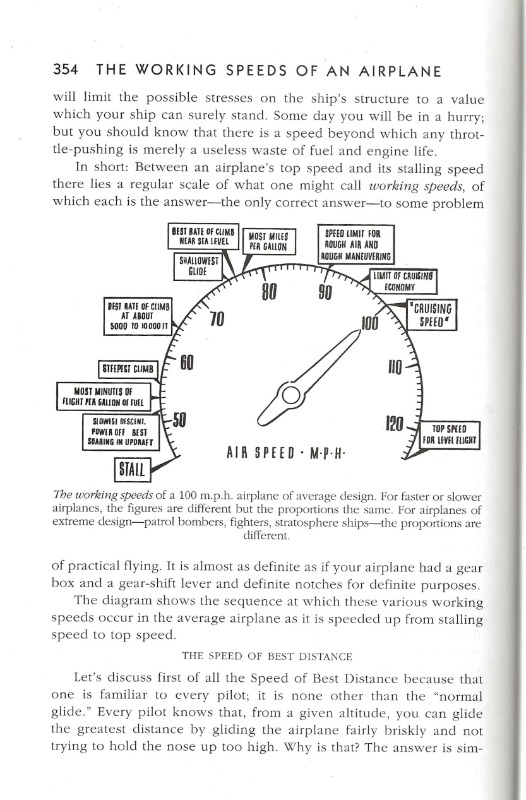
     SpeedsOfAnAirplane.jpgForgot to attach the chart

    Participant
    STEVE on September 14, 2024 at 4:25 pm #22752

    Hi James,
    I have a PA 28 180 E manual, and while it’s nowhere near as expansive as later manuals I believe patient study will lead you to the information you need.
    I have found stall speeds at different weights, suggested landing speeds, and speeds and fuel consumption numbers at various altitudes and power settings. 
    According to the 180E manual the flaps up stall speed is 67 mph, and the flaps down stall speed is 57 mph at MTOW (gross wt)

    You can extrapolate from these numbers using a chart in Wolfgang Langwiesche’s book “Stick and Rudder,” a classic flying manual.
    In the chapter titled “The Working Speeds of an Airplane” Langwiesche explains what speed to fly at if you want to get the most miles per gallon of fuel; the speed of best distance (which is normal glide speed), how to stretch your fuel against a wind, and the speed of best duration.

    I’ll attach his chart to this answer. The speeds are predictable. See if you can extrapolate what they would be for your airplane. 

    Let’s go through one a flight using data in the 180E book.

    Plan a flight from your airport (home ‘drome) to a point 500 nm away. For the sake of this exercise we will choose a flight over low terrain without any appreciable wind.
    Lets also presume that you are loading your airplane to the Maximum Take off Weight (MTOW) of 2400 pounds with a full fuel load (50 gallons).

    According to the landing and takeoff performance charts you should be able to lift off after a ground run of approximately 750 feet and get over a 50 foot obstacle in approximately 1650 feet (at sea level) If your airport is at 3000’ MSL, the two numbers would be approx 825 and approx 2150 feet.

    You climb out at the suggested cruise climb speed of 100 mph; you’re planning to cruise (and the hemispheric cruising rule suggests) 7,500 feet. 

    You rate of climb will decrease from about 770 ft/min to 370 ft/min at 7,500 feet. If we average those two climb rates we get an average climb rate of 570 feet/min. It takes about 13 minutes to get to 7500. Since 13 minutes is approx 21 percent of an hour we can determine that in that 13 minutes we’ve traveled 21 miles. 

    Next we set the engine power for cruise power. According to the manual, the preferred power setting for cruise is 75% power. 
    According to the power setting chart in section V, 75% power is just attainable at 7000 ft. but 70% power is attainable up to 9000 feet so we will cruise at 70% power by running the engine at 2590 rpm. According to the True Airspeed and rpm vs Density Altitude chart in the Performance section of the 180E manual this will result in a 138 mph cruise speed. 

    One place the 180 E manual falls down is providing the full throttle fuel consumption. I have a Lycoming Operator’s Manual for the 360 series engines. For an O-360 A series engine full throttle and 2700 rpm will  yield a fuel consumption of around 16.5 gph. As I mentioned earlier 70 percent cruise yields 9.3 gph. 

    Fuel consumption estimates are 13 minutes at a maximum consumption of 16.5 gph equals around 3.5 gallons. Then we settle down (on our fictitional flight) burning 9.3 gph.

    We have approximately 479 miles left. Divide 479 by 138 for an estimated time enroute of approximately 3.5 hours. Based on our fuel computations we should have 3.5 times 9.3 gph and that 21 % of the 16.5 gph (3.465 gallons) for the full throttle climb segment of the flight yields an expected fuel consumption number of 32.55 + 3.4565 for a total fuel burn of just a schosh over 36 total gallons. 

    It looks like we’re safe to make this flight under VFR fuel planning margins since our total fuel consumption is right around 36.01 gallons. 

    I hope I haven’t misunderstood your question, but it seems to me that most of the pre flight and inflight planning numbers you need are in the 180E and earlier manuals. 

    Please let me know if I’ve been any help, or if there’s anything I’ve misunderstood. 

    Best,
    Steve

    Participant
    James Grahn on September 13, 2024 at 8:51 am #22751

    I have asked a similar question before, but I’m trying to teach my neighbors 14 year old to fly and want to get it right.  I have a 1962 PA28-180. On your suggestion, I bought a duplicate Airplane Flight Manual.  Unfortunately, back in those days, they really didn’t have much useful information in them.  I’m specifically looking for planning charts with weights and speeds.  I have an Information Manual for a PA28-161 from 1976 that has numbers in it, but I hesitate to use them as it is a different model.  Is there a better manual that can be used?  The immediate need is published Vx, Vy, and Vso.  Shortly I’ll need the XC planning stuff.
    Thanks a bunch,
    Jim

Viewing 5 posts - 1 through 5 (of 5 total)
  • You must be logged in to reply to this topic.
Log In

Piper Flyer Association is the trusted resource for Piper aircraft owners and pilots, providing expert maintenance guidance, ownership support, and safety information for Piper airplanes.

About Us

  • Mission Statement
  • Our Values
  • Who We Are
  • Contact Us
  • Mission Statement
  • Our Values
  • Who We Are
  • Contact Us

Site Info

  • Advertise
  • Privacy Policy
  • Terms of Service
  • Cancel/Refund
  • Advertise
  • Privacy Policy
  • Terms of Service
  • Cancel/Refund

Membership

  • Join
  • Events
  • Benefits
  • Join
  • Events
  • Benefits

Get In Touch

1042 N Mountain Ave Ste B #337 Upland, CA 91786
Email:
 kent@aviationgroupltd.com
Contact: 626-844-0125

Free Newsletter
Facebook X (Twitter) Instagram

All rights reserved. PIPER FLYER ASSOCIATION. © 2004-2026 All Rights Reserved

Type above and press Enter to search. Press Esc to cancel.

In order to provide you with the best online experience this website uses cookies.

By using our website, you agree to our use of cookies. Learn more

Functional Always active
The technical storage or access is strictly necessary for the legitimate purpose of enabling the use of a specific service explicitly requested by the subscriber or user, or for the sole purpose of carrying out the transmission of a communication over an electronic communications network.
Preferences
The technical storage or access is necessary for the legitimate purpose of storing preferences that are not requested by the subscriber or user.
Statistics
The technical storage or access that is used exclusively for statistical purposes. The technical storage or access that is used exclusively for anonymous statistical purposes. Without a subpoena, voluntary compliance on the part of your Internet Service Provider, or additional records from a third party, information stored or retrieved for this purpose alone cannot usually be used to identify you.
Marketing
The technical storage or access is required to create user profiles to send advertising, or to track the user on a website or across several websites for similar marketing purposes.
  • Manage options
  • Manage services
  • Manage {vendor_count} vendors
  • Read more about these purposes
View preferences
  • {title}
  • {title}
  • {title}

Sign In or Register

Welcome Back!

Login below or Register Now.

Lost password?

Register Now!

Already registered? Login.

A password will be e-mailed to you.