


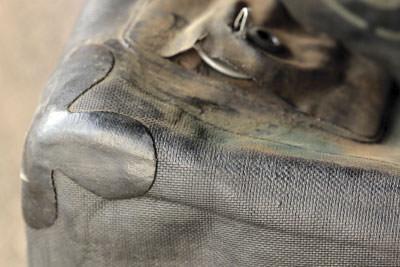
Contributing editor and A&P Steve Ells recently installed an FFC fuel bladder in the left tank of his 1960 Comanche.
I open the cabin door of my airplane to start my preflight inspection I’ve been catching a whiff of Avgas.
I checked around the shaft of the fuel selector thinking that fuel was wicking up past the selector shaft seal, but didn’t see the telltale blue stain. I pretzel-ed myself into position to double-check, and risked (more?) brain damage by sucking in a big whiff.
Nope, that wasn’t the source of the leak.
I looked in the engine compartment—maybe there was a leak there? But a thorough visual inspection didn’t reveal any blue staining.
Uff da, I thought to myself. This lack of evidence narrows the source of the smell to one of the fuel bladders—one of the “rubber bags” snugly hidden away inside the fuel tank bay of the wing.
I removed the wing root fairing and saw it: a small blue stain.
It wasn’t very big, yet it was there.
Bladder backstory
According to one source, fuel bladders were installed in Piper airplanes for two reasons. First, the military used bladders because it thought that the bladder—being flexible—was much less likely than an aluminum or integral tank to burst during a crash.
And second, installing a bladder—even the semi-stiff bladders manufactured 70 years ago—took less time than manufacturing and welding up a rigid tank or sealing the wing structure to create an integral tank.
Causes of fuel bladder failure
The most common cause of bladder failure is porosity of the upper surface.
It’s pretty well known that fuel bladder life is maximized by keeping the tank as full as possible. This lessens plasticizer loss by keeping temperatures moderated.
But the breakdown of the upper surface is inevitable and when it gets to a certain point, fuel starts to evaporate out of the tank.
I had noticed that the fuel level in the left tank had dropped by an inch or so between flights; another sure sign the fuel was evaporating out the porous top surface of the tank.
I needed a bladder and after checking with a couple of trusted techs for suggestions, ordered one from Floats & Fuel Cells (FFC) in Memphis, Tenn.
FFC technology
A few days after ordering, a big box arrived. I was surprised at how light it was, but after opening the box and inspecting the new bladder, I understood why.
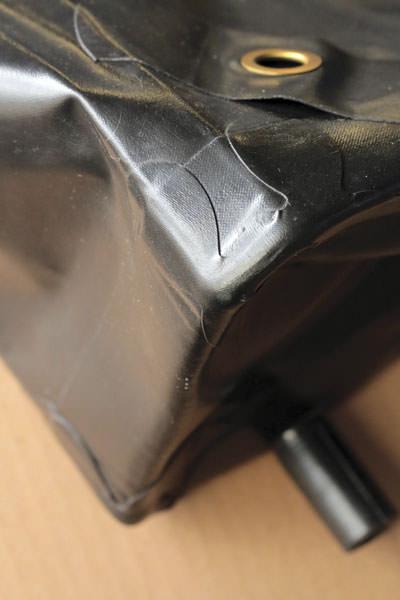
New fuel bladders from Floats & Fuel Cells are very flexible and are visibly smoother than the old, semi-rigid bladder. Sort of like the difference between a 1960 Cadillac El Dorado and a 2015 Tesla.
Each corner of my new bladder tank is rounded and each potential wear point and corner is smoothly reinforced. According to Brewer, this is because bladders from FFC are cured in an autoclave that melds all the parts together by utilizing temperature and pressure to create a one-piece unit.
And it’s light. The weight of the 30-gallon bladder is 4.9 pounds.
Modern bladder-style tanks from Floats & Fuel Cells are constructed of a proprietary P2393 nitrile rubber. Nitrile combines “excellent resistance to petroleum-based oils and fuels, silicone greases, hydraulic fluids, water and alcohols with a good balance of such desirable working properties as low compression set, high tensile strength and high abrasion resistance,” according to one reference book. The only drawback is a low resistance to attacks by ozone.
FFC’s bladders consist of a four-layer construction. The layers (from inner to outer) are a nitrile layer that retards permeability; a transparent fuel vapor barrier that’s bonded to a nylon fabric layer; and an outer layer of nitrile rubber formulated to resist ozone attacks.
Remove and replace
I flew the fuel level in the left bladder down to six gallons before siphoning the remaining fuel into grounded fuel cans. (Important: Always establish a ground between the aircraft and the fuel cans to prevent static electricity from spontaneously igniting the fuel vapors.)
I next removed the large access (top) plate and the fuel quantity sender from the top of the wing and removed the screws and bolts connected to the reinforcing/mounting ring molded into the top of the bladder.
I tried to wrestle the old semi-rigid bladder out and up through the access hole, but soon realized there was a vast difference between the new, flexible, lightweight FFC bladder that I had just unpacked and inspected and the semi-rigid heavy bladder that was leaking.
I needed enough room to shove most of my right arm down inside the old bladder to free the feed nipple and pull loose the clips holding it in position.
I took the easy way—I cut the old bladder into pieces. It was a good decision; a box knife and scissors was all it took. That transformed the process of working in the tank bay from an arm-bruising struggle into an easy job.
The rate-determining step in the removal of older bladder tanks is getting the fuel feed nipples that are molded into each bladder to release from the rigid airframe fuel feed lines. The bladder in my Piper Comanche has a single feed nipple located in the aft inboard corner of the tank.
Due to my prior experience in struggling to pull an old bladder free of the feed line, I spent at least an hour using my box knife to cut away sections of the nipple from the feed line. It wasn’t difficult because the nipple was old and brittle.
Not content with that, I then spent time spraying Kroil between the nipple and the feed line after I had shoved a small pointed punch between the two surfaces. (This penetrating oil spray is designed to free up frozen hardware, but I figured that since it penetrates so well it would work to break the seal between the nipple and the rigid feed line.)
I worked the punch—and sprayed the Kroil—between the feed line and the nipple from the wing root and from inside the tank. Then I went home for the day.
The next day I applied straight pulling pressure and to my surprise the bladder nipple slid easily off the fuel feed line and over the coarse screen at the end of the line. Removal complete!
They don’t last long?
There’s a tale that has been passed along at the preflight planning table and in the pilot’s lounge that bladders don’t last long and that they’re very hard to change. Hogwash.
Six years ago, I changed the right bladder in my airplane. This year, I changed the left bladder.
The left bladder was manufactured in 1957 and installed in 1959 in my 1960 vintage airplane. There’s a maintenance logbook entry citing, “Replaced fuel tanks” in late 1988.
This led me to believe that both bladders had been removed, sent out, repaired and reinstalled, since both bladders I removed had the original U.S. Rubber part numbers, serial numbers and acceptance dates. Thirty years before the first repair is not short-lived. (For more information, take a look at “Refurbish, Repair or Replace: What do to when your fuel bladder fails” in the December 2013 issue of Piper Flyer. —Ed.)
Some are repairable (and some aren’t)
There were at least four different bladder tank manufacturers in the past. These companies included industry powerhouses such as U.S. Rubber, BF Goodrich, Firestone and Goodyear Aerospace.
There were good construction methods and some that weren’t so good—some bladders are very repairable and some are not. Companies in the refurbishment business know which bladders are good candidates for overhaul. (For a link to table on the FFC website with specifics on which brands/types can be repaired, see Resources at the end of this article. —Ed.)
My Comanche’s original tanks had a cotton-based construction. According to Kevin Brewer at FFC, those U.S. Rubber 584 bladders would not be repaired today. The right one lasted 22 years after being refurbished, the left one 28 years.
There are at least two other companies that produce and sell bladder-type fuel cells.
Clips and hangers
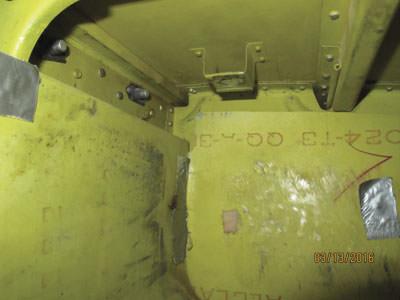
Bladder-type tanks are fabricated to fit as perfectly as possible within the fuel tank bay inside the wing. The Floats & Fuel Cells bladder arrived with a new gasket, a roll of industrial-strength, fabric-backed tape and nine button-type spring clips.
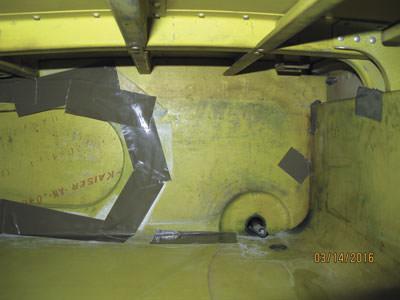
The tape is used to prevent tank abrasion. It’s laid over all rivet and screw heads and all seams within the fuel tank bay prior to installing the bladder. The tank bay of my Piper was very clean, so all I had to do was remove the old tape and install new tape.
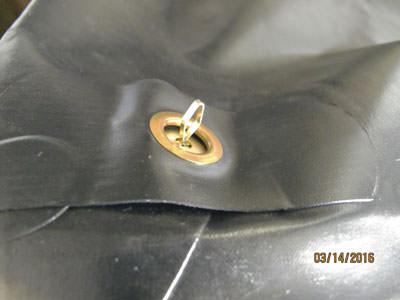
The clips slip under a reinforced ring attached to the outside surface of the bladder. There’s a ring/clip in each bottom corner of the tank that’s there to keep the bottom of the bladder wrinkle-free.
The bladder in my airplane holds 30 gallons. It’s shaped like a rectangle except for the forward corner of the inboard section which extends forward; it’s like a triangular piece was grafted onto the rest of the rectangle.
There are five clips that need to be pushed into receptacles to hold the upper surface of the bladders in position. All of the removal, installation, flow nipple and clip installation work has to be done through the access hole in the top of the wing.
It’s important to use the new clips and to get them snapped into the receptacles without bending them.
AD 68-13-03 applies to the bladder tanks in my PA-24 Comanche. It requires a visual inspection every 100 hours to check the condition of the clips. So installing new clips—and installing them correctly—is important.
Since the bladder in my Piper is small, I didn’t have any problem with arm length/finger strength issues during clip installation.
Finishing up
One part of the installation is difficult. Two half-inch (inside diameter) flexible tubes need to be slid over tube ends attached to the metal top plate and tube ends mounted in the wing. These tubes connect the top plate fuel spill drain-off tube and the fuel tank vent line tube.
Once these tubes are slid into position, the reinforcing/mounting ring of the bladder has to be pulled up into position so the screws connecting the two can be started and torqued.
My solution to pulling the bladder reinforcing/mounting ring up into position—since the top plate completely fills the access hole, thereby cutting off access to the bladder—is to fabricate two long aligning pins out of bolts.
These are screwed into nut plates in the bladder mounting ring prior to sliding the flexible tubes onto the wing mounted tubes.
Once the top plate is in position I pull up on the aligning pins—which are nothing more than long bolts with the heads cut off—and start screwing in the screws that hold the top plate and the reinforcing/mounting ring together.
Calibrating a dipstick
After the bladder is in and is deemed ready, I like to fill the tank in five-gallon steps—with the airplane on level ground and the landing gear struts and tires at normal inflation—for two reasons: this is the perfect time to make up a fuel tank quantity dipstick (I know I sound like a dipstick salesman, but they work and they are a simple safety tool) and it allows you to make sure you know exactly how much fuel your new bladder holds.
A new bladder should provide good service for at least 20 years, and likely much longer if steps are taken keep the top surface of the bladder cool.
Do this by shading the top surface of the wings whenever possible and by striving to top off the fuel tanks after each flight since the fuel will moderate bladder surface temperatures by acting as a heat sink. Hangaring an aircraft is the most effective method for preserving its fuel bladders.
Know your FAR/AIM and check with your mechanic before starting any work.

Steve Ells has been an A&P/IA for 44 years and is a commercial pilot with instrument and multi-engine ratings. Ells also loves utility and bush-style airplanes and operations. He’s a former tech rep and editor for Cessna Pilots Association and served as associate editor for AOPA Pilot until 2008. Ells is the owner of Ells Aviation (EllsAviation.com) and the proud owner of a 1960 Piper Comanche. He lives in Templeton, Calif. with his wife Audrey. Send questions and comments to editor@www.piperflyer.com.
RESOURCES >>>>>
– PFA supporter

