


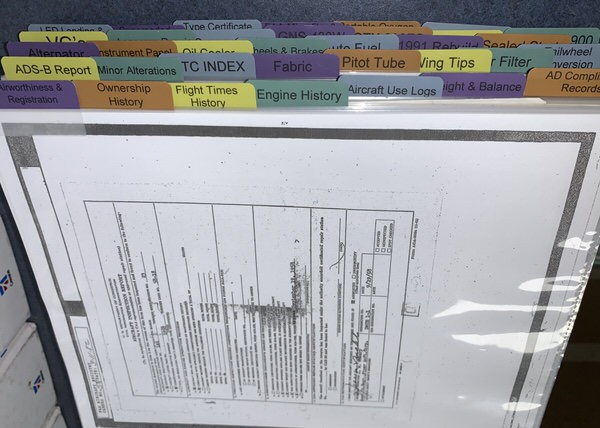
MATTHEW McDANIEL takes us into the world of paper cuts, coffee stains, and jumbled masses of aircraft paperwork to describe how you can transform chaos into a neatly-filed and organized masterpiece that will simplify—and add value to—your aircraft ownership experience.
By Matthew McDaniel
While not every aircraft has a baggage compartment, every aircraft carries baggage. That is to say, whether young or old, aircraft have histories. Due to the regulatory requirements that control aircraft certification, production, registration, and maintenance, aircraft carry their history (in the form of paperwork) with them as they age, more so than any other modern form of transportation. Compounding the issue, aircraft (both commercial and private) also tend to live longer lives than most road vehicles.
However, not all aircraft record-keeping is equal. Well-organized aircraft paperwork can be beneficial in many ways. It can decrease maintenance costs and downtime, thus increasing utility and reliability. It can bolster safety through increased awareness of past issues and items to watch. Most of all, it can increase an aircraft’s value, whether a sale is imminent or not.
That one random box
It seems that the sale of most aircraft over a year or two old comes with a variety of miscellaneous items. You’ll obviously get the maintenance logbooks and various manuals. But there also always seems to be an extra box of stuff. That box is most often filled with papers. Random receipts, parts manuals, FAA Form 337s, installation manuals, etc.
It’s not at all uncommon for the box to be thrown into a corner of the hangar or home office and forgotten. Yet, that box of random paper often holds hidden value…or can even make the difference between your aircraft operating 100% legally or not.
Of course, the older the aircraft, the bigger the box. If the plane has a history involving commercial operations, it likely has many more hours than an owner-flown pleasure aircraft of the same age. More hours + more maintenance = more paperwork. The paperwork box is likely small if the plane is in its factory stock configuration and has only been updated to keep pace with legal requirements. On the other hand, if the plane has been heavily modified, updated constantly to keep pace with changing technologies, or “tricked out” to eke out every knot of speed or ounce of efficiency, the box is likely much larger.
Whatever the case, it is a truly rare owner who has every piece of paper well organized. It’s not that every previous owner was a chaotic slouch. It is more often the case that one or two previous owners fell behind, started “the box” and then just never caught up (or kept falling further behind). Subsequent owners may have been superb record keepers during their time of ownership but never found the time to clean up the mess of paperwork they inherited.
With each passing year and owner, what’s in the box becomes more mysterious and can also lose perceived value/relevance. That doesn’t have to be the case; organizing your plane’s paperwork can be educational and valuable.
One bite at a time
Like the old joke, one must proceed one bite at a time when eating an elephant. The key to emptying the box and organizing its contents (and all your aircraft’s documents) is to have a priority list and a plan of action.
I’ve helped manage a variety of aircraft over the past 30 years. In each case, I have made it a point to organize the aircraft’s paperwork. A fascinating history always unfolds along the way, deep learning occurs, and everything about owning/managing the aircraft becomes easier thereafter.
So, what are some important items to know, document, and organize?
- Certification and Production Documents
- Aircraft Logbooks
- Supplemental Type Certificates (STCs), Service Bulletins (SBs), and Major Repair/Alteration History
- Minor Alterations History
- Flight Time History
- Engine History
- Weight & Balance History
- Ownership History
The best place to start with any such project is to order your aircraft’s complete record from the FAA. This is delivered on a CD-ROM, which can be ordered from the FAA for only $10. See Resources for an ordering link. Turnaround time is typically under two weeks. The CD-ROM usually contains two files:
- Registration History (Bills of Sale, Registration Applications, Certificates of Registration, and Mortgage Loan & Bank Records).
- Airworthiness History (FAA 337 Major Repair/Alteration Forms, STCs, associated drawings and documents).
The FAA CD-ROM can be viewed, saved, and printed on most computers. It makes an excellent source for cross-referencing aircraft logbook entries and random STC or 337 paperwork you’re trying to make sense of.

Organizing your documents
The most straightforward process for me has been to create one document for each category above and use these to organize the data my research reveals. Those documents should be created in a program you’re comfortable with and be easy to update (to encourage you to do so whenever necessary). The following are what I usually use for the document categories/titles:
Certification and Production Documents
The FAA’s CD-ROM often has the aircraft’s Production Certificate and Type Certification Data Sheet included. If not, they are easy enough to find on the FAA website and/or via web searching. Both are great historical documents, and the latter can also be helpful for maintenance questions.
Logbooks
Most any owner/pilot knows that having an aircraft’s logbooks throughout its full life span is a significant value booster. Missing logbooks are always a concern for buyers, and it can indicate sloppy ownership and record keeping in the past and/or a desire to hide something (like damage history).
Complete logs going back to the date of manufacture resolve any such concerns. They are so valuable that I highly recommend they be scanned/digitized (for backup) and stored in a fire-proof container.
After getting the FAA CD-ROM and the logbooks, I usually start a deep-dive audit of the logs, using the FAA records for cross-reference. Thus begins the process of learning your aircraft’s history, not just in terms of maintenance performed, but when and how often it was flown, any extended periods of downtime, documented damage history/repairs, modifications, and when any major components were overhauled.
STC, SB, and Major Repair/Alteration History
The “box” almost always contains Form 337s and/or documents related to STCs, SBs, or major repairs. They might not even be specific to your aircraft but rather copies of 337s filed for other aircraft, which were used as a reference when your aircraft was modified.
Using these documents, the FAA CD, and log entries, make a chronological chart listing each STC, SB, Major Repair, and Modification/Alteration. Include pertinent data such as the STC number, logbook reference, date completed, and date superseded (if applicable).
For each item, organize the associated documents in a binder and tab them for easy reference. A similar digital record is good, but nothing replaces the original paperwork. Mechanics and future buyers will thank you! To be legal, major changes to your aircraft require this documentation to be submitted to the FAA and retained with the aircraft maintenance records.
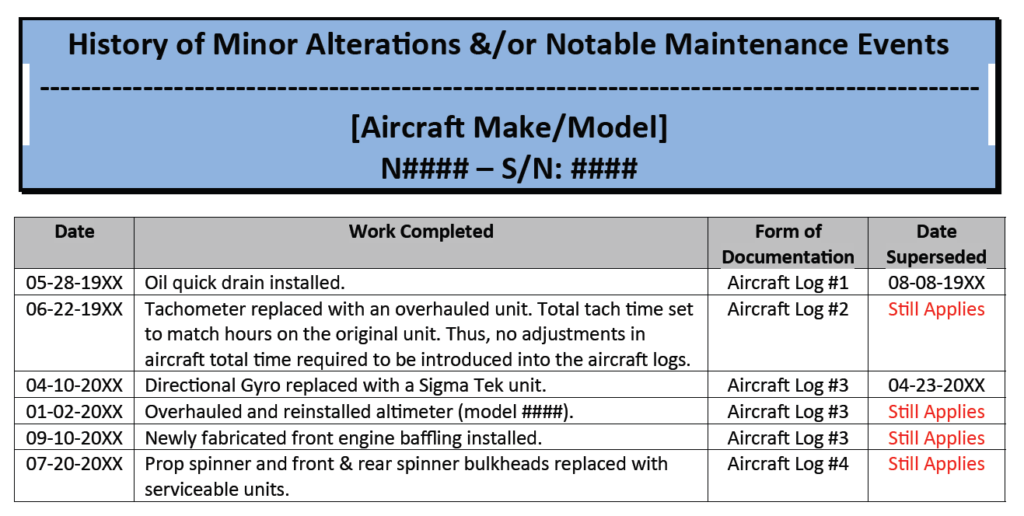
Minor Alterations
These don’t typically generate much paperwork as they only require a logbook endorsement. However, for notable ones, make a chart similar to the one for major alterations so they can be easily located via your note referencing the relevant logbook page.
Flight Time History
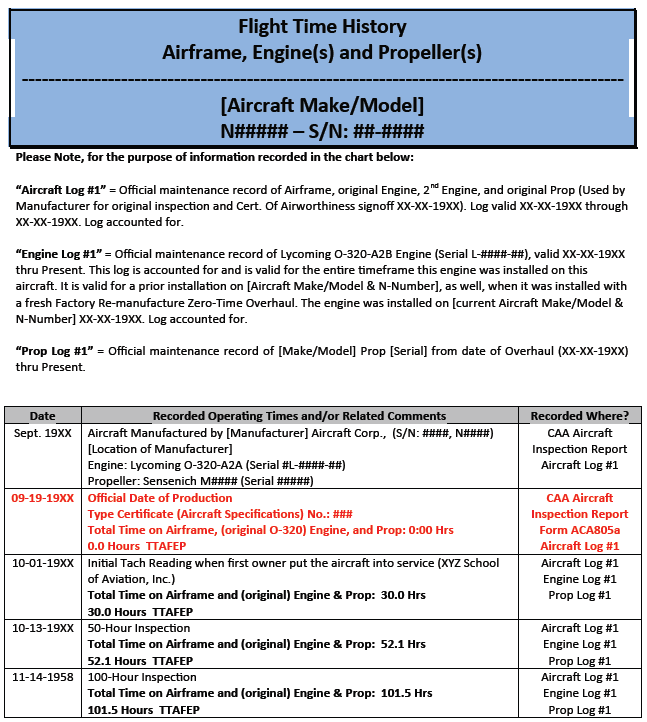
While auditing your aircraft’s logbooks, you’ll note that almost every entry is accompanied by an aircraft time reference: Tach Time, Hobbs Time, Total Time Airframe (TTAF), Time Since Major Overhaul (SMOH), etc.
Every logbook audit I’ve done has found errors in those times. Usually, it’s a simple math error or a number transposition error, which then gets carried into the future (often for years). When such errors occur multiple times across the years, the errors compound.
I’ve found compounding errors that add hundreds of hours to an aircraft’s total time (not great for value) or subtract hundreds of hours from an engine’s total or since-overhaul time (not great for safety). So, as you work through each logbook, verify the times logged. Then, cross reference them between airframe, engine, and propeller logs. Make a document where you input major milestones in your aircraft’s life, the various times it had on that date, and which logbook(s) each input references.
When an error is found, add the details in a notation on this document and keep a running total of those errors. When your audit is complete, a log entry can be made to correct the error(s), endorsed by the A&P who checks your work, and your document becomes the detailed evidence of how such errors were identified and corrected. Continuing to audit every new entry put into the logs and updating your Flight Time History document should trap any future errors before they propagate.
Engine History
If you don’t have the original paperwork for your engine(s) detailing the date of manufacture, serial number(s), etc., the manufacturer can be contacted to provide that data (assuming they are still in business). If it’s an older engine, the manufacturer usually has information on any factory overhaul or re-manufacturing the engine has undergone.
This info, your logs, and the logbook audit you perform can be used to make an Engine History document like the Flight Time document detailed above. Knowing and having easy access to the complete history of your engine(s) is a significant safety—and value—booster.
Weight & Balance History
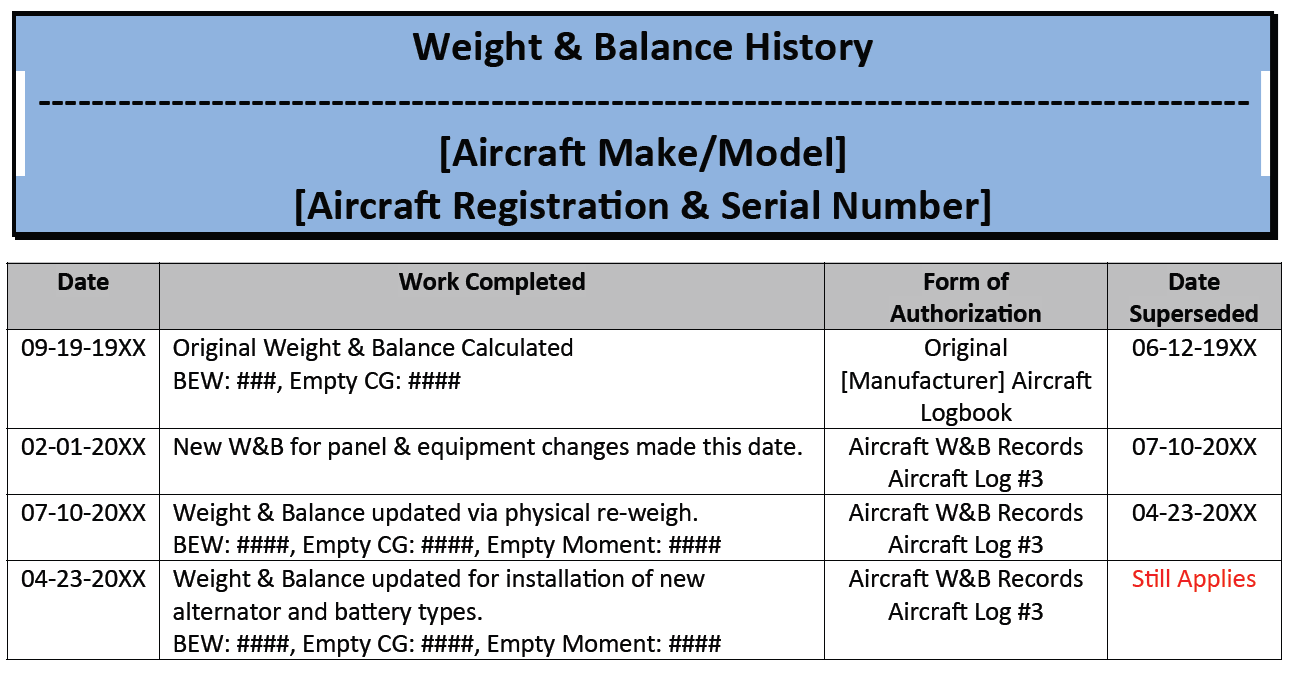
Superseded weight & balance (W&B) documents are often in the box. Only the current W&B is required to be onboard the aircraft. However, previous W&Bs can provide insight into how the aircraft has changed over the years. I always endeavor to turn up as many W&B references as possible via stray documents and logbook entries. From those, a document with the changing empty weight and C.G. numbers can be made, including effective and superseded dates. (Math errors can occur in these documents, too. It never hurts to double-check the calculations, especially if it’s been a while since the aircraft was weighed. —Ed.)
Ownership History
The FAA disc is invaluable in determining who previously owned your airplane. From there, it’s usually easy to determine the geographical area it was based in (and for how long). If your airplane is decades old and has transitioned through multiple owners, this can also be a fascinating research project. Interesting things invariably turn up, like sales to one’s spouse or kids, Delaware corporations, LLCs, factory dealers, bank loans, defaults, and periods of heavy use or disuse. (“Interesting” can mean unpleasant things, too. For example, evidence of old uncleared liens can show up in this research. —Ed.)
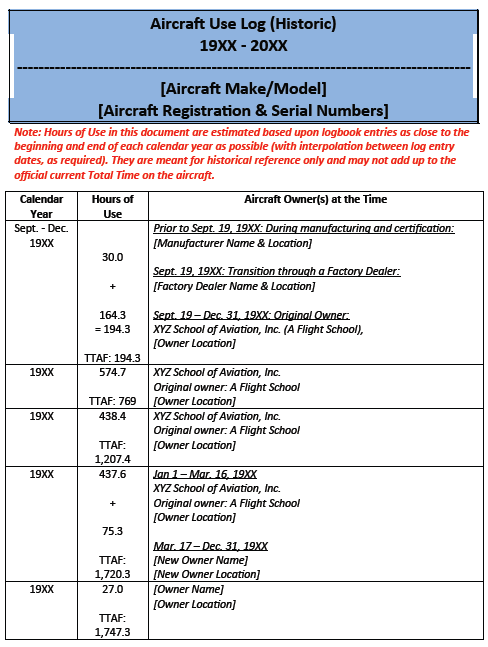
Historical Use Logs
Cross-referencing your Ownership History document against dates in the maintenance logs, it’s easy to determine when and how much each owner flew the plane and who owned it when any damage happened or repairs, upgrades, or alterations were done.
I like to complete this document in annual increments to detail how much the aircraft flew each calendar year. If multiple owners are involved in the same year, interpolate between maintenance log entries and sales documents to determine which owner flew what portion of the total hours. You could denote the airframe’s total time at the end of each calendar year, as well.
Ongoing Use Logs
Most owners seem to have some sort of use log to track their usage and/or document business versus personal usage. You can use this document to update the Historical Use Logs at the end of each year. For this log, input whatever parameters are important to you. Flight times, of course, but also oil added, fuel used/remaining, passenger names, routes flown, etc.
Recycling the box
With your logbook audits complete, you’re probably starting to see the bottom of the box!
I use two large three-ring binders to hold the newly organized physical documentation. One is dedicated to the aircraft itself. It starts with the history documents detailed above, followed by the production and manufacture documents, and then ongoing maintenance (AD compliance, SB completion, annual inspections, etc.).
Since STC and/or field-approved modifications are critical documents for an aircraft’s legality and value, I organize each into a separate tab within the binder. Tab each aircraft system or item repaired/altered, and insert the associated STC documents, 337 Forms, Continued Airworthiness Instructions, etc.
The second binder is more of an owner’s paperwork collection. Here, you can place your purchase documents, state and federal registration documents, insurance documents, expense spreadsheets, and maintenance receipts.
That old box is almost always teeming with past maintenance receipts. However, most aren’t that important to retain. Do you really need the receipts for those three fasteners you bought from Aircraft Spruce or the oil change performed by your shop six years ago? Probably not. If the receipt is for major maintenance and/or acts as proof of purchase for anything with an active warranty, it’s definitely worth keeping. But only by filing it away in an organized fashion can it be easily located when needed. Otherwise, it’s just more box filler for the next owner.
Once the box of stuff that came with your plane is empty, please break it down and recycle it. You’re well-organized now and have the tools to stay that way!
Editor’s note: Examples of the documents that McDaniel uses to organize his paperwork are attached below.
Matthew McDaniel is a Master and Gold Seal CFII, ATP, MEI, AGI, and IGI, and Platinum CSIP. In 34 years of flying, he has logged nearly 22,000 hours total and 6,000 hours of instruction given. As owner of Progressive Aviation Services (progaviation.com), he has specialized in Technically Advanced Aircraft and Glass Cockpit instruction since 2001, yet retains a passion for teaching in (and learning about) antique taildraggers. Currently, he’s also a Boeing 737-series Captain for an international airline, holds eight turbine aircraft Type Ratings, and has flown over 135 aircraft types. Matt is one of less than 15 instructors worldwide to have earned the Master CFI designation for 11 consecutive two-year terms. He owns a vintage taildragger which he enjoys flying with his wife, two children, and friends. Send questions or comments to editor@www.piperflyer.com.
Sample Forms
Aircraft Use Log (Historic) (Download Attachment)
Aircraft Make/Model & Registration Number (Download Attachment)
Engine History (Download Attachment)
Flight Time History (Download Attachment)
History of Minor Alterations &/or Notable Maintenance Events (Download Attachment)
History of STC’s, SB’s, and Major Repairs/Alterations (Download Attachment)
Ownership History (Download Attachment)
Supplemental Type Certificate (Download Attachment)
Weight & Balance History (Download Attachment)

