


Q: Hi Steve,
I’m looking for recommendations regarding the best aftermarket air conditioning for a 1968 Piper PA-31 Navajo. Any ideas?
Jeff
A: Hi Jeff,
My research shows that Air Center in Chattanooga markets its Cool Air system for many singles and twins. The company claims it can install a Cool Air system in any 28-volt airplane. However, the PA-31 is not listed on the Air Center website as an aircraft they have converted. Contact Gary Gadberry to see if he can do your Navajo. (The website and telephone number are in Resources at the end of this article. —Ed.)
Just to be clear, I did not see the Cool Air system in the FAA Supplemental Type Certificate listing; but STC listings are not always up-to-date. Since it’s not on the STC listing, make sure you ask how Air Center certifies Cool Air AC systems.
One company that is listed in the STC listings for your aircraft is Air Comm; the STC holder is listed as ACC-KP LLC in Addison, Texas. However, as I wrote above, the STC listings are not always up-to-date. It turns out that Air Comm (now in Colorado) purchased Meggitt, which had previously purchased Keith Air Conditioners.
For what it’s worth, I once installed a Keith air conditioning system in a Cessna Skymaster. The compressor and fan are electrically-powered. Unfortunately, the current draw was very high; something like 50 amps.
Since the two alternators on that Skymaster were 38-amp units, we had to get FAA field approvals to install larger alternators to ensure that there would never be too great a draw on the airplane’s electrical system generating capacity.
Frankly, we were surprised that an STC was granted for this installation without forewarning us of the need to update the alternators. And so was the owner when we explained the need for larger alternators.
In the end, the system worked well, and I have to say it was a very comprehensive and well-engineered installation kit.
Happy flying,
Steve
Q: Hi Steve,
I see about 16 gph fuel flow on my Piper PA-28R-200 Arrow 200 at sea level takeoff power. Strangely, this puts me at about only 75 F rich of peak. I’m seeing 1,400 to 1,450 F egt during takeoff.
Is there a way to increase the takeoff power fuel flow? What fuel flow should I see at full rated power in my Arrow 200?
Baris
A: Hi Baris,
Great question. Let’s look at some statistics about the systems involved.
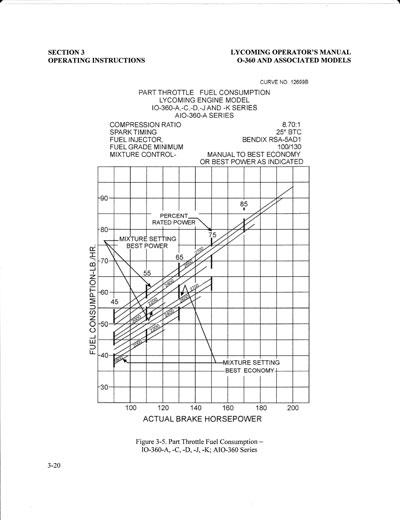
The Lycoming Operators Manual: O-360 and Associated Models is chock full of information about your engine and other Lycoming 360-series engines.
Figure 3.5 in the manual cites a fuel consumption at full rated power (200 hp) of 93.5 pph. 100LL Avgas weighs 6 pounds per gallon at standard temperature. If you divide 93.5 by 6, you’ll see a full-power fuel flow of 15.58 gph.
Based on the data from the performance charts published by Lycoming, you are getting a little more than full-power fuel flow at takeoff.
You said you were seeing a fuel flow of 16 gph at takeoff. I’m going to assume that you’re getting that number from a fuel flow gauge. If your fuel flow gauge is an aftermarket stand-alone gauge or is part of an aftermarket engine monitor such as the ones from Insight, Electronics International or JP Instruments, the fuel flow gph reading will be correct if what’s called the “K-factor” has been properly set during the installation of the gauge.
You can verify the correctness of the K-factor by filling each of your tanks to a recognizable spot; on the filler neck, for instance. Then after taking off on one tank (we will call this tank No. 1), climb to an altitude you’re comfortable with for cruising and leaning. After leveling off, lean the engine in accordance with your normal practice at your normal cruise power setting. Note the time and switch to the other fuel tank (tank No. 2).
Fly without touching the throttle or mixture knobs or climbing or descending for an hour. Note the fuel flow gauge gph reading during the flight. At the end of exactly one hour, switch from tank No. 2 back to tank No. 1 and return to base. When fueling tank No. 2, the amount of the fill should match the gph reading you noted on the fuel flow gauge.
If it doesn’t, you need to adjust the gauge’s K-factor setting. It’s an easy task, though the exact procedure varies by gauge manufacturer. You’ll want to consult the manual for your specific gauge. Continue to adjust the K-factor and check its accuracy with the procedure I just described until you’re within a few tenths of a gallon per hour.
Regarding your temperature readings: you’ll be better served watching your CHT numbers instead of EGTs. Cylinder head temperatures are the most important number during high-power operations. Exhaust gas temperatures should not be of much concern.
If your CHT numbers stay below 400 F during high power operations, you’re getting sufficient fuel flow, no matter what your fuel flow gauge reads.
EGT numbers are used to establish peak EGT when leaning at 75 percent power or lower. Due to many variables such as installation orientation and distance from the cylinder exhaust flange, the actual numeric value of EGTs is not important.
My suggestion is that you pay attention to your CHTs and do the K-factor calibration flight and adjust the K-factor if necessary.
Happy flying,
Steve
Q: Do you have an annual checklist for a Piper PA-28-180 Cherokee that you can send me?
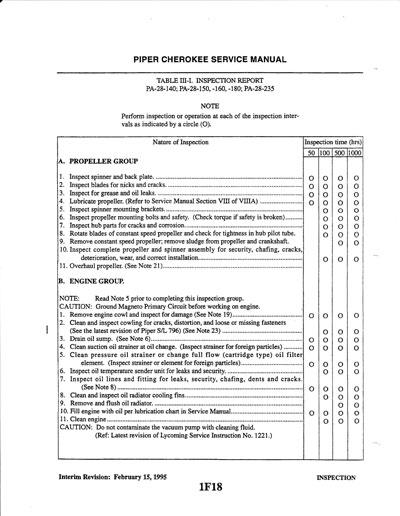
A: You’ll want to get ahold of a copy of the Piper Cherokee Service Manual. The Inspection Report checklist for the Cherokee series begins on the first page of Table III-I (Page 68).
Be sure to read the helpful notes at the end of the checklist—but realize that this list does not include other must-do annual inspection items such as AD research and compliance for airframe, engine, propeller and accessories such as magnetos, spark plugs, induction air filters and so on.
14 CFR Part 43, Appendix D states what items must be inspected in the course of an annual inspection. However, there is no “FAA-approved” annual inspection checklist for your (or any other) airframe. Each repair station or independent shop creates a checklist or uses the checklist in the service manual as a general guideline.
Happy flying,
Steve
Know your FAR/AIM and check with your mechanic before starting any work.
Steve Ells has been an A&P/IA for 44 years and is a commercial pilot with instrument and multi-engine ratings. Ells also loves utility and bush-style airplanes and operations. He’s a former tech rep and editor for Cessna Pilots Association and served as associate editor for AOPA Pilot until 2008. Ells is the owner of Ells Aviation and the proud owner of a 1960 Piper Comanche. He lives in Templeton, California with his wife Audrey. Send questions and comments to editor@www.piperflyer.com.
RESOURCES >>>>>
AIR CONDITIONING
Air Center, Inc.
aircenterinc.com
Gary Gadberry
(423) 893-5444
Air Comm Corp.
aircommcorp.com
ENGINE MONITOR/FUEL FLOW
GAUGES – PFA SUPPORTER
Insight Instruments Corp.
insightavionics.com
ENGINE MONITORS/FUEL
FLOW GAUGES – OTHER
Electronics International, Inc.
buy-ei.com
JP Instruments
jpinstruments.com

