


An in-depth look at FAR 21.9 and Advisory Circular No. 23-27 by aviation legal consultant and A&P/IA Kristin Winter
The FAA keeps an iron grip on the supply of approved replacement parts for Type Certificated aircraft. Replacement parts generally must come from the airframe, engine or propeller manufacturer, or from an approved source that has been issued Parts Manufacturing Approval, commonly referred to as a PMA.
There are some other limited exceptions for what the FAA refers to as “standard” parts, such as nuts, bolts and other hardware manufactured under an industry standard such as AN (Army-Navy) or MS (Military Standard), or parts manufactured by a repair station.
There is one major exception to the FAA’s tight grip, and that is the owner produced part. Owner produced parts are commonly used by the airlines, which often have a large fleet of the same or similar types of aircraft.
Like the owner of a General Aviation aircraft, an airline often wants to avoid the high cost of commonly used parts from the original equipment manufacturer (OEM), so it will reverse engineer and produce batches of parts that are
then used in its fleet. An example might be landing gear bearings that wear
out frequently.
The availability of owner produced parts appears to go back for decades, though the origin is unclear. As it is of biggest benefit to airline operators, there is a major constituency to make sure that owner produced parts remain an available solution for all aircraft owners and operators.
FAA standards and definitions
The FAA sets out the limitations on replacement parts in FAR 21.9.
Paragraph (a)(5) provides that one type of approved part is one that is “roduced by an owner or operator for maintaining or altering that owner or operator’s product.”
This simple statement leaves lots of questions unanswered. One common question is: must the owner or operator physically produce the part themselves? Most GA aircraft owners may not be equipped or sufficiently skilled to make a part in their basement. Fortunately, the friendly FAA has provided an interpretation.
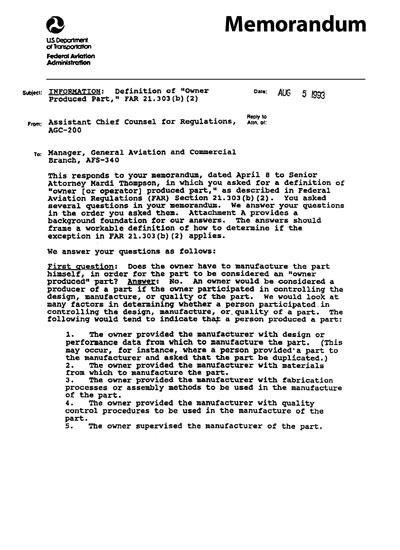
When the FAA renumbered and revised Part 21 in 2009, it specifically made mention in the Federal Register that the interpretation memorandum issued on Aug. 5, 1993 was still operative.
The answer to the first common question as to whether the owner/operator must physically produce the part is clearly no. The FAA memorandum states that “An owner would be considered a producer of a part if the owner participated in controlling the design, manufacture or quality of the part.”
The memorandum goes on to provide five nonexclusive indicia that an owner “participated” in the production of the part (italics added):
1. The person provided the manufacturer with design or performance data from which to manufacture the part. (This may occur, for instance, where a person provided a part to a manufacturer and asked that the part be duplicated.)
2. The person provided the manufacturer with materials from which to manufacture the part.
3. The person provided the manufacturer with fabrication processes or assembly methods to be used in the manufacture of the part.
4. The person provided the manufacturer with quality control procedures to be used in the manufacture of the part.
5. The person supervised the manufacturer of the part.
Responsibility of owners, responsibility of mechanics
So what does this mean to our aircraft owner faced with the unavailability of a critical part, or who is suffering from cardiac arrest at the cost and time delay of obtaining the part from the original equipment manufacturer?
It is important to keep in mind that it is the owner or operator’s obligation to produce a part that is airworthy, meaning that the part conforms to type design and is safe to install in the aircraft.
The installing mechanic’s responsibility is only to make a reasonable assessment that it is an airworthy part and to install it properly. (It will likely help the mechanic feel comfortable if they are provided with a copy of the drawing, the specifications, and/or have been part of the process from the beginning.)

Ways an owner can participate
Two options for owner participation jump out of the memorandum on first blush.
First, the owner can provide the part to an appropriate manufacturer (such as a machine shop) and ask them to duplicate it.
The other option is if an owner supervises the production, which might involve working with the mechanic to fabricate the part. Supervision would not likely require an owner to stand there every moment, but to be reasonably available to provide supervision or answer questions.
In practice, owner supervision might be a little difficult given the likely disparity of knowledge between the owner and the mechanic. However, if the owner is willing to certify in the logs that he or she supervised the production of the part, it is unlikely to be challenged.
FAR 21.9 put into practice
So let’s look at some practical applications. Not long ago, I determined that it was time to replace the flap tracks on my Twin Comanche. I had spoken with another owner who had the same problem, and we agreed to pool our resources to obtain some owner produced parts.
I obtained an exemplar track and sent it to a metallurgical lab for analysis to determine the proper material. The lab charged a bit over $200 for the testing and provided a formal report. The other owner produced a drawing of the part.
Armed with material and drawing, we had a couple of ship sets made. The cost was about $75 each, and the sets were created in five working days (turnaround can vary depending on how busy the shop is), compared to a cost of over $300 each from Piper and a wait of unknown duration.
We clearly met the first example of conditions that qualified me as participating in controlling the design of the part. (See photo, top of page 26.)
Some considerations
One of the most useful options for the aircraft owner is the specific acknowledgement by the FAA legal memorandum that an owner may provide the part and ask that it be duplicated.
There is one complexity here in that many machine shops can duplicate a part, but are not equipped to determine what material it was made from. That might mean that the owner will need to resort to the metallurgical testing lab as we did with the flap tracks.
Consideration must also be given to whether the part had any protective coating which should be duplicated. This could mean having the completed part anodized or cadmium plated.
All of this may make it uneconomical to use the owner-produced exception if one is simply trying to avoid purchasing an overpriced bushing from the manufacturer.
This is an area where an active type club that maintains a database of parts that have been owner produced—and possibly test results, and even CNC programs—can be most helpful. There appears to be no requirement that participation in the design requires an owner to reinvent the drawing, material specs, etc.
Gray areas remain
There are some gray areas still, even with the FAA’s memorandum. Take, for instance, a retractable gear single with a loose bushing where the nosegear pivots. The boss in the mount is worn slightly oversized so that bushing is no longer a press fit.
To use a new OEM bushing would require removing the engine, removing the mount and sending the mount out for repair. The cost could easily exceed $5,000.
A repair involving an oversized bushing might be a cost effective solution, provided your mechanic is comfortable making that repair.
As the owner, you send the bushing to the lab and sketch out a drawing with the dimensions that have the bushing .001 inch wider than the factory.
With the material specification in hand and the dimensions, you may then have a machine shop fabricate one. I have done this with great success and the only way I could tell a new OEM bushing from the oversized one was to get out a micrometer. (See photo, bottom left.)
Success here will require a mechanic comfortable with the oversized bushing being an acceptable minor repair, so it is important to discuss this with your mechanic before embarking on such a repair.
It is not unreasonable for the mechanic to ask the owner to make a logbook entry that they provided a part produced under FAR 21.9(a)(5) and provide the information used for its manufacture.
Why not use a commercially available part?
Any discussion of owner produced parts seems to raise the question about whether an owner can just go and buy the part which is commercially available.
A good example of this might be a wheel bearing which is frequently a standard Timken bearing. From Piper, that bearing is $110.24; the parts catalog even identifies it as a Timken 13889 bearing. One can likely get the same item from the local auto parts store or a bearing supply company for $25 to $30—but is that legal?
As an owner produced part, the interpretation seems to suggest that it is not, though to my knowledge that hasn’t been clearly addressed—especially in the context of Piper identifying the actual vendor part number.
If the aircraft owner got out the calipers and confirmed that the auto parts bearing was the same size, number of rollers, etc., arguably that would qualify as participating in the quality control of the part. This is another gray area.
But there is one more option. Fortunately with this example, McFarlane Aviation has already obtained a PMA for the bearing, so for $40 instead of $100, one can obtain a bearing with a PMA stamp.

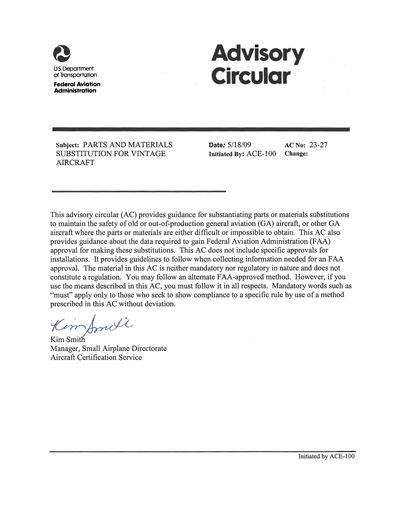
Substitute parts under Advisory Circular No. 23-27
Advisory Circular (AC) 23-27 provides information on using substitute parts for small, unpressurized aircraft Type Certificated before 1980. That includes most standard Piper airplanes.
Note that the operative deadline is not when the aircraft was produced, but when it was certificated—so even a late model Piper Archer is going to qualify, as it was Type Certificated before 1980.
While a bit confusing in its applicability, this AC appears to provide an approval for parts substitution if such would be considered a minor repair or minor alteration and to provide the basis for a field approval if a major repair or major alteration is required.
Directly applicable to our example is the provision that states that “You may substitute parts where a direct substitute for a part/material can be found under manufacturer part number, military specification, or other recognized standard, such as the SAE.”
For most aircraft owners, AC 23-27 can provide a route for substituting an industry standard part for an OEM part which may no longer be available in a timely manner or for a reasonable price. Mil-Spec switches, SAE alternator belts, batteries, etc. can often be used under the guidance of this Advisory Circular without resorting to an owner produced part.
For those of us who cannot afford a new or nearly new aircraft and who don’t have the luxury of just dropping off our plane at the local OEM service center with the keys and the Visa card, FAR 21.9 and AC 23-27 can be helpful in keeping aircraft maintenance cost effective, while still meeting the regulatory requirements.
Kristin Winter has been an airport rat for almost four decades. She holds an ATP-SE/ME rating and is a CFIAIM, AGI, IGI. In addition, Winter is an A&P/IA. She has over 8,000 hours, of which about 1,000 are in the Twin Comanche and another 1,000 in the Navajo series. She owns and operates a 1969 C model Twinkie affectionately known as Maggie. She uses Maggie in furtherance of her aviation legal and consulting practice; she also assists would-be Comanche, Twin Comanche, and other Piper owners with training and pre-purchase consulting. Send questions or comments to editor@www.piperflyer.com.
RESOURCES >>>>>
May 18, 2009
Both documents are available at www.piperflyer.com/Forum under “Magazine Extras”
– PFA supporter

