


Onboard weather avoidance equipment, and techniques for using it.
Anyone who has listened to an AM radio in thunderstorm country knows that lightning creates a lot of static on the radio. Likewise, readers of aviation stories have probably come across the mention of how an ADF will, at times, point to a lightning strike.
Out of this commonly observed phenomenon, airborne lightning detection equipment was born over 40 years ago. Christened the “Stormscope” by its inventor, Paul Ryan, the unit married radio frequency (RF) detection with a cathode ray tube (CRT) screen in order to plot lightning strikes.
One of the beauties of the Stormscope was that it didn’t require the large antenna needed by an onboard radar system. At that time, radar was largely limited to twins which had the room in the nose for the antenna; a few radar installations used a large pod under the wing.
The Stormscope used an ADF-sized antenna, so it was feasible to mount the equipment in most single engine aircraft and any twins that would not easily be outfitted with a radome in the nose. Thunderstorm detection came to the masses.
The term “Stormscope” has been appropriated to refer to all lighting detection equipment, but it is only technically correct when applied to the original line of products.
There are currently three providers of airborne lightning detection equipment (ALDE).
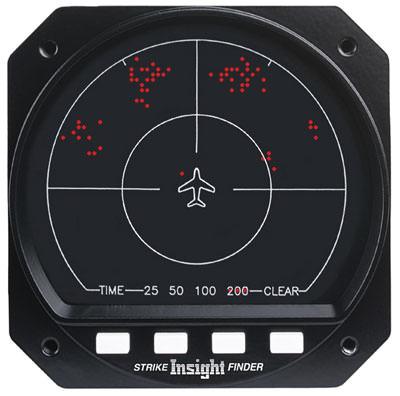
Insight Avionics manufactures a unit called the Strike Finder that analyzes individual strike signal properties to determine the bearing, range and severity. This data is plotted on an LED display as single orange dots. A stabilization module (not a rotating gyroscope) is available as a factory installed option; no field configuration or calibration of the module is required.
Avidyne makes the TWX670 Color Tactical Lightning Detection System which displays on its MFD, as well as some third-party displays. Color-contoured mapping of the electrical activity from the TWX670 sensor is often used as a complement with satellite-based datalink weather.
I’ll deal mostly with the Stormscope in this article, but the operating principles are the same—they all use radio detection to find lightning activity.
Evolution of the Stormscope
Over the years, the patents and trademark for Stormscope passed from Ryan International, to 3M, to B.F. Goodrich, and Stormscope is today owned and produced by L-3 Technologies’ avionics division.
The Stormscope can be thought of as having three generations, though this is a bit of a simplification. The Stormscope WX-7 was the first generation. In 1981, the second generation consisting of the WX-8, WX-9, WX-10/10A and WX-11 came out.
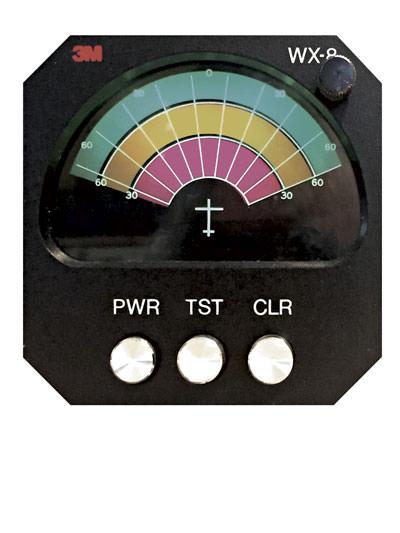
The WX-8 was a simplified unit that displayed a 135-degree forward-looking arc divided up into radial segments with three pseudo range rings that lit up green, orange or red depending on the intensity of the strikes detected.
The red segment was the innermost range/ring and the green was the outermost. WX-8s are still commonly found in General Aviation aircraft, though the unit has been out of production for many years—as have all of the second-generation units.
Another common second generation unit was the WX-10/10A. The units are almost identical, with the WX-10A having an improved processor. WX-10 series units display a 360 view with four range settings: 25 nm, 50 nm, 100 nm and 200 nm. There is also an option to select forward 180 degrees, which can provide better resolution as the unit’s memory only has to store those ahead, and not behind, the aircraft.
The WX-11 was essentially the same as the WX-10, but with the added feature of being gyrostabilized so that display would sync with the aircraft’s heading changes.
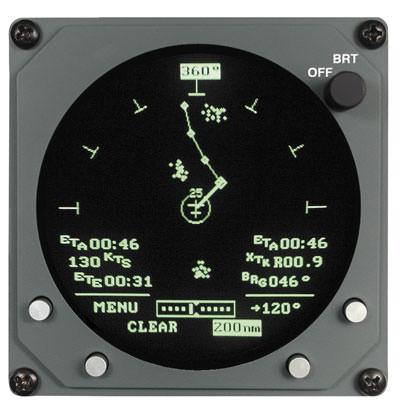
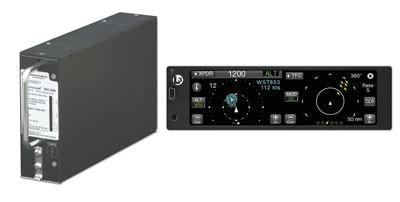
The third generation was dubbed by 3M the Series II Stormscope, and the WX-500 and WX-1000 are the two products on the market today. A Stormscope WX-500 will display information on many of the common MFD units, while the WX-1000 has its own display. These third-generation units have improved algorithms to provide more sensitivity and increased accuracy.
How it works
Any of the airborne lightning detection systems use well established radio detection principles and equipment to figure out what direction a lightning strike is coming from. In this, the units are quite accurate.
Ground units can use triangulation to obtain distance to the strike; airborne units do not have that luxury. Instead, the airborne units guess at the distance by comparing the strength of the RF signal made by the lightning strike to an average. The dot is then placed on the display on the measured radial and at the calculated distance relative to the distance ring depending on the range selected by the pilot.
If all lightning strikes were of the average strength, the distance displayed would likely be quite accurate. However, Mother Nature is never that cooperative. Hence a roughly circular cell will paint as an ellipse or sometimes in a stingray-shaped blob with the tail pointing at the aircraft in the center of the screen; this phenomenon is referred to as radial spread.
Usage and risk assessment
With the characteristics of a lightning detection system in mind, some techniques are helpful to interpret what the unit is telling you. The two primary pieces of information that a pilot needs to know when flying in the vicinity of thunderstorms are location and strength.
Determining strength is where the Stormscope is the most helpful. Onboard radar is better for location, but doesn’t tell you as much about the strength.
As lightning strikes more closely correlate with turbulence, and turbulence is more closely associated with inflight breakups, a few tips on determining the strength of a cell are in order.
It seems common sense that the more closely the strikes are displayed on the screen, the stronger the cell. That is true; however, there are other considerations. One of the most important is how fast the strikes are occurring.
One technique that I use is to hit the CLR button from time to time on my WX-10A so that I can watch a particular cell repopulate. A strong cell may add a dot on the display every few seconds so that it pretty much redisplays the cell is a minute or so.
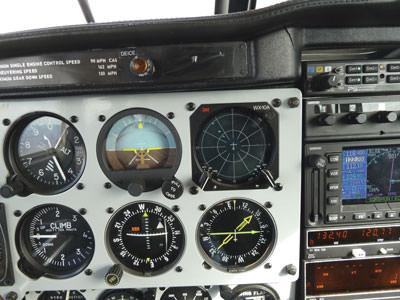
Another technique is to change the range setting. If one is detecting a cell on the outer ring of the 100 nm range setting, I will change to 200 nm and see if more is shown. If so, it may indicate that what I am seeing at first is just a few strong hits and that on the longer range, I can see the outline of a larger cell. Any cell that paints well on the 200 nm range is one to be taken seriously.
Changing to the 50 nm range may show you whether a few of the strikes are strong enough to show on that setting. Tightness of the dots and the rapidity which they will repopulate tell you much about strength of the cell.
It is also good to keep in mind the overall atmospheric conditions when assessing the risk. If the storms are growing, as they typically are through the day with the peak solar energy in early to midafternoon, then the cells are likely getting stronger and extra caution is warranted.
At night, they are typically dissipating and what you see is what you get. I have gone through cells that painted only a strike or two, but painted ominously on the weather radar. Since it was after midnight, I was confident that the air mass cell was just collapsing and dropping water—and it was. (Always be alert to the potential for rapidly changing conditions, and don’t violate your personal margin of safety. —Ed.)
My strategy for using my WX-10A is to leave it set at the 100 nm range. Anything showing up in this range is worthy of the pilot’s attention. As a cell starts to populate on the outer edge, I can watch it move closer.
Once it is clear that I am not looking at a few random discharges that occasionally come and go, I will consider changing course. I have had good success with changing the heading so that no cell is in the 50 nm range within 30 degrees of the nose. That should give 25 nm of clearance from the storm.
To me 25 nm is adequate for the typical air mass thunderstorms, but ones associated with a strong frontal system may need a wider berth. Here is where knowing the overall weather conditions and having recent information on the tops of the cells can assist with the big picture decision-making.
As one changes course, it is important to hit the CLR button (unless the unit has a gyrostabilizer) so that you keep a clear idea of where the storm is relative to the aircraft.
An ALDE makes a nice accompaniment to onboard Nexrad by providing some real-time input, and to better allow the pilot to assess the strength of a thunderstorm and circumnavigate the worst of the cells.
With a little experience, onboard strike detection equipment can be the difference between taking a flight knowing some deviations may be necessary, and keeping the aircraft in the hangar for fear of blundering into a life-altering situation.
Kristin Winter has been an airport rat for almost four decades. She holds an ATP-SE/ME rating and is a CFIAIM, AGI, IGI. In addition, Winter is an A&P/IA. She has over 8,000 hours, and owns and operates a 1969 C model Twinkie affectionately known as Maggie. Send questions or comments to editor@www.piperflyer.com.
RESOURCES >>>>>
Weather avoidance equipment
– PFA supporters
Stormscope

