


Elevate your flying experience with SiriusXM weather and the Garmin GDL 52 receiver offering unparalleled situational awareness through broad coverage, comprehensive products, high-resolution radar updates, and seamless integration.
By Michael Leighton
It’s no secret that I am a huge fan of SiriusXM. A few years back, I was given a portable SiriusXM weather receiver to compare and contrast SiriusXM and ADS-B weather products. After that, I was hooked. While I did have some issues with the first receiver I had, I loved the weather information provided. Garmin solved that for me with their GDL 52 Portable SiriusXM/ADS-B Receiver, which fixed virtually every issue I had encountered with my old non-Garmin unit. But more on that in a moment.
Why I love SiriusXM
Let me tell you why I fell in love with the SiriusXM weather platform. First, because it’s satellite-based, you get weather information delivered to your cockpit while you are still on the ground; you don’t have to be airborne to receive it. Typically, I have already received updated weather before I’ve completed my runup.
Second, the service area for SiriusXM includes most of Canada, Mexico, the Gulf of Mexico, and the Caribbean all the way down to the southern Bahamas. I have been traveling down to the Bahamas for the better part of 35 years now, and the ability to see realtime weather more than a hundred miles offshore makes crossing that expanse of water far less stressful.
While both ADS-B (more accurately, Flight Information Services-Broadcast, or FIS-B) and SiriusXM deliver METARs, TAFs, PIREPs, AIRMETs, and SIGMETs, as well as TFRs, the FIS-B product data is typically limited to within 250 nm, and sometimes as little as 100 nm, of your location (within the continental U.S. only) at the altitudes most of us fly (below 10,000 feet). SiriusXM delivers all the information for the entire service area. (See Resources for a full list of FIS-B and SiriusXM weather products and their respective ranges.)
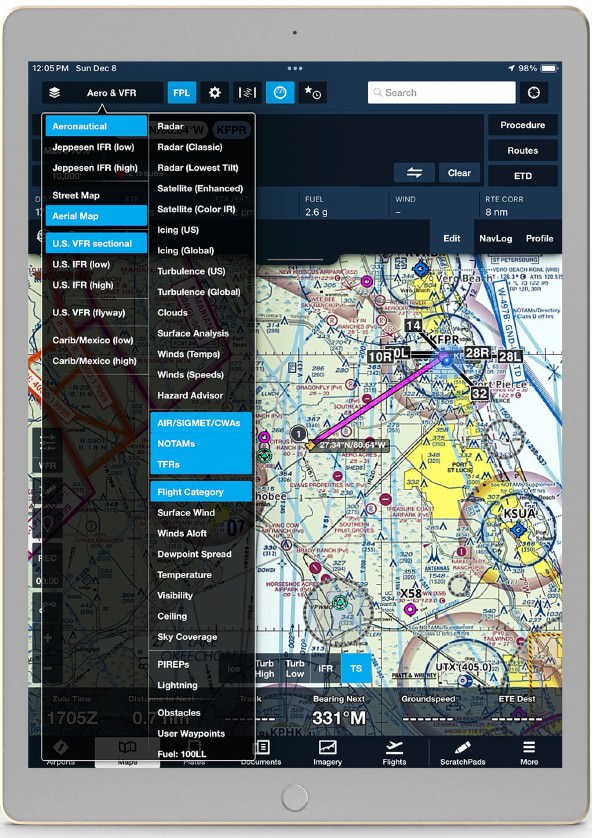
Further, FIS-B displays radar depictions beyond 250 nm of your present position in a low-resolution (very “blocky”) mode, while SiriusXM provides the entire continental U.S. radar in high resolution, all the time.
But to me, the most valuable asset SiriusXM has is its radar depiction. Their product shows you tops, direction of movement, and speed. They also offer an in-flight “lowest-tilt” radar depiction, which can show you where the rain is actually falling (as opposed to the composite display from FIS-B, which may show rain aloft that’s not reaching the ground).
Yes, the FIS-B offerings now include a lowest-tilt radar product, though it does not include storm vectors on that layer, nor can I seem to always access it in flight. Not to get too deep into the weeds, but FIS-B doesn’t show any radar returns below 20 dBZ, while SiriusXM does, and for us small aircraft operators, that matters. Smaller dBZ values indicate lighter forms of precipitation and mist that can impact flight visibility.
SiriusXM claims to update the radar plot every three minutes versus FIS-B’s every six minutes, but honestly, I can’t say I always see that. While you can’t use datalink weather to penetrate an area of severe weather (or at least shouldn’t—people die that way), the fresher the data, the more options you have. If you are flying a high-performance aircraft, the 250 nm range thing matters more than if you’re flying a slower aircraft, and if you fly in active weather, the radar depiction on SiriusXM is a real advantage.
If you travel to Canada, Mexico, or, like me, deep into the Bahamas, the extended range also really matters.
Freezing levels are another product that just shines on SiriusXM. You can’t receive that on FIS-B while on the ground, but you can get it from SiriusXM. It is important to know the up-to-date freezing levels when launching into IMC.
SiriusXM offers a series of how-to webinars on using their weather products. They are especially useful if you only use some of the products occasionally.

The Garmin GDL 52
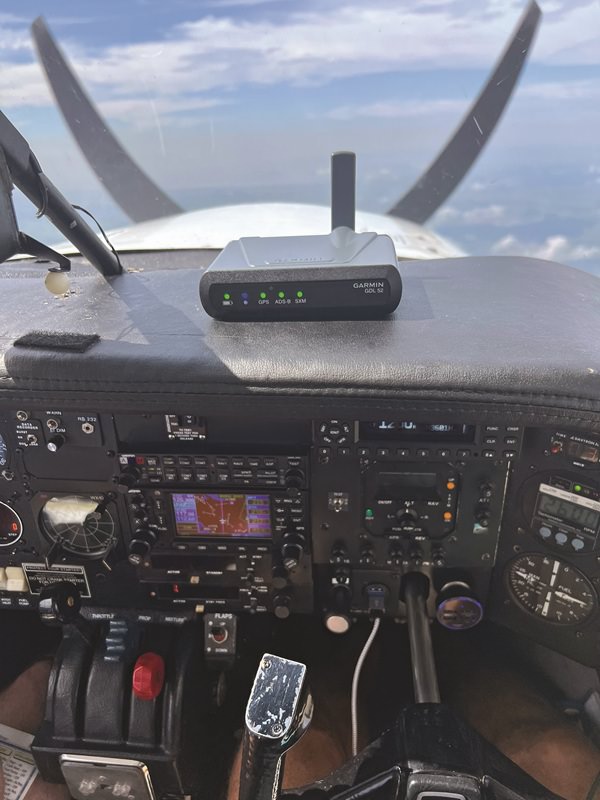
Then comes Garmin. The GDL 52 receives ADS-B data (including FIS-B weather and ADS-B traffic), and SiriusXM. It has a self-contained GPS as well. I’ve sat it on the glareshield of everything from a Piper Cub to a Cessna Citation. It features a series of LED indicators to let you know it’s receiving and is connected via Bluetooth to your iPad. It locks on seamlessly and stays put. I haven’t had a signal loss at any time with the GDL 52, something that happened about once per flight with the old receiver I had.
The GDL 52 receives both ADS-B/FIS-B and SiriusXM weather data and sends it to your EFB (ForeFlight and Garmin Pilot, as well as select Garmin portable devices) to be displayed. Menus in those products allow you to seamlessly switch between data sources, so if you can’t get what you want from one system, you can look at the other. The battery is good for five hours, more than most of us have fuel for, and if you have a USB charging port in your plane, you can always plug it in. It is a high-amp (3.5W max) device, so older USB ports may not put out enough amps to charge the battery during use.
I don’t listen to music when I fly, but plenty of my pilot buddies do, and the GDL 52 receiver can receive SiriusXM music channels as well (with a subscription). However, ForeFlight (my EFB software of choice) is not able to access the music feeds. If you use Garmin Pilot or a compatible Garmin aviation portable device for your EFB, you can receive and control SiriusXM music in flight through the GDL 52. The music can be streamed to a compatible Bluetooth headset or audio panel as well.
I have a single complaint about the GDL 52: the on/off switch is super-sensitive, and it’s easy to accidentally turn it on while it’s in your flight bag. I fabricated a makeshift switch guard to fix that after I pulled it out of my bag one day and it was as dead as a doornail.
The unit comes with a charging cord and a mounting tray you can affix to your aircraft, but for me, I fly too many different aircraft to use it.
As previously stated, I’ve used the GDL 52 in everything from my Piper J-3 Cub to the Cessna Citation 560 I fly for a living. If you’re like me and you use your plane for transportation because you consider flying on the airlines to be a form of torture, you want this device! On a dark and stormy night when you’re getting ready to shoot an approach, possibly to minimums, do you really want to be thinking, “Gee… I should have spent the money!”?
The Aviator Lite package I fly with costs $39/month, and I think it’s worth every penny. In our world (the world of $100 spark plugs and $30 oil filters), it almost feels like a bargain.
Michael Leighton is a 15,700-hour, three-time and current master CFII/MEI/ATP and A&P/IA. He operates an aircraft maintenance facility, aircraft charter, and flight training company in Fort Pierce, Florida, and Spartanburg, South Carolina. You can reach him at flymkleighton.net or through the Association. Send questions or comments to editor@piperflyer.org.

