


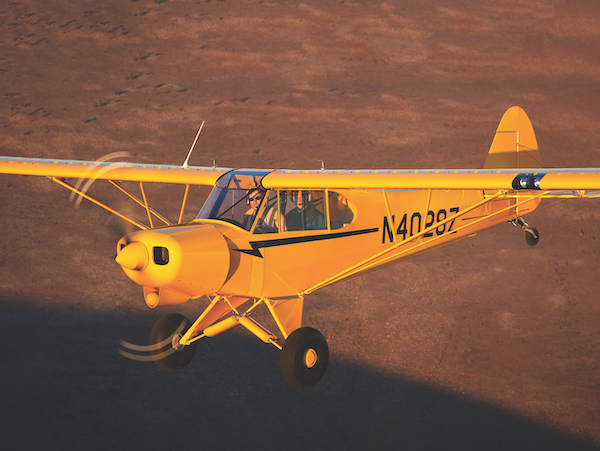
Every airplane owner seems to want upgrades, but few offer as much real-world benefit for so little investment as vortex generators. From improved controllability to reduced stall speeds and shorter takeoff distances, VGs deliver noticeable improvements—without high cost or long installation downtime.
By Steve Ells
Upgrades! It seems that every new airplane owner wants to upgrade their airplane. Some want to go faster, some want a modern, fully-integrated touchscreen avionics suite, some want to get off the ground in a shorter distance, some want an interior that matches the new paint, and a few (wise) owners decide to add a very simple and inexpensive safety and handling mod first. Today, we’re going to take a look at what I think is the greatest weight/cost benefit modification on the market for Piper aircraft: vortex generators, commonly referred to as “VGs.”
What are VGs?
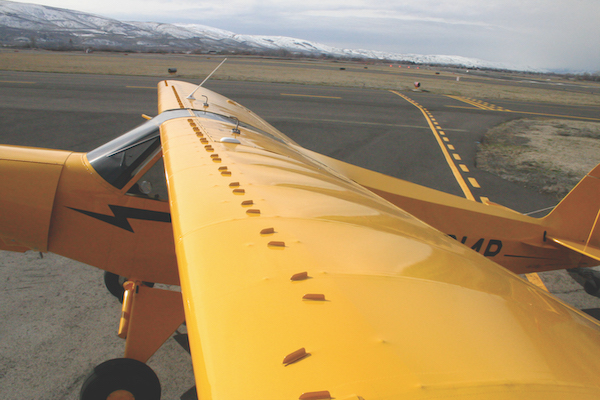
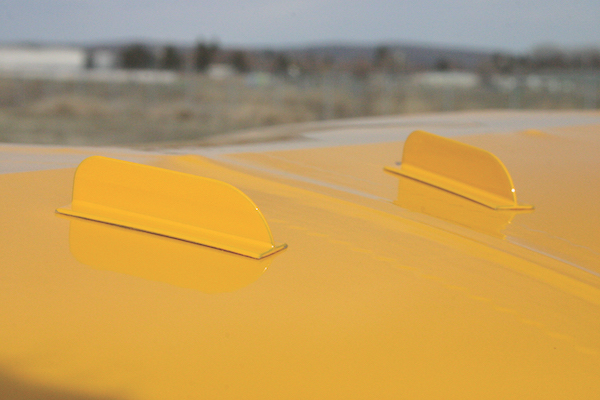
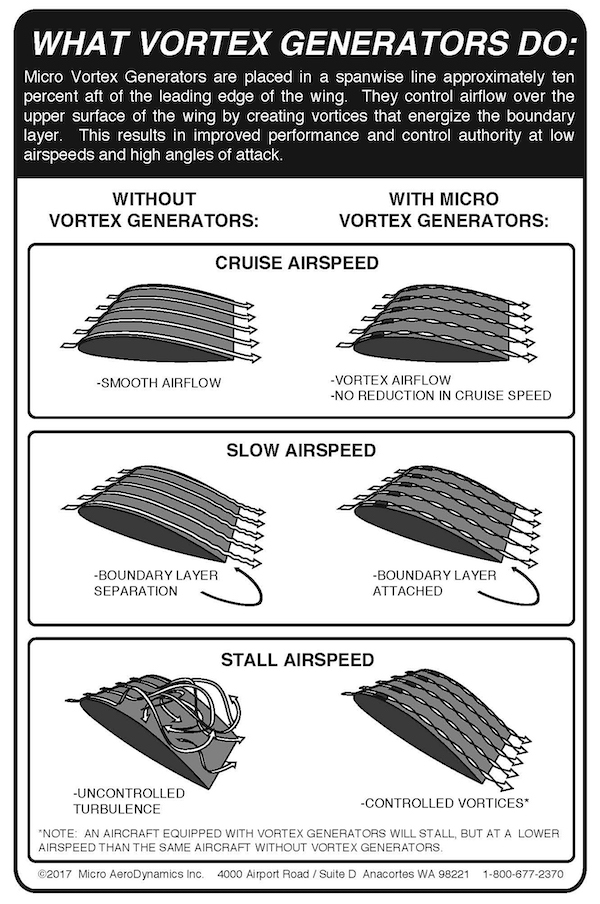
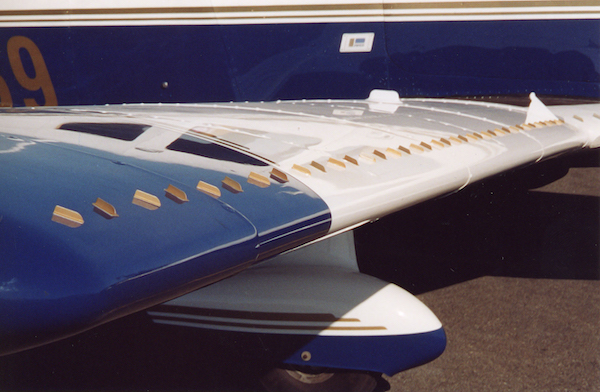
VGs are simple devices. Typically manufactured from aluminum, they are small blades placed at very specific angles spanwise aft of the leading edge on wing and tail flying surfaces. You’ve probably seen them as you walk past aircraft on the ramp: they look like tiny shark fins lined up in a row. When air flows over an airplane’s wing, you’ll recall that it can separate from the upper surface of the wing, especially at slower speeds and higher angles of attack. When the air separates, the plane loses lift, and can even stall. Vortex generators address this by creating tiny, spinning air currents called vortices: almost like mini horizontal tornadoes! As air flows past them, VGs redirect and swirl the airflow over the upper surface of the wing, to help mix the fast-moving air above the wing with the slower air closer to the surface—you’ll sometimes hear this called “energizing the boundary layer.” This mixing keeps the airflow attached to the top surface of the wing longer. The result? Airplanes can fly safely at slower airspeeds and higher angles of attack than before, and airflow over control surfaces like ailerons and rudders remains effective for a longer period of time, giving pilots better control, especially during slow-speed maneuvers such as takeoff and landing.
Reports from the field
I asked Piper Flyer Association forum members to share their experiences with this modification. Joel Whitaker flies a Piper PA-24-250 Comanche 250. The following is a portion of his report. I did the VGs mod last, and after the installation, I’d change that order: they would be the absolute first thing I’d install. My stall speeds went from 70 mph (60 knots) clean to 62 mph (54 knots) and 62 mph (54 knots) dirty to 55 mph (48 knots). It was a drastic change, and it’s fantastic. I have not done any climb tests, but I can easily get on and off in 1,000 feet at my home runway (KSZT) with two people and full mains (60 gallons of fuel).
Installation
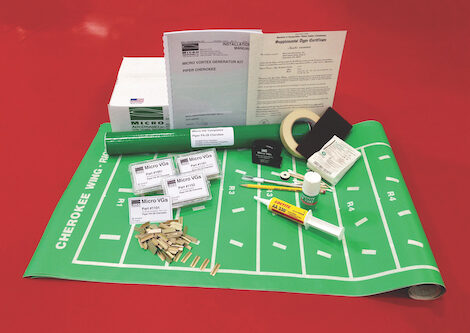
The installation time for VGs is minimal, typically measured in hours rather than days. The change that may take the most time is made to the airspeed indicator. Since the stall speeds of modified airplanes are lowered (anywhere from 7 to 21 knots according to one vendor’s website), the airspeed indicator’s markings must be adjusted to reflect the changes. (Note that most, but not all STC’d VG installations require changes to the airspeed indicator. —Ed.) Kit installation instructions are simple and do not require any special tools; everything is included.

VG options for Pipers
Micro AeroDynamics Inc., of Anacortes, Washington, and BLR Aerospace (formerly Boundary Layer Research) in Everett, Washington, produce the small VG fins that are precisely placed on the wings, rudder, and horizontal stabilizers of Pipers. BLR VG kits for Piper twins include the Piper PA-34 Seneca II, III, and IV, and the Piper PA-31 Navajos (up to and including the Colemill Panther I and II). Micro AeroDynamics’ VG kits are available for all Piper J models, and all PA-series single models. That means the J-3, J-4, and J-5, and PA-models from PA-11 up through the PA-36 Pawnee Brave and PA-38 Tomahawk. There are two prices for Piper single-engine kits; $750 for fabric airplanes, and $1,595 for metal airplanes. There are also VG kits for Piper twin-engine airplanes from each vendor. Coverage includes the PA-23 Apache Geronimo, the PA-23-250 Aztec, the PA-30 and -39 Twin Comanche, the PA-34 Seneca (I, II, III, IV, and V), and the PA-44-180 Seminole.
Weight increases and performance benefits
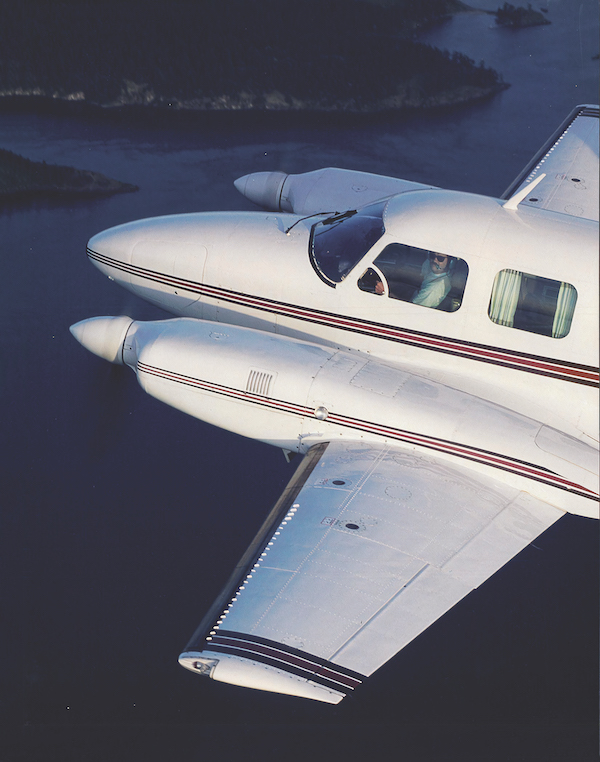
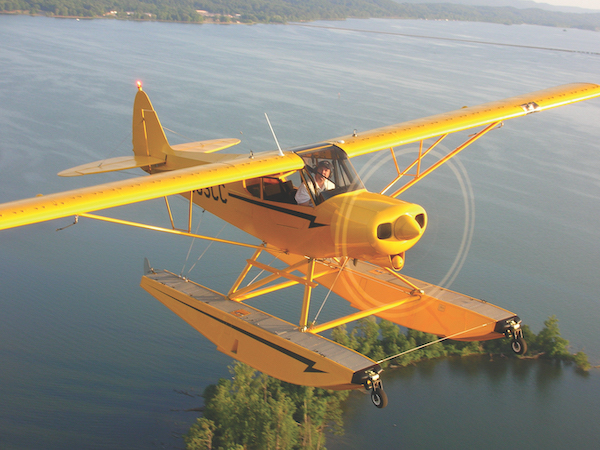
Although there are no MTOW increases for single- engine Pipers, a few Piper twin-engine models (most of the Piper PA-31 series) get MTOW boosts of more than 350 pounds with VG kits from BLR. The Piper PA-34-200T Seneca II gets a 168-pound boost to its zero fuel weight with kits from either vendor. The VG kit for the Piper Seneca II from Micro Aero promises to lower the Vmc by 9 mph (7.8 knots), down to 71 mph (81 knots). Let’s take a look at the performance benefits from the installation of a set of these VGs on a Piper PA-18 Super Cub. According to Micro Aero, the $750 one-day upgrade lowers the stall speed 16%, improves controllability and handling characteristics, and provides the best “moose stall” protection. Wait… what’s a moose stall?
Moose stalls
For those who are not quite sure what a moose stall is, I’ll describe one I witnessed at the Soldotna, Alaska, airport (PASX). We hurried out of the hangar that fall day when we heard the unmistakable sound of a rapid throttle increase followed by the thump of an airplane hitting the ground. We quickly found the aircraft. It was on the ground, left wing down, below the turn from the crosswind to downwind leg. The owner, who survived thanks to the welded steel cage of the Super Cub fuselage, had been practicing touch-and-goes after a long summer of hard work. He hadn’t flown much during the summer. A “moose stall” is a specific type of stall that often happens when pilots are flying low and slow—typically while circling to look at something on the ground, like a moose in Alaska. Focusing attention outside the airplane, the stall occurs when the pilot allows airspeed to decay while in a tight, steep turn (oftentimes combined with inadequate coordination, so that the subsequent stall leads to a spin). VGs can improve the stall margin, and thus safety, when maneuvering low and slow. That said, with VGs or not, any time you’re low and slow and turning steeply, you need to be on guard and ready to level the wings, add power, and climb safely away. I was in Alaska from 1983 to 1992; believe me when I say there were Super Cub rebuild shops that picked up enough rebuilds due to moose stall accidents to keep them busy all winter.
VGs on a laminar flow wing?
The VG kit for a Piper PA-24 Comanche, which has a laminar flow wing, consists of 64 individual T-shaped parts that are precisely positioned using paper templates applied to the wings and tail surfaces before being glued into position using LOCTITE AA 330 adhesive. I’ve had a set of Micro Aero VGs installed on my PA-24 since December 2004. Some Comanche owners have suggested that I don’t fully understand the airfoil on my airplane and have questioned me for installing anything that disturbs airflow on the laminar flow wing of my Comanche. Regardless, I always want control of my airplane as far into the low end of the speed spectrum as possible. VGs give me that. Micro Aero’s advertisements claim that a set of its VGs will lower the Comanche’s clean stall speed by 8 mph (6.9 knots) and the dirty stall speed by 5 mph (4.3 knots). VGs do nothing to increase airspeeds. Some believe that the installation of VGs costs them a few knots of airspeed during cruise. If this is true, I’ll accept that trade-off, because to me, the delta in time flown on a 300 nm trip is barely significant whether I cruise at 130 kias or 135 kias. (For what it’s worth, the time difference would only be five minutes!).
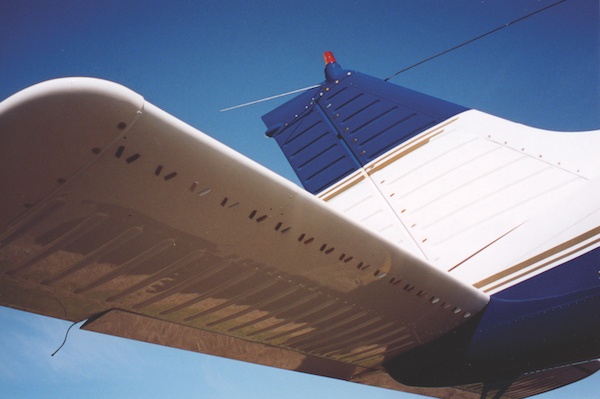
VGs: a small investment for safer flight
In the world of frugal aviation, every upgrade must justify its cost, and vortex generators continually prove their value. For a relatively small investment, they offer significant safety enhancements, extending the performance envelope and reducing the risk of slow-speed stalls.
Steve Ells is contributing editor and tech rep for Piper Flyer Association. He has been an A&P/IA for 45-plus years. He is a commercial pilot with instrument and multiengine ratings and loves utility and bush-style airplanes and operations. He’s a former associate editor for AOPA Pilot. He owns Ells Aviation and lives in Templeton, California. Send questions and comments to editor@piperflyer.com.
Resources
PFA SUPPORTERS

