
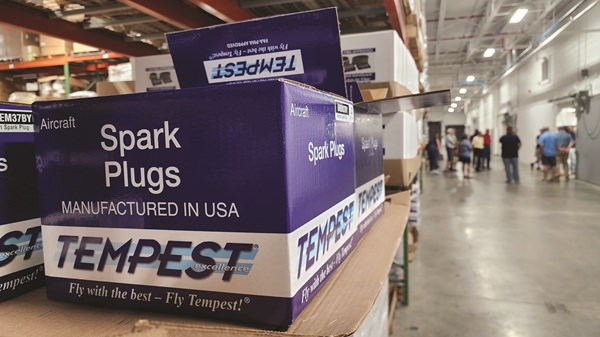
Photos by Alan Kirby Media
Special report from an outstanding event that gave PFA members a behind-the-scenes look at Tempest Aero Group’s Burlington facility in North Carolina.
By Kent Dellenbusch
For several years, Piper Flyer Association members have been asking us to host regional gatherings. Well, this year, we did just that, with the help of PFA supporter Tempest Aero Group. In August, we had a blast touring the Tempest manufacturing plant in Burlington, North Carolina.
After greeting our members as they arrived at Burlington/Alamance Regional Airport (KBUY) on a beautiful sunny morning, we gathered in a few cars and drove the 3 miles or so to Tempest’s shop. Easy breezy.
The Tempest tour
We were met there by the friendly Tempest crew, including John Herman, Vice President, Sales and Marketing, and Vince Bechtel, Director of Aftermarket Sales. They provided us with coffee and doughnuts, and we settled into our conference room chairs to listen to a short spark plug maintenance/testing presentation by Vince.
Every time I attend a seminar, I always retain a new bit of information to take with me. This time it was the “drop it once, drop it twice” message. If you don’t know this one, Vince will tell every A&P/IA that if you drop one of their spark plugs once, drop it a second time: in the garbage. Vince explained how even the smallest micron crack can have detrimental consequences. A picture he showed us proved it; someone had a costly engine repair after flying with a dropped plug installed.
Next, we headed to the back rooms to see how Tempest makes things. Yes, I’m a bit of a geek when it comes to knowing how it all works.

Starting in the area that manufactures and overhauls carburetors, we met Mike Wentland, who moved to North Carolina when Marvel Schebler was acquired back in 2008. He knows these and other older carburetors like the back of his hand. Every carburetor that Tempest sells is either newly assembled or rebuilt by skilled technicians. There is a ginormous testing machine that must be 10 feet wide by 15 feet high with all kinds of gauges and hookups to test each carburetor. Seeing this monstrosity of a testing station gave me confidence that their carburetors can withstand many pressure and altitude extremes.
At Tempest, the oil filters are assembled by hand (yes, by hand). I was blown away to see this part of the assembly process. A team measures the paper filter, administers the super-strong glue that keeps it in place, and then the whole can is assembled. People were at different workstations performing their tasks, passing the oil filter can down the line for the next step in the manual process.
They did have some cool pneumatic compressing machines to fit parts together and do the crimping thing, but even that was fun to watch. As I observed this whole process, I came to understand why one would pay a little more for quality and not some cheap mass-produced brand.
I had to ask about the fine wire spark plugs that many of our members boast about. They, too, are manually assembled. A cool “Terminator”-style compressing machine sitting behind a Plexiglas shield applies the finishing touches, so each spark plug is as tight as a drum.
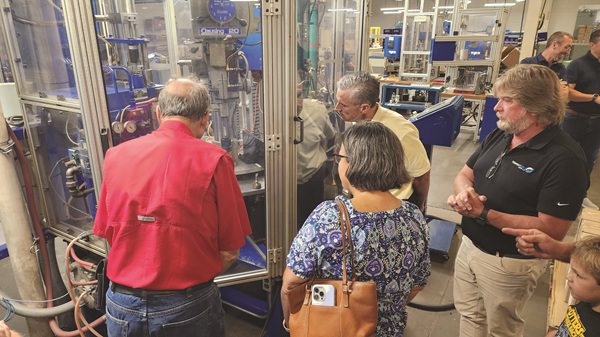
Like the other products Tempest makes, there is a team making each and every spark plug by hand. I asked about their “fine wire” plugs. Are you sitting down? Good. I knew they were made of iridium, but what I did not know is that this precious metal is super, super expensive. It’s more expensive than gold. As of today (November 9), the price per pound of iridium and gold is as illustrated.
- Iridium (lb) – $67,447.92
- Gold (lb) – $39,154.21
Source: dailymetalprice.com
I think I want to be an iridium miner now.
Now, what I find very interesting, and you should as well, is that Tempest buys their iridium in bulk quantity. During the months it takes to build spark plugs from their stock, the price of iridium will fluctuate daily, like any precious metal. Guess what? Tempest often eats the difference when the market price changes. They do not adjust the price of their plugs daily.
I had to know more about this precious metal. Is anybody else thinking of Gollum and his “Precious” from Lord of the Rings? No, just me? OK. Iridium is part of the platinum group metals (PGMs). It is the second-densest known metal. It has a silvery-white color resembling platinum and palladium. Its high hardness, brittleness, and high melting point (approximately 2,400 degrees Celsius) make the metal challenging to work with or form. Most acids do not cause damage to it, due to iridium’s high corrosion resistance. All this for that little fine wire. I’m sold.

The tour group then huddled into a smallish room with only six or seven employees. This low-traffic, dust-free area is where they assemble the dry air vacuum pumps. The room is designed to keep the pump’s inner workings as clean and pure as possible.
I asked a few questions about the little splines that are activated by centrifugal force, and John Herman handed me one to examine. There’s not much weight to these little buggers, but they do leave a gray film as if you were handling a No. 2 pencil by its tip. It’s kind of fun to see the inner workings of the dry air pumps. They’re simple really, but a lot of operational demand is put on these little guys.
I think I’ll wrap this conversation up by talking about Tempest’s air filters. I’ve always been a fan (get it, high-velocity moving air) of anodized aluminum, which Tempest uses for their air filter housings. I like the idea of a lightweight alloy that looks good for many years being used as the frame that holds a filter element that can be washed and reused.
Did you know that these Tempest air filters are made of 100% spunbond polyester media? This media offers maximum airflow while still filtering out 99% of contaminants larger than 5 microns. No, I don’t know those numbers off the top of my head; this data is spelled out, along with the installation, cleaning, inspection, service, and replacement schedule, on the Tempest website.

While I’m on the subject of websites, Tempest offers great details about all of its products on its site. Just go to the landing page for the product you’re interested in, and you will see tabs (About, Application, Specifications, Product Literature, and a couple more) where you can get detailed info.
If you ever need special assistance, just send me an email, and I’ll get in touch with Vince or John at Tempest directly on your behalf. They are only a few keyboard clicks away with an answer.
After our personalized tour, we all met in the conference room for a wonderful build-your-own-sandwich lunch with plenty of chips, ice-cold sodas, and water. It was a long day, with lots of questions asked, interesting machinery to watch, and people to meet.
To top off a great day, Tempest generously donated a full set of fine wire spark plugs as a door prize for one lucky attendee!
There is a reason I do not write often in Piper Flyer. I tend to ramble a lot, as you can see here. But, heck, I had fun. I hope you can sense that in this recap of our Tempest tour.
I’d like to say one more thing. The next time you buy your Tempest plugs, oil filter, air filter, or anything else from these guys, know this: they have dedicated employees who have been there for years—family members, working side-by-side, who take pride in doing what they are doing. You can feel it when you walk through the assembly plant, and see hundreds of employees, hand-crafting products with extremely rigid quality control processes. Yes, they even have a department for the QC guys as well, with file cabinets full of data everywhere. There might be cheaper products out there, but remember the old saying: “You get what you pay for.”
Don’t skimp—your life and your Piper’s health could be at stake.
Kent Dellenbusch is Vice President and Director of Sales for the Piper Flyer Association. Send questions and comments to editor@piperflyer.org.