
Forum Replies Created
Posted In: Frank
-
Participant
Kent – thank you for the fast reply!
I talked to Acorn last week (no joy) and called the shops on your list this morning… looks like most roads lead back to Acorn as the first-level supplier after the manufacturer (Aeroquip) who is saying they won’t ship any more until 2025.
I have my fingers crossed that I can use the allowed inspection-and-continued-use extension into 2025!
-Frank.ParticipantParticipantI’m pleased to report that L88 (New Cuyama Airport in New Cuyama, California) is repaired and open for visiting pilots! Please see images below for pictures from the reopening ceremony.
There is also an upcoming work day on December 10, 2022. Email ssapping1@aol.com if you are interested.
And finally, I’m attaching the airport information sheet for L88.
Happy flying, and I hope you can stop by to check out this small-town airport!
-Frank.
 Attachments:Participant
Hi Aaron –
Congratulations on your purchase! I was looking for a Seneca III early last year but everything I was finding had some unusual damage history (one had hit a deer, one had fallen off its jacks onto its props, etc.) In the meantime, I located and purchased a 1978 Aztec. It had a clean history, but the first year has been expensive in terms of clearing deferred maintenance. I feel your pain.
If you can get through the first year, I think it will be worth the time and money – I’m enjoying my Aztec. My impression is that the Seneca will have lower fuel burn and be faster than the Aztec, so you’ll be in good shape for long flights.
I found it helpful to work with a shop that specializes in Aztecs, even though they are a long flight from me (Diamond Aire in Kalispell). I have them on speed dial for questions, and the airplane spent a month there for a passenger door rebuild and a slew of other work. Then my first annual was two months at my local shop, where they replaced almost every hydraulic line, the motor mounts, all the corroded exhaust parts, etc.
If you can find the folks who know the Seneca inside and out, they will know the gotchas for that model and year. You may also have issues with parts availability during the first annual, at least I did. I found that Acorn Welding in Canada does a ton of Aztec work and was able to build a tailpipe for me that was unavailable from anyone else. I bought a fair number of parts from an old-school fellow in Connecticut with no website or email. I just got on the phone with him and listed everything my shop couldn’t locate, and he checked his supplies. The problem wasn’t the engine itself (which is a standard Lycoming) but the Aztec-custom parts like the exhaust. I bet there’s similar solutions for those hard-to-find Seneca parts.
-Frank.
ps. I lived in Dayton for a few years in the late 80s, and my first training flights were at KMGY.ParticipantParticipantHi Emmanuel –
As Steve mentions, the absolute number should always be taken with a grain of salt. And if you are getting one number each for EGT and CHT, you can only treat this is as a general guess for what the remaining cylinders are doing. Over time you will likely see a pattern develop, then when the temperatures depart from this pattern, it’s time to be concerned (or check to see if you have leaned at high altitude and forgotten to enrichen as you descend!).
Having said all that, I like to look at the manufacturer’s operating recommendations.
I believe this is Lycoming’s operator’s manual for that family of engines, including the IO-360-C:
The operator’s manuals can be wordy and confusing, because they cover a number of different engines. But I find it interesting to see what the manufacturer recommends.
Here’s a few snippets I found – before using this guidance you should have a look yourself:
Section 3 – Operating Instructions – General Rules
“For maximum service life, cylinder head temperatures should be maintained below 435°F (224°C) during high performance cruise operation and below 400°F (205°C) for economy cruise powers.”
“LEANING TO EXHAUST GAS TEMPERATURE GAGE.
a. Normally aspirated engines with fuel injectors or uncompensated carburetors.
(1) Maximum Power Cruise (approximately 75% power) – Never lean beyond 150°F on rich side of
peak EGT unless aircraft operator’s manual shows otherwise. Monitor cylinder head
temperatures.
(2) Best Economy Cruise (approximately 75% power and below) – Operate at peak EGT.”There is also guidance for oil temperature on page 3-11 – for ambient air temperatures above 30 degrees F, the “desired” oil temperature is 180 degrees F, and the max is 245 F.
Boiling it all down, if it were me, I’d start by operating conservatively and recording some data:
– Can you takeoff at full power (and full rich) and keep CHT below roughly 400? If not, I’d be visiting my shop to discuss the situation with them, perhaps there is an engine cooling issue.
– For cruise, try operating at 65% power (2350RPM, per page 3-13), and leaning to peak EGT. How many gallons per hour are you burning (do you have a fuel flow gauge?). From the book, it should be about 9.5 gallons per hour. What happens to EGT if you enrichen to 10 gallons per hour? I’d be tempted to operate slightly rich of peak in exchange for slightly cooler temperatures and possibly longer engine life, but that’s just me, and opinions vary.
– What is your nominal oil temperature and pressure during takeoff and cruise? Record these values, then you’ll have a heads-up if they change dramatically one day.
-Frank.
ParticipantHi Emmanuel –
Congratulations!
There’s a variety of opinions about this topic. Does your airplane have an IO360 in it? Once we nail down the exact engine, I can help you find references for it.
Also – what gauges do you have for EGT and CHT – is it a single number, or do you have per-cylinder readings?
-Frank.
ParticipantBogert recommended the following:
04M-24/30: Piper Comanche PA-23, PA-24, PA-30 & PA-39 Also PA-32 Cherokee Six axle w/pants if tabs above wheel are broken (Not verified for Piper Saratoga with fixed gear), Navion Rangemaster H
That’s a good point about the welder – it’s always good to have friends with equipment.
It’s on order!Thanks again!
-Frank.ParticipantHi Steve –
Thanks – I had not run across that option!
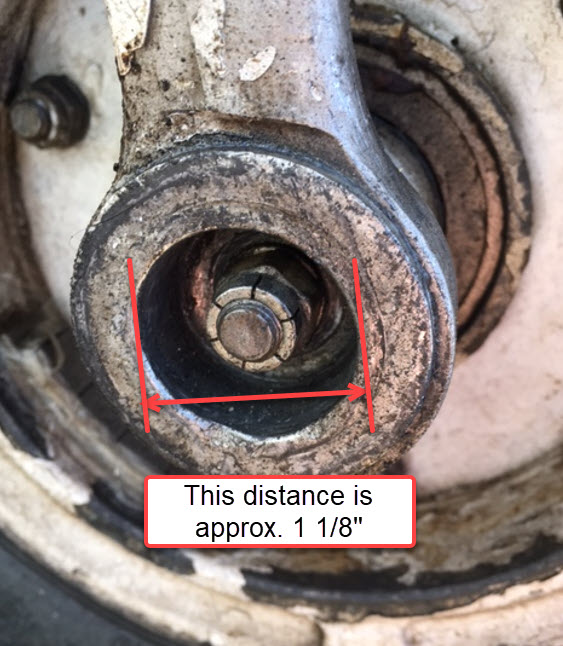
I estimated the measurements shown in the pictures below. I sent these to Bogert to see what they suggest.
Where did you find the dimensions you listed (8.75″ fully open and 7″ when fully closed)? I’m sure they must be on the Bogert website but I looked and didn’t see them. I bet it’s something obvious I’m missing.
The nose on the Aztec is long – I’m thinking the 67 inch extension would be useful… but I haven’t measured it out, and should do that.
Thanks!
-Frank.